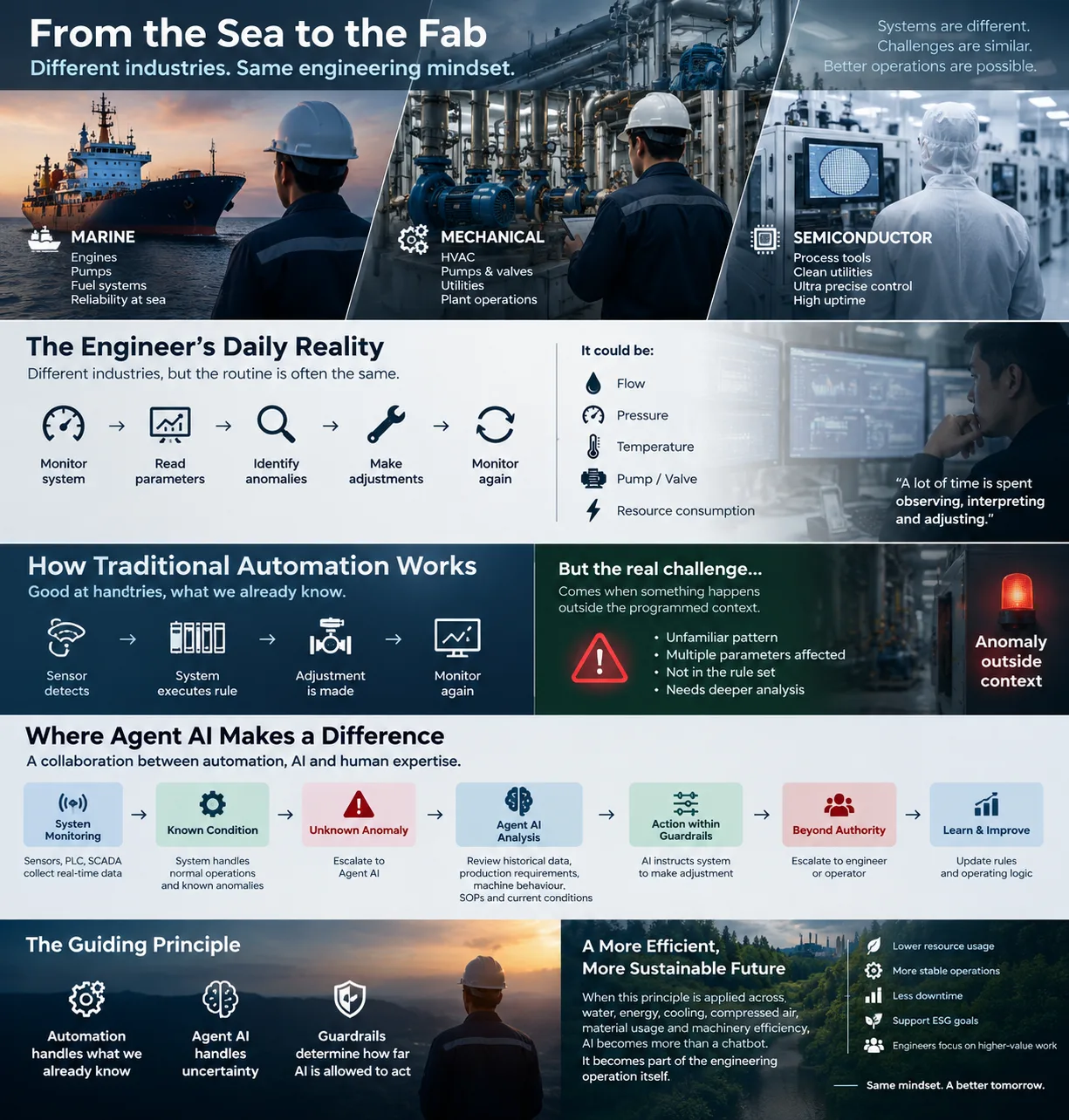
Most of my work sits at the point where the physical layer meets the software layer. I've built and deployed monitoring and control stacks across marine, mechanical and semiconductor operations, and the pattern repeats in every one of them: engineers spend a large share of their day watching systems, reading parameters, spotting anomalies, making adjustments, then watching the result again. Flow, pressure, temperature, pumps, valves, resource consumption. The variables change; the loop doesn't.
Deterministic automation already covers a lot of that ground. A threshold is crossed, the sensor reports it, the controller fires the rule, the actuator moves, and the loop verifies the outcome. That works because the condition was known in advance and somebody wrote the logik for it. The problem starts at the edge of that logik, where an anomaly shows up that was never in the original context and doesn't match any programmed rule.
That boundary is where Agent AI earns its place in the stack. I don't want an agen with its hand on every actuator. The architecture I build toward is the agen helping construct and maintain the operating logik, while the deterministic layer keeps running normal operations and known anomalies on its own. When something falls outside the programmed context, the system escalates it to the agen instead of dropping it on the floor.
The agen then assembles the context it needs, pulling historical data, production requirements, machine behaviour, SOPs and current operating conditions before working out what should happen next. If the resulting action still sits inside the predefined guardrails, it can instruct the system to make the adjustment. If it exceeds its authority or hits a safety limit, it hands the decision to an engineer or an operator.
The architecture principle is simple: deterministic automation handles what we already know, Agent AI handles uncertainty, and guardrails define how far the agen is allowed to act.
Point that at water flow, energy consumption, cooling systems, compressed air, material usage or machinery efficiency, and AI stops being a chatbot bolted onto the side of the operation. It becomes part of the engineering operation itself.














Ruang pembaca
Apa pendapat anda?
Komen disemak sebelum diterbitkan. Email diperlukan untuk moderasi dan tidak dipaparkan kepada pembaca.
इस हिस्से वाले हिस्से ने मुझे सोचने पर मजबूर किया।
This is where point that at water flow finally makes sense.
Bookmarked, mainly for deterministic automation handles.