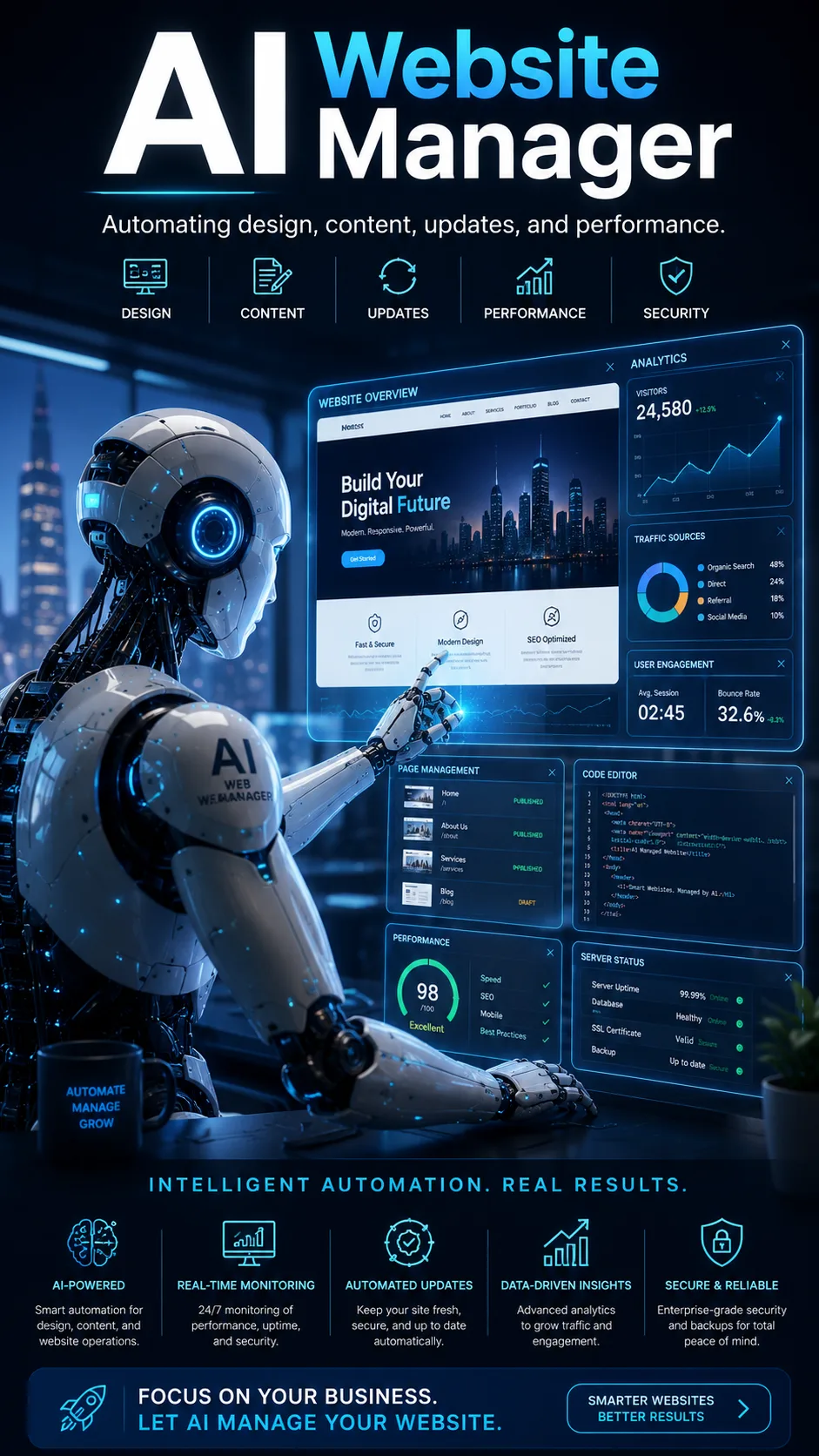
AI is now getting deployed alongside sensors, databases, APIs and legacy systems across most industries. But in the field, the question we keep running into is not whether to adopt AI.
The engineering problem is:
How do we make AI reliable, observable, cost-efficient, secure and useful inside live operations?
That is the problem NeuralOps is built to solve.
NeuralOps is not a rip-and-replace strategy. It is a systems-integration approach: AI agents, deterministic logik, databases, automation rules, specialised models, APIs and human governance wired together into a single coordinated operational stack.
The design principle is straightforward:
Put AI where probabilistic reasoning adds value. Keep deterministic execution where precision and repeatability are non-negotiable.
In retail and e-commerce, NeuralOps can run inventory telemetry, customer-service agents, marketplace analytics, affiliate orchestration, product-content pipelines, advertising performance analysis and financial reconciliation.
In finance and accounting, it can handle bank-statement ingestion, transaction classification, financial reporting, anomaly detection, cash-flow monitoring and management reporting.
In healthcare, NeuralOps can power appointment workflows, administrative operations, medical knowledge retrieval, hospital web infrastructure, internal document management and operational dashboards - while keeping clinical decisions under professional medical governance.
In manufacturing, AI agents can sit alongside production databases, machine telemetry and maintenance logs to support predictive maintenance, quality control, anomaly detection and production optimisation.
In agriculture, NeuralOps can combine drones, soil and weather sensors, weather feeds and environmental data for crop monitoring, irrigation optimisation, pest detection and yield forecasting.
In logistics and supply chain, specialised agents can monitor inventory telemetry, warehouse operations, delivery performance, procurement workflows, supplier scorecards and demand patterns.
In education, NeuralOps can drive adaptive learning, assessment engines, research assistance, academic analytics and administrative automation.
In environmental monitoring, the same architecture can connect AI dengan drones, sensor networks, satellite links and distributed monitoring systems for forests, biodiversity, wildlife, water quality, flood detection and search-and-rescue operasi.
Even inside IT and cybersecurity, organisations can deploy specialised AI agents functioning as an AI Pengurus IT, Server Administrator, Pembangun or Keselamatan Analyst - each operating within clearly defined permissions and responsibilities.
The practical future is probably not one massive LLM running everything.
It is a federated architecture of:
Specialised Ejen AI + Decoupled Sistem + Structured Data + Intelligent Penghalaan + Manusia Oversight
This also has real implications for ESG and resource efficiency.
Not every job needs the most powerful model. A SQL query should stay a SQL query. A deterministic calculation should stay deterministic. Lightweight tasks can run on small models or edge devices, while large models are reserved for genuinely complex reasoning.
The operating principle becomes:
Right Tugasan → Right System → Right Model → Right Compute
That cuts token burn, infrastructure cost and wasted compute.
That is what we are building toward at AINNA.
We are moving from AI experimentation to AI operations - systems that ship, run and get maintained.
The teams that win will not be the ones running the biggest models.
They will be the ones that know where to put AI, where to keep it out, how to govern it operationally, and how to measure the value it creates.
That is the engineering direction behind NeuralOps.
#ArtificialIntelligence #NeuralOps #AIAgents #AgenticAI #Automasi #DigitalTransformation #EnterpriseAI #Industry40 #ESG #Inovasi #Teknologi #AIInfrastructure
















Ruang pembaca
Apa pendapat anda?
Komen baharu dihantar untuk semakan terlebih dahulu. Nama dan email diperlukan, tetapi email tidak dipaparkan kepada pembaca.
databases, APIs and legacy systems - sums the whole thing up.
Sent this to two people already. AI agents, deterministic logik, databases is why.
如果还有40的后续,我会继续读。 这点我还要再消化一下。
Useful. We are dealing with customer-service agents, marketplace analytics right now.
Bookmarked, mostly for transaction classification, financial.
Ringkas dan jelas. 40 boleh kongsi dengan team saya.
Di sini baru 40 nampak masuk akal. Patut baca sekali lagi.
Still thinking about AI is now getting deployed.
Not sure I agree with industry40 #ESG #Ino 40, but the rest holds up.
เห็นด้วยเรื่อง40 แต่ทำจริงยาก. ยังต้องอ่านซ้ำอีกที
ยังคิดเรื่อง40อยู่
The framing around anomaly detection, cash-flow monitoring is better than I expected.