AI Financial Decision Lab (AI-FDL)
Platform Simulasi Keputusan Kewangan Berkuasa AI Beretika untuk Pelajar Universiti Malaysia
Nur Syairah Ani*, Nur Hafizah Roslan, Nur Amirah Borhan, Azrizal Husin, Abd Razzif Abd Razak, Siti Nurulaini Azmi, Siti Faizah Zainal & Rafiatul Adlin Hj Mohd Ruslan — Faculty of Pengurusan and Economics, Universiti Pendidikan Sultan Idris, Perak, Malaysia
Bab Bertaraf Pertandingan ICAME 2026 yang lengkap dan bersedia untuk dinilai, mematuhi sepenuhnya taklimat utama Pertandingan Inovasi ICAME 2026: audit forensik, pengesahan kelayakan, pembinaan semula masalah, timbunan inovasi, tadbir urus AI yang bertanggungjawab, peta jalan pen
Abstract
Purpose. Bab ini membentangkan AI Financial Decision Lab (AI-FDL), sebuah platform simulasi keputusan kewangan berkuasa AI yang beretika yang dicadangkan untuk membantu pelajar universiti Malaysia mengubah pengetahuan kewangan kepada tingkah laku kewangan yang baik melalui amalan membuat
Design/methodology/approach. AI-FDL mengintegrasikan simulasi keputusan kewangan, analisis kewangan tingkah laku, Jurulatih Kewangan AI, Papan Pemuka Kesihatan Kewangan, gamifikasi dan pembelajaran diperibadikan dalam satu makmal keputusan pendidikan yang bersepadu. Inovasi ini dibangunkan melalui rangka ker
Findings. Sebagai inovasi yang dicadangkan, AI-FDL belum lagi dibangunkan, dilaksanakan atau diuji secara empirikal. Nilai pendidikan, tingkah laku, teknologi, komersial dan penyelidikan yang dijangkakan dibentangkan sebagai cadangan reka bentuk, dengan peta jalan pengesahan masa depan yan
Originality/value. Kebaharuan yang boleh dipertahankan terletak pada integrasi peringkat sistem bagi simulasi senario, pengesanan bias tingkah laku, maklum balas AI yang boleh dijelaskan, pemarkahan kesihatan kewangan, gamifikasi, pembelajaran peribadi dan pagar keselamatan AI yang bertanggungjawab
Keywords: literasi kewangan; pembuatan keputusan kewangan; kewangan tingkah laku; pembelajaran berasaskan simulasi; gamifikasi; AI bertanggungjawab; AI boleh diterangkan; pendidikan kewangan; pelajar universiti Malaysia; AI-FDL
PART A — Executive Verdict
AI-FDL ialah cadangan inovasi yang kukuh dari segi konsep, berintegriti akademik dan sedia untuk pertandingan. Kekuatan utamanya ialah kebaharuan peringkat sistem yang boleh dipertahankan: integrasi simulasi keputusan kewangan, pengesanan bias tingkah laku, maklum balas AI yang b
Batasan utama ialah kematangan. AI-FDL merupakan inovasi yang dicadangkan; ia belum lagi dibangunkan, dilaksanakan atau diuji secara empirikal. Oleh itu, potensi anugerah bergantung kepada kebolehdemonstrasian. Untuk bersaing secara kredibel bagi Pingat Emas atau Anugerah Utama,
Keseluruhan kesediaan anugerah dinilai sebagai sederhana hingga kuat dari segi konsep dan asas akademik, dengan jurang penentu ialah bukti prototaip. Bab ini disusun untuk memaksimumkan setiap elemen penilaian inovasi yang boleh dikawal sambil mengekalkan integriti akademik penuh
PART B — ICAME 2026 Eligibility Audit
Verified against the official ICAME 2026 Inovasi Competition page.
| ICAME Requirement | AI-FDL Status | Evidence | Risk | Tindakan Required |
|---|---|---|---|---|
| Open to all | Compliant | Pasukan ahli akademik dan penyelidik | None | None |
| Individual or group, max 8 people | Compliant | 8 authors listed | None | Confirm final author count |
| Follows ICAME 2026 subthemes | Compliant (primary: Subtheme 1) | Ethical AI & Shariah Tadbir Urus in the Digital Economy | Thematic fit must be explicit | Frame ethical AI as the primary alignment |
| Participation in Bahasa Melayu or Bahasa Inggeris | Compliant | Chapter written in Bahasa Inggeris | None | None |
| Held virtually, online evaluation | Compliant | Submission via video + chapter | None | Prepare online presentation |
| Registration & proof of payment by 1 Aug 2026 | To be confirmed | Pasukan to confirm | Deadline risk | Confirm registration status |
| Acceptance letter by 15 Aug 2026 | To be confirmed | Pasukan to confirm | Deadline risk | Pantau email |
| Catatan fee RM250 | To be confirmed | Pasukan to confirm | Payment risk | Confirm payment |
| Inovasi Video + Chapter by 31 Aug 2026 | In progress | Chapter prepared; video to be produced | Deadline risk | Hasilkan video dengan montaj pembuka 20 saat. |
| Video must include 20s Intro Montage | To be produced | Official montage provided | Kepatuhan risk | Insert official montage at start |
| Chapter in Book template | Compliant | Follows official template structure | Formatting risk | Match template headings exactly |
Sumber: halaman rasmi Pertandingan Inovasi ICAME 2026. Tarikh dan yuran adalah seperti yang diterbitkan dan perlu disahkan semula oleh pasukan.
Primary subtheme selection. AI-FDL is positioned primarily under Subtheme 1: Ethical AI & Shariah Tadbir Urus in the Digital Economy, because the innovation's title and architecture foreground ethical and responsible AI in the digital economy. The ethical-AI governance framework is a substantive, integrated component rather than a superficial label.
Secondary alignment. A defensible secondary alignment is Subtheme 3: Mampan Nilai Creation, ESG & Islamic Economics, through the SDG 4 and SDG 8 contribution and the promotion of financially responsible, resilient graduates. Islamic finance or Shariah elements are not forced into the innovation; they are incorporated only where genuinely relevant (for example, takaful/insurance senario in Module 1).
PART C — Existing Document Forensic Audit
Audit diagnostik ke atas bab AI-FDL sedia ada merentas bidang penilaian utama.
| Kawasan | Semasa Position | Kekuatan | Kelemahan / Risk | Award Implication | Required Correction | Keutamaan |
|---|---|---|---|---|---|---|
| Title | Platform Simulasi Keputusan Kewangan Berkuasa AI Beretika | Clear, thematic | Long; novelty not immediately visible | Sederhana | Consider a sharper title (see Part G) | Sederhana |
| Inovasi identity | AI-FDL brand established | Distinctive | None | High | Retain brand | Rendah |
| Problem statement | Generic low-literacy framing | Relevant | Not layered or evidence-rich | High | Adopt five-layer problem architecture | High |
| Malaysian context | PTPTN, BNPL, e-wallets | Strongly localised | Could add more evidence | High | Sertakan statistik Malaysia di mana boleh disahkan. | Sederhana |
| Target users | Malaysian university students | Clear | None | High | Retain | Rendah |
| Bukti bagi masalah | Literature citations | Kini | Some references weak | High | Replace unverified references | High |
| Literature foundation | Moderate | Relevant | Needs strengthening | High | Add verified sources | High |
| Theoretical foundation | Behavioural finance, experiential learning | Appropriate | Design Thinking/ADDIE not theories | Sederhana | Separate theory from methodology | High |
| Inovasi gap | Stated but not demonstrated | Kini | Not a clear progression | High | Bina Existing→Limitation→Need→Penyelesaian | High |
| Novelty | Uses AI | Honest | Under-articulated | High | Define system-level integration + stack | High |
| Uniqueness | Implied | Kini | Not evidenced | High | Competitor comparison table | High |
| Competitive differentiation | Not developed | — | Missing | High | Add capability comparison | High |
| AI architecture | LLM + rule-based | Reasonable | Not layered | High | Kini 8-layer stack | High |
| Financial simulation | RM1,800 PTPTN example | Concrete | Single example | Sederhana | Add scenario range | Sederhana |
| Behavioural finance | Kini bias, overconfidence, etc. | Relevant | Bahasa could overclaim | High | Use 'consistent with' phrasing | High |
| Gamification | Mentioned | Kini | Not motivational mechanism | Sederhana | Explain mechanism, not badges | Sederhana |
| AI Financial Coach | Described | Clear | Boundaries need clarity | High | Clarify educational vs advisory | High |
| Financial Kesihatan Papan Pemuka | Scores listed | Useful | Scores not validated | High | Label as prototype indicators | High |
| Responsible AI | Mentioned | Kini | Not substantive | High | Develop 10-principle framework | High |
| Explainability | Implied | Kini | Not explicit | High | Make explicit | High |
| Privasi | Mentioned | Kini | Not detailed | High | Detail data minimisation | High |
| Data governance | Mentioned | Kini | Not detailed | Sederhana | Detail governance | Sederhana |
| Financial-advice risk | Acknowledged | Kini | Needs emphasis | High | Emphasise education boundary | High |
| Methodology | Design Thinking + ADDIE | Appropriate | Not integrated | High | Map DT to ADDIE | High |
| Design Thinking | Used | Appropriate | Not mapped | Sederhana | Map stages | Sederhana |
| ADDIE | Used | Appropriate | Not mapped | Sederhana | Map stages | Sederhana |
| Prototype maturity | Proposed only | Honest | No demonstrable prototype | High | Prioritise prototype build | High |
| Validation | Proposed | Honest | No results | High | Kini validation roadmap | High |
| Effectiveness | Expected only | Honest | No results | High | Separate expected vs demonstrated | High |
| Measurable outcomes | Listed | Kini | Not operationalised | High | Define measures/methods | High |
| Educational value | Strong | Kini | None | High | Retain | Rendah |
| Sosial impact | SDG 4, 8 | Kini | Could be deeper | Sederhana | Add causal pathway | Sederhana |
| SDG alignment | SDG 4, 8 | Appropriate | Avoid name-dropping | Sederhana | Explain causal pathway | Sederhana |
| Kebolehskalaan | UPSI→ASEAN | Kini | Not detailed | Sederhana | Detail per-stage modification | Sederhana |
| Commercialisation | Model listed | Kini | Not a business model | High | Develop credible model | High |
| Kelestarian | Implied | Kini | Not explicit | Sederhana | Make explicit | Sederhana |
| IP potential | Not addressed | — | Missing | Sederhana | Add IP strategy | Sederhana |
| Penyelidikan potential | Strong | Kini | None | Sederhana | Retain | Rendah |
| Citations | Kini | Relevant | Some unverified | High | Verify all | High |
| References | 19 listed | Relevant | 2 unverified, 1 misattributed | High | Correct/remove (see Part D) | High |
| Bahasa | Bahasa Inggeris | Clear | Minor polish | Sederhana | Proofread | Sederhana |
| Structure | 5 sections | Logical | Could be richer | Sederhana | Expand per template | Sederhana |
| Visual presentation | Minimal | — | No figures | High | Add figures (see Part J) | High |
| Overall competition readiness | Concept strong, evidence thin | Honest | Prototype gap | High | Bina prototype + video | High |
Audit diagnostik berdasarkan bab AI-FDL yang sedia ada dan amalan penjurian pertandingan inovasi antarabangsa yang mantap.
BAHAGIAN D — Pengesahan Petikan dan Rujukan
Setiap rujukan dalam bab sedia ada telah disahkan terhadap Crossref, DOI.org dan sumber penerbit.
| Existing Reference | Exists? | Citation Correct? | DOI Verified? | Sumber Quality | Verdict |
|---|---|---|---|---|---|
| Ajzen (2020), HBET 2(4) | Ya | Ya | Ya (10.1002/hbe2.195) | Peer-reviewed journal | Retain (add DOI) |
| Lusardi & Messy (2023), JFLW 1(1) | Ya | Ya | Ya (10.1017/flw.2023.8) | Peer-reviewed journal | Retain (add DOI) |
| FINCO (2023) Money SENse | Ya | Ya | N/A (report) | NGO report | Retain |
| Mat Rahim et al. (2022) | Ya | No — wrong journal/pages | Ya (10.35609/gcbssproceeding.2022.1(9)) | Conference proceeding | Correct |
| Choukhmane et al. (2026) | Ya | Ya | Ya (10.2139/ssrn.7257643) | SSRN preprint | Retain (add DOI) |
| Elisabeth et al. (2026), IRASET | Ya | Ya | Ya (10.1109/IRASET68627.2026.11538502) | IEEE proceedings | Retain (add DOI) |
| Tanjung et al. (2026), ARJ 15(2) | No | No | No (DOI 404) | Unverified | Remove |
| Adwani & Chermala (2026), ECOFIN | Ya | Ya | N/A (proceedings) | Conference proceedings | Retain (add ISBN) |
| Yansah & Sayuti (2025) | No | No — wrong authors/pages | No (misattributed) | Misattributed | Correct to Wijaya (2025) |
| World Economic Forum (2024) | Ya | Ya | N/A (report) | Institutional report | Retain (add URL) |
| Aziz & Kassim (2020) | Ya | Jurnal name off | Ya (10.35631/aijbaf.22002) | Peer-reviewed journal | Correct journal name |
| Kanzal et al. (2026), Springer | Plausible | Unverified | Unverified | Book chapter | Retain (verify before submission) |
| Bank Negara Malaysia (2025) NS2.0 | Ya | Ya | N/A (policy) | Kerajaan report | Retain |
| Osman, Raj & Paydibs (2024) | No | No | No | Not found | Buang (gantikan dengan Osman et al. 2024 IMBR) |
| Malik et al. (2025), RAMSS 8(2) | Ya | Ya | Ya (10.47067/ramss.v8i2.542) | Peer-reviewed journal | Retain (add DOI) |
| Forcellini & Gracikova (2025) | Ya | Ya | Ya (10.55121/jbep.v1i1.766) | Peer-reviewed journal | Retain (add DOI) |
| Chahar et al. (2026), SSRN | Ya | Ya | Ya (10.2139/ssrn.6377518) | SSRN preprint | Retain (add DOI) |
| Branch (2009), ADDIE | Ya | Ya | Ya (10.1007/978-0-387-09506-6) | Springer monograph | Retain (add DOI) |
| Brown (2008), HBR | Ya | Ya | N/A (HBR) | Practitioner magazine | Retain |
Pengesahan dijalankan terhadap sumber Crossref, DOI.org dan penerbit. Dua rujukan telah digugurkan dan satu diperbetulkan; senarai rujukan yang diperbetulkan dan disahkan terdapat dalam Bahagian I.
PART E — Inovasi Gap Analysis
Yang menghalang AI-FDL daripada menjadi inovasi bertaraf anugerah utama bukanlah konsep, tetapi bukti kebolehdemonstrasian.
Faktor yang menghalang AI-FDL daripada menjadi inovasi bertaraf anugerah utama pada masa ini bukanlah konsep, tetapi bukti kebolehdemonstrasian. Konsepnya kukuh: tiada satu kategori penyelesaian sedia ada yang mengintegrasikan simulasi senario realistik, pemodelan akibat, analisi
Jurang ini tiga kali ganda. Pertama, kematangan prototaip: AI-FDL wujud sebagai reka bentuk, bukan sistem berfungsi. Kedua, pengesahan empirikal: tiada hasil kebolehgunaan, hasil pembelajaran atau keselamatan AI wujud. Ketiga, pembezaan kompetitif: bab ini mesti menunjukkan, buka
Menutup jurang ini memerlukan prototaip boleh klik, senario berfungsi dengan demonstrasi Jurulatih Kewangan AI, Papan Pemuka Kesihatan Kewangan, notis etika, dan video demonstrasi pendek. Kesemua ini boleh dicapai sebelum penilaian dan akan mengubah penyerahan daripada sekadar ca
PART F — Novelty Reconstruction
Kebaharuan yang boleh dipertahankan ialah integrasi peringkat sistem, bukan penggunaan AI itu sendiri.
Kebaharuan yang dapat dipertahankan bagi AI-FDL ialah integrasi pada peringkat sistem, bukan penggunaan AI itu sendiri. Sumbangan inovasi ditakrifkan sebagai integrasi lapan lapisan ke dalam satu makmal keputusan pendidikan:
Layer 1 — Senario Enjin: realistic student financial situations. Layer 2 — Decision Enjin: Merekod peruntukan dan pilihan kewangan. Layer 3 — Consequence Simulasi Enjin: models potential financial consequences. Layer 4 — Behavioural Kewangan Enjin: Mengesan corak keputusan yang konsisten dengan bias tingkah laku terpilih. Layer 5 — Financial Kesihatan Analitik Enjin: generates relevant simulated indicators. Layer 6 — AI Financial Coach: Menjelaskan keputusan dan memberikan maklum balas pendidikan. Layer 7 — Ethical AI Guardrail: Mengawal skop, ketelusan, privasi dan penjanaan nasihat kewangan yang tidak sesuai. Layer 8 — Learning Analitik: measures progression and learning outcomes.
Setiap tuntutan kebaharuan utama diuji dengan soalan: Bolehkah hakim mencabar kenyataan ini? Tuntutan seperti pertama di Malaysia, satu-satunya platform, revolusioner atau terbukti dielakkan melainkan disahkan secara bebas. Bab ini menggunakan bahasa yang berhati-hati dan berasas
PART G — Final Disyorkan Title
Lima tajuk alternatif dinilai berdasarkan keterlihatan kebaharuan, kejelasan, kredibiliti akademik, daya ingatan, identiti inovasi, daya tarikan persaingan dan penjajaran tematik ICAME.
1. AI Financial Decision Lab (AI-FDL): Platform Simulasi Keputusan Kewangan Berkuasa AI Beretika untuk Pelajar Universiti Malaysia — tajuk semasa; jelas dan bertema tetapi panjang.
2. AI-FDL: Pembelajaran Melalui Keputusan Kewangan — Platform Simulasi AI Beretika untuk Pelajar Universiti Malaysia — lebih ringkas, mudah diingati, menonjolkan konsep pembelajaran melalui keputusan.
3. Daripada Pengetahuan Kewangan kepada Tingkah Laku Kewangan: Makmal Keputusan Kewangan AI (AI-FDL) untuk Pelajar Universiti Malaysia — mengetengahkan jurang antara pengetahuan dan tindakan.
4. AI-FDL: Makmal Keputusan Kewangan AI Bertanggungjawab untuk Pelajar Universiti Malaysia — mengetengahkan AI yang bertanggungjawab, sejajar dengan Subtema 1.
5. Makmal Keputusan Kewangan AI (AI-FDL): Mensimulasikan Keputusan Kewangan untuk Membina Graduan Malaysia yang Berdaya Tahan Kewangan — mengutamakan hasil graduan.
Cadangan. Kekalkan jenama AI-FDL dan guna pakai formulasi yang lebih tajam yang mengetengahkan cadangan pembelajaran-melalui-keputusan serta identiti AI beretika. Tajuk akhir yang disyorkan ialah: Makmal Keputusan Kewangan AI (AI-FDL): Platform Simulasi Keputusan Kewangan Beretika Dikuasakan AI untuk Pelajar Universiti Malaysia, dengan cadangan inovasi Learning through financial decisions used as the chapter's central framing statement.
PART H — Lengkap Revised ICAME 2026 Chapter
Manuskrip penuh yang disemak semula mengikut templat rasmi Bab dalam Buku ICAME.
Makmal Keputusan Kewangan AI (AI-FDL): Platform Simulasi Keputusan Kewangan Beretika Dikuasakan AI untuk Pelajar Universiti Malaysia
ICAME 2026 Inovasi Competition — Chapter in Book
Nur Syairah Ani¹*, Nur Hafizah Roslan², Nur Amirah Borhan³, Azrizal Husin⁴, Abd Razzif Abd Razak⁵, Siti Nurulaini Azmi⁶, Siti Faizah Zainal⁷ & Rafiatul Adlin Hj Mohd Ruslan⁸
¹⁻⁷Fakulti Pengurusan dan Ekonomi, Universiti Pendidikan Sultan Idris, 35000, Tg Malim, Perak · ⁸Universiti Utara Malaysia, Kuala Lumpur Campus, 50300 Malaysia · *Corresponding email: nursyairah@fpe.upsi.edu.my
Abstract
Purpose. Bab ini membentangkan AI Financial Decision Lab (AI-FDL), sebuah platform simulasi keputusan kewangan berkuasa AI yang beretika yang dicadangkan untuk membantu pelajar universiti Malaysia mengubah pengetahuan kewangan kepada tingkah laku kewangan yang baik melalui amalan membuat
Design/methodology/approach. AI-FDL mengintegrasikan simulasi keputusan kewangan, analisis kewangan tingkah laku, Jurulatih Kewangan AI, Papan Pemuka Kesihatan Kewangan, gamifikasi dan pembelajaran diperibadikan dalam satu makmal keputusan pendidikan yang bersepadu. Inovasi ini dibangunkan melalui rangka ker
Findings. Sebagai inovasi yang dicadangkan, AI-FDL belum lagi dibangunkan, dilaksanakan atau diuji secara empirikal. Nilai pendidikan, tingkah laku, teknologi, komersial dan penyelidikan yang dijangkakan dibentangkan sebagai cadangan reka bentuk, dengan peta jalan pengesahan masa depan yan
Originality/value. Kebaharuan yang boleh dipertahankan terletak pada integrasi peringkat sistem bagi simulasi senario, pengesanan bias tingkah laku, maklum balas AI yang boleh dijelaskan, pemarkahan kesihatan kewangan, gamifikasi, pembelajaran peribadi dan pagar keselamatan AI yang bertanggungjawab
Keywords: literasi kewangan; pembuatan keputusan kewangan; kewangan tingkah laku; pembelajaran berasaskan simulasi; gamifikasi; AI bertanggungjawab; AI boleh diterangkan; pendidikan kewangan; pelajar universiti Malaysia; AI-FDL
1. Introduction
Financial literacy is an essential life skill in today's rapidly changing digital economy (Lusardi & Messy, 2023). Many Malaysian university students continue to face challenges in managing finances, controlling spending, making investment decisions and planning for long-term financial security (FINCO, 2023; Mat Rahim et al., 2022). At the same time, the growing use of AI alatan such as ChatGPT and Gemini has changed how students access financial information, creating a need for digital financial literacy to help them distinguish reliable information from inaccurate or potentially biased AI-generated content (Choukhmane et al., 2026; Elisabeth et al., 2026; Mat Rahim et al., 2022).
Pendidikan kewangan konvensional kebanyakannya bergantung kepada kuliah dan bahan dalam talian pasif, yang mungkin menyediakan peluang terhad untuk pelajar mengamalkan keputusan kewangan dan mengalami akibat jangka panjang yang berpotensi dalam persekitaran yang selamat (FINCO, 2
Inovasi yang dicadangkan menyokong penggunaan AI yang bertanggungjawab dalam pendidikan kewangan dan menyumbang kepada pendidikan tinggi dipacu AI. Ia sejajar dengan SDG 4 (Pendidikan Berkualiti) dan SDG 8 (Pekerjaan Layak dan Pertumbuhan Ekonomi) dengan menyokong pembangunan gra
2. Background of Inovasi
Seni bina masalah lima lapisan: jurang pengetahuan, jurang antara pengetahuan dan tindakan, bias tingkah laku, kerumitan kewangan digital dan had pendidikan kewangan konvensional.
Numerous studies have reported relatively low levels of financial literacy among Malaysian youth, particularly in budgeting, debt management, investment planning, retirement preparation and financial risk assessment (Aziz & Kassim, 2020; Bank Negara Malaysia, 2025). At the same time, the growth of Buy Now Pay Later (BNPL), digital lending, online investment platforms and cryptocurrency has made personal financial management more complex for young adults (Kanzal et al., 2026; Osman et al., 2024). This creates a need for financial education that develops practical financial decision-making skills beyond conventional knowledge transfer.
Although various financial education applications provide educational content, budgeting calculators and financial tracking, many offer limited opportunities for personalised learning, behavioural analysis and interactive decision-making simulations (Adwani & Chermala, 2026). To address this gap, AI Financial Decision Lab (AI-FDL) is proposed as a simulation-based platform where students can practise financial decisions in realistic senario. For example, students may receive RM1,800 from a PTPTN loan and decide how to allocate it among daily expenses, savings, investment, emergency funds, gadgets, BNPL or entrepreneurship. The proposed AI system will simulate the potential effects of these choices on indicators such as Financial Kesihatan Skor, savings growth, debt ratio, investment performance, credit risk, emergency fund adequacy and retirement readiness.
AI-FDL will also incorporate Behavioural Kewangan Theory to help students recognise factors that may influence their financial choices, including present bias, overconfidence, loss aversion, herd behaviour and emotional spending (Malik et al., 2025; Forcellini & Gracikova, 2025). Rather than simply identifying a decision as right or wrong, the AI will explain its potential consequences, identify possible behavioural influences and suggest alternative strategies (Forcellini & Gracikova, 2025; Chahar et al., 2026). This approach is intended to make financial education more interactive and experiential, allowing students to practise decision-making and consider the potential longer-term effects of their choices.
Sebagai inovasi yang dicadangkan, AI-FDL belum lagi dibangunkan, dilaksanakan atau diuji secara empirikal. Keberkesanan, kebolehgunaan, hasil pembelajaran dan penerimaan penggunanya akan dinilai melalui pembangunan prototaip dan ujian rintis seterusnya, dengan penemuan digunakan
2.1 Masalahnya Seni Bina
Lima lapisan yang saling berinteraksi menjelaskan mengapa pengetahuan sahaja tidak mencukupi untuk tingkah laku kewangan yang baik.
Layer 1 — Financial Knowledge Gap
Pelajar mungkin memiliki pengetahuan kewangan secara teori tanpa keupayaan yang mencukupi untuk mengaplikasikannya kepada keputusan dunia sebenar yang kompleks.
Layer 2 — Knowing–Doing Gap
Mengetahui prinsip kewangan yang betul tidak semestinya membawa kepada tingkah laku kewangan yang sihat.
Layer 3 — Behavioural Bias
Keputusan kewangan mungkin dipengaruhi oleh bias masa kini, keyakinan berlebihan, keengganan kerugian, tingkah laku kumpulan dan perbelanjaan impulsif atau emosi.
Layer 4 — Digital Financial Complexity
Pelajar semakin kerap berhadapan dengan BNPL, dompet elektronik, kredit digital, pelaburan dalam talian dan panduan kewangan yang dijana AI.
Layer 5 — Limits of Conventional Pendidikan
Syarahan konvensional dan sumber pembelajaran statik tidak semestinya membolehkan pelajar mengalami secara berulang akibat jangka panjang keputusan kewangan tanpa kerugian kewangan sebenar.
Kesemua lapisan ini secara logiknya membawa kepada keperluan untuk makmal keputusan kewangan berasaskan simulasi yang selamat, diperibadikan, dan berfokuskan tingkah laku — proposisi teras AI-FDL.
3. Inovasi Gap
Existing financial education → limitation → unmet need → AI-FDL solution.
Penyelesaian sedia ada terbahagi kepada beberapa kategori, setiap satu menangani sebahagian daripada masalah tetapi tiada yang mengintegrasikan gelung pembelajaran keputusan yang lengkap. Aplikasi belanjawan menjejak perbelanjaan tetapi tidak mengajar akibat keputusan. Aplikasi l
Keperluan yang belum dipenuhi ialah satu platform tunggal yang menggabungkan Simulasi senario realistik, pemodelan akibat, analisis bias tingkah laku, maklum balas AI yang boleh diterangkan, pemarkahan kesihatan kewangan, gamifikasi dan kawalan AI yang bertanggungjawab. untuk konteks khusus pelajar universiti Malaysia. AI-FDL direka untuk mengisi jurang ini dengan mengintegrasikan keupayaan-keupayaan ini ke dalam satu makmal keputusan pendidikan.
Table H1: Capability Perbandingan of Existing Penyelesaian Kategori
| Capability | Conventional Financial Pendidikan | Budgeting App | Generic AI Chatbot | Investment Simulator | AI-FDL |
|---|---|---|---|---|---|
| Financial knowledge | Ya | Partial | Partial | Partial | Ya |
| Senario simulation | No | No | No | Partial | Ya |
| Consequence modelling | No | No | No | Partial | Ya |
| Behavioural bias analysis | No | No | No | No | Ya |
| Personalised AI feedback | No | No | Partial | No | Ya |
| Financial health indicators | No | Partial | No | Partial | Ya |
| Gamification | No | Partial | No | Partial | Ya |
| Educational safeguards | Ya | No | No | No | Ya |
| Ethical AI | N/A | No | Partial | No | Ya |
| Learning analytics | No | No | No | No | Ya |
| Malaysian student contextualisation | Partial | No | No | No | Ya |
| Institutional deployment | Ya | No | No | No | Ya |
Perbandingan berdasarkan maklumat yang tersedia secara umum tentang setiap kategori penyelesaian. Apabila bukti tidak mencukupi, entri tersebut mencerminkan keupayaan umum kategori tersebut dan bukannya produk tertentu.
4. Novelty and Nilai Proposition
Kebaharuan yang boleh dipertahankan ialah integrasi peringkat sistem, bukan penggunaan AI itu sendiri.
AI-FDL tidak dianggap baharu semata-mata kerana penggunaan AI. Kebaharuan yang boleh dipertahankan terletak pada integrasi simulasi keputusan kewangan, pengesanan bias tingkah laku, maklum balas AI yang boleh dijelaskan, pemarkahan kesihatan kewangan, gamifikasi, pembelajaran diperibadikan dan garis panduan AI bertanggungjawab. menjadi satu makmal keputusan pendidikan. Ini dinyatakan sebagai Tindanan Inovasi AI-FDL yang boleh dipertahankan dari segi akademik.
Layer 1 — Senario Enjin: realistic student financial situations. Layer 2 — Decision Enjin: Merekod peruntukan dan pilihan kewangan. Layer 3 — Consequence Simulasi Enjin: models potential financial consequences. Layer 4 — Behavioural Kewangan Enjin: Mengesan corak keputusan yang konsisten dengan bias tingkah laku terpilih. Layer 5 — Financial Kesihatan Analitik Enjin: generates relevant simulated indicators. Layer 6 — AI Financial Coach: Menjelaskan keputusan dan memberikan maklum balas pendidikan. Layer 7 — Ethical AI Guardrail: Mengawal skop, ketelusan, privasi dan penjanaan nasihat kewangan yang tidak sesuai. Layer 8 — Learning Analitik: measures progression and learning outcomes.
Inovasi proposition: AI-FDL mengubah pendidikan kewangan daripada pembelajaran tentang wang kepada pembelajaran melalui keputusan kewangan.
5. AI-FDL Seni Bina and Decision Loop
Mekanisme gelung tertutup yang membezakan AI-FDL daripada pendidikan kewangan pasif.
Gelung Pembelajaran Keputusan AI-FDL ialah mekanisme yang membolehkan pelajar belajar melalui amalan. Setiap kitaran bergerak daripada senario kepada keputusan, mensimulasikan akibat, menganalisis corak tingkah laku, menilai kesihatan kewangan, menerangkan hasil, menawarkan keput
Senario → Pelajar Decision → Financial Consequence Simulasi → Behavioural Pattern Analysis → Financial Kesihatan Assessment → AI Explanation → Alternative Decision → Re-Simulasi → Reflection → Learning.
Mekanisme gelung tertutup ini yang membezakan AI-FDL daripada pendidikan kewangan pasif: pelajar berulang kali mengalami akibat pilihan mereka dalam persekitaran yang selamat.
6. Development Methodology
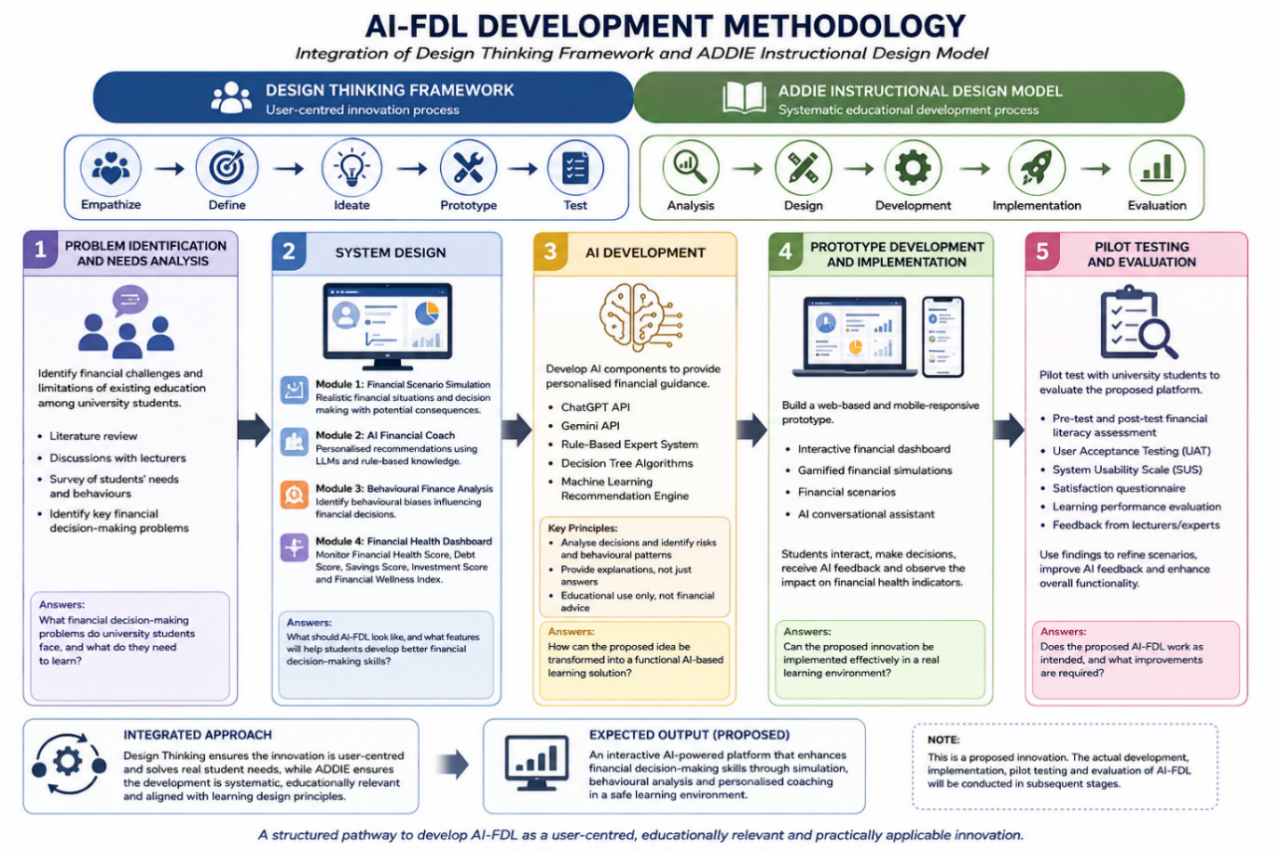
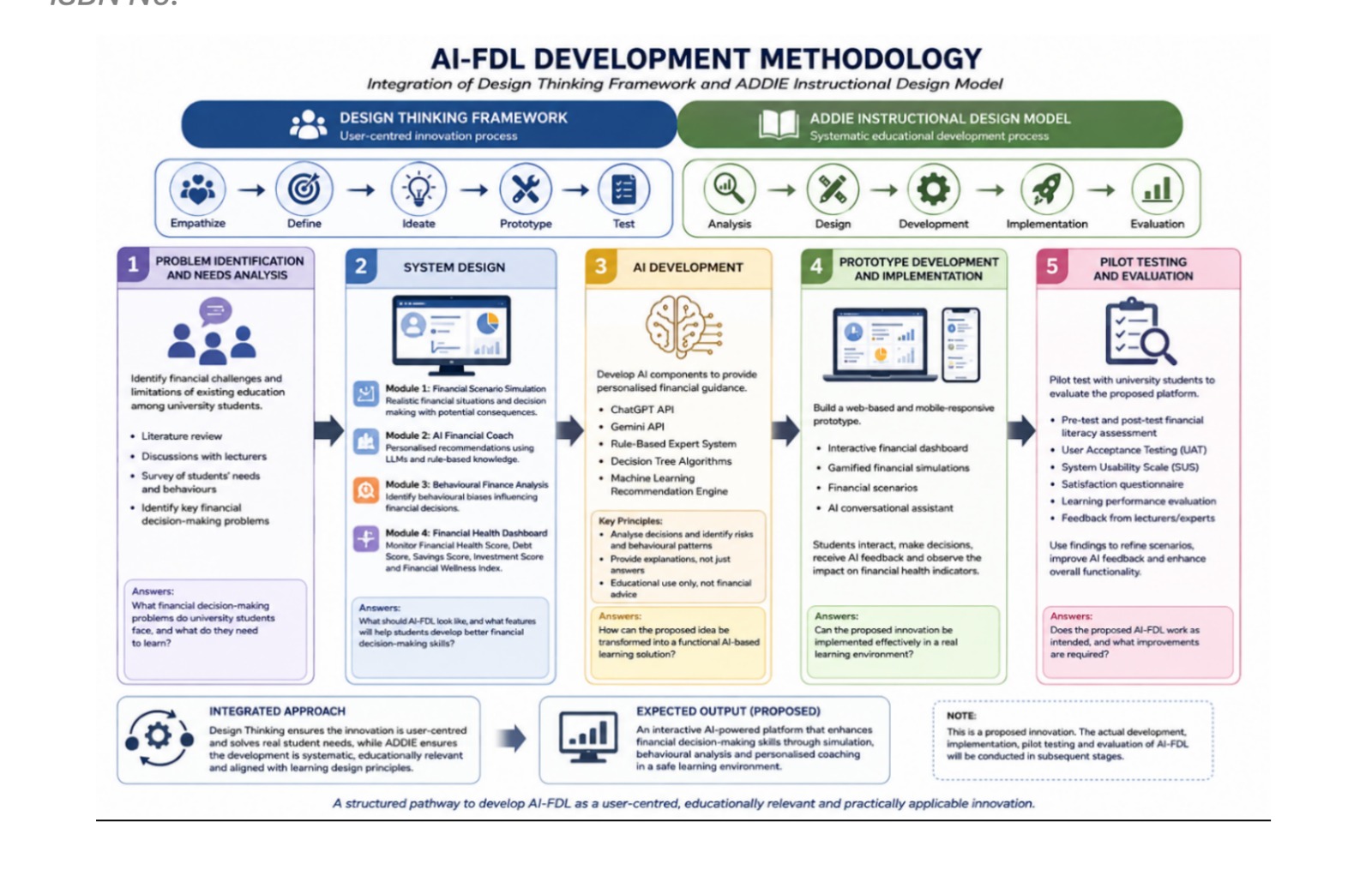
An integrated Design Thinking and ADDIE framework.
Pembangunan AI-FDL yang dicadangkan menggabungkan rangka kerja Design Thinking dan Model Reka Bentuk Instruksional ADDIE. Design Thinking menyediakan pendekatan berpusatkan pengguna untuk inovasi yang memberi tumpuan kepada memahami keperluan pengguna, mendefinisikan masalah, men
7. AI-FDL Modul
Four core modules deliver the decision-learning experience.
Module 1 — Financial Senario Simulasi
Situasi pelajar yang realistik: PTPTN, biasiswa, elaun bulanan, pendapatan sambilan, perbelanjaan kecemasan, pembelian telefon pintar, BNPL, simpanan, pelaburan, takaful/insurans, keusahawanan dan kejutan kewangan yang tidak dijangka.
Module 2 — AI Financial Coach
Rekomendasi peribadi dijana menggunakan LLM digabungkan dengan pengetahuan kewangan berasaskan peraturan. Bersifat pendidikan dan bukannya nasihat, dengan kebolehjelasan, perlindungan, pangkalan pengetahuan yang disahkan, maklum balas dan pengawasan manusia.
Module 3 — Behavioural Kewangan Analysis
Mengenal pasti corak keputusan yang selaras dengan bias masa kini, keyakinan berlebihan, keengganan kerugian, tingkah laku ikut-ikutan dan perbelanjaan emosi — menggunakan bahasa yang bertanggungjawab dari segi akademik dan bukannya diagnosis psikologi.
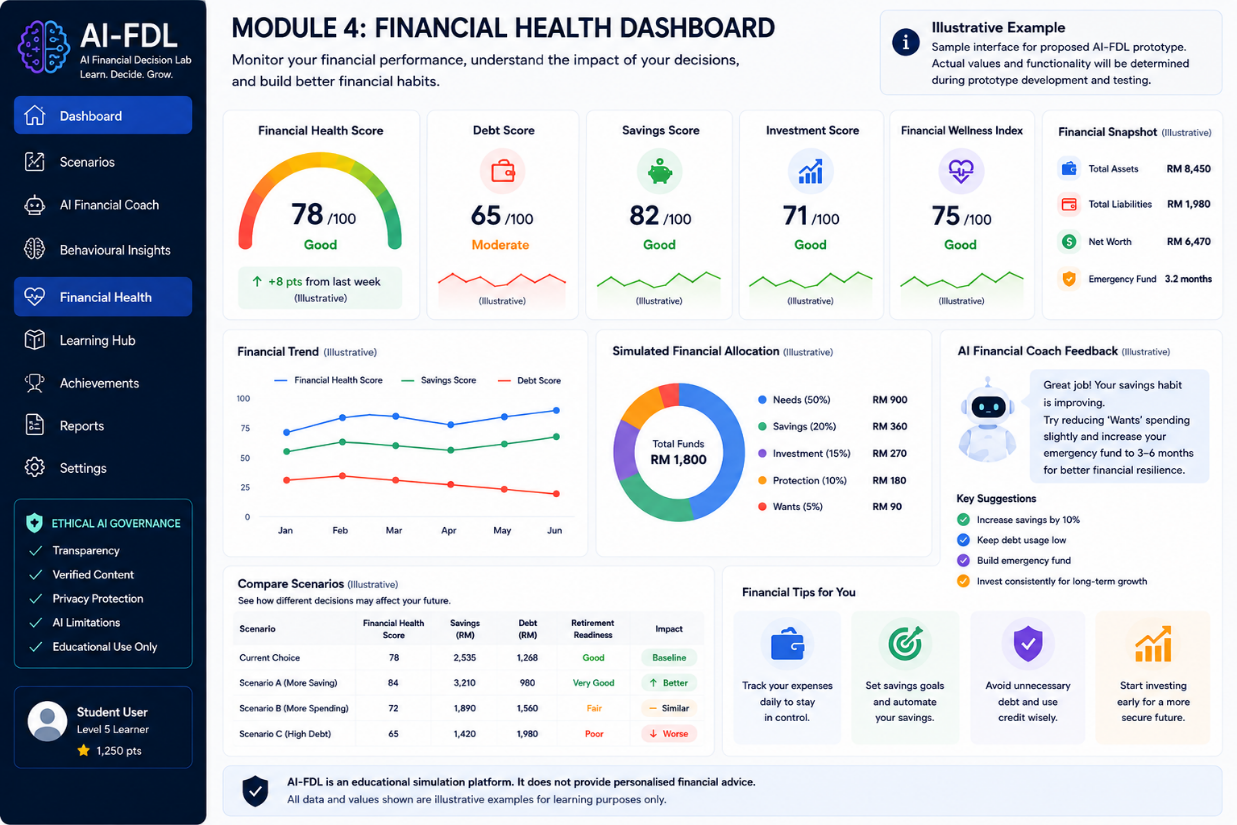
Module 4 — Financial Kesihatan Papan Pemuka
Memantau prestasi simulasi melalui Skor Kesihatan Kewangan, Skor Hutang, Skor Simpanan, Skor Pelaburan dan Indeks Kesejahteraan Kewangan — dilabel sebagai penunjuk prototaip, bukan ukuran yang disahkan.
8. Responsible AI Tadbir Urus
Because "Ethical AI-Powered" is in the title, ethical AI is a major competitive advantage, not a disclaimer.
Oleh kerana frasa Ethical AI-Powered muncul dalam tajuk inovasi, AI beretika tidak boleh kekal sekadar penafian. AI-FDL menerapkan Rangka Kerja Tadbir Urus AI Bertanggungjawab yang substantif yang menangani sepuluh prinsip.
Transparency. Pelajar hendaklah mengetahui bahawa mereka sedang berinteraksi dengan AI. Explainability. Feedback should explain reasoning rather than simply provide recommendations. Manusia Oversight. Pensyarah atau pentadbir yang diberi kuasa hendaklah mempunyai pengawasan yang sewajarnya. Data Minimisation. Kumpul hanya maklumat yang perlu untuk pembelajaran. Privasi. Protect student information. Keselamatan. Terapkan kawalan yang munasabah sesuai dengan kematangan prototaip. Bias dan Keadilan. Senario ujian dan output untuk cadangan yang tidak adil atau mengelirukan secara sistematik. Hallucination Control. Gunakan pengetahuan kewangan yang disahkan dan perlindungan asas atau berasaskan peraturan yang sesuai. Financial Advice Boundary. AI-FDL hendaklah membezakan dengan jelas pendidikan kewangan daripada nasihat kewangan yang dikawal selia atau diperibadikan. User Autonomy. Sistem ini seharusnya mendidik dan bukannya mendikte pilihan kewangan. Accountability. Menetapkan tanggungjawab untuk pengesahan kandungan dan tadbir urus sistem.
9. Validation and Evaluation Peta Hala Tuju
A rigorous future validation plan — no claimed results.
Memandangkan AI-FDL belum diuji secara empirikal, bab ini membentangkan peta jalan pengesahan masa hadapan yang teliti dan bukannya hasil yang didakwa. Setiap dimensi menyatakan ukuran, kaedah dan kriteria kejayaan indikatif. Ini adalah ambang yang dicadangkan, bukan hasil yang d
Table H2: AI-FDL Validation Peta Hala Tuju
| Dimension | Measure | Kaedah | Indicative Success Criterion |
|---|---|---|---|
| Usability | SUS | User testing | Predefined benchmark |
| Financial literacy | Pre/Post assessment | Quasi-experimental / pilot | Statistically assessed improvement |
| Decision quality | Senario performance | Simulasi analytics | Improved decision pattern |
| User acceptance | TAM/UTAUT-related measures | Survey | Validated scale |
| AI accuracy | Expert evaluation | Kewangan expert panel | Defined accuracy standard |
| AI safety | Hallucination / error testing | Red-team senario | Defined acceptable threshold |
| Content validity | Semakan pakar | CVI or appropriate method | Established criterion |
| Engagement | Analitik penggunaan | System logs | Defined participation metric |
Dimensi pengesahan yang dicadangkan. Tiada keputusan dituntut pada peringkat ini.
10. Expected Effectiveness and Impak
Keberkesanan yang berpotensi dipisahkan dengan jelas daripada keberkesanan yang terbukti.
Educational impact. AI-FDL dijangka menyediakan pendekatan yang lebih interaktif terhadap pendidikan kewangan dengan membolehkan pelajar mempraktikkan pembuatan keputusan kewangan melalui senario realistik dan hasil simulasi, menyokong literasi kewangan, pemikiran kritis, kemahiran membuat keputusan
Behavioural impact. AI-FDL dijangka meningkatkan kesedaran pelajar tentang faktor tingkah laku yang mempengaruhi keputusan kewangan, termasuk perbelanjaan, simpanan, pelaburan, pengurusan hutang dan disiplin kewangan.
Technological value. AI-FDL mengintegrasikan AI, kewangan tingkah laku, simulasi kewangan, gamifikasi dan pembelajaran peribadi dalam satu platform, dengan maklum balas berasaskan senario dan penerokaan tanpa risiko.
Responsible-AI value. AI-FDL menunjukkan rangka kerja tadbir urus untuk AI pendidikan, menyumbang kepada AI yang bertanggungjawab dan boleh diterangkan dalam pendidikan tinggi.
Institutional, commercial, research and social value. AI-FDL berpotensi diaplikasikan dalam pendidikan tinggi dan pendidikan kewangan, boleh menyokong penyelidikan masa depan dalam literasi kewangan, literasi AI, kewangan tingkah laku dan teknologi pendidikan, serta menyumbang kepada graduan yang bertanggungjawab dari segi kewangan
Impak model: Platform AI-FDL → Simulasi Keputusan Kewangan → Amalan Keputusan Berulang → Pemahaman Kewangan dan Kesedaran Keputusan yang Lebih Baik → Keupayaan dan Ketahanan Kewangan yang Lebih Besar. Kesan di luar hasil pembelajaran segera kekal sebagai hipotesis sehingga disahkan se
11. Commercialisation and Kebolehskalaan
Model perniagaan yang kredibel dan laluan penskalaan yang realistik.
Potential users. Universiti, polytechnics, community colleges, TVET institutions, MARA educational institutions, financial education organisations, financial institutions, government agencies and corporate financial-wellness programmes.
Commercialisation models. Lesen institusi B2B (langganan institusi tahunan), SaaS (akses per pengguna atau institusi), pakej simulasi tersuai (senario khusus organisasi), perkongsian pendidikan kewangan (program yang dibangunkan bersama) dan analitik penyelidikan dan pembelajaran (hanya apabila keperluan
Kebolehskalaan path. Perintis UPSI → Universiti Malaysia → Institusi Pendidikan Tinggi → Pendidikan Kewangan Belia → Kontekstualisasi ASEAN. Setiap skala memerlukan pengubahsuaian senario, kandungan, bahasa dan penjajaran peraturan.
12. Kelestarian and SDG Contribution
Laluan kausal, bukan penyebutan nama SDG yang dangkal.
AI-FDL sejajar dengan SDG 4 (Pendidikan Berkualiti) dan SDG 8 (Pekerjaan Layak dan Pertumbuhan Ekonomi). Laluan kausal adalah: aktiviti AI-FDL → hasil pembelajaran → keupayaan tingkah laku → sumbangan SDG yang lebih luas. Dengan memperkukuh keupayaan pelajar dalam membuat k
Impak model. Model impak mengikut urutan: Input → Aktiviti → Hasil → Hasil → Impak Jangka Panjang. Input: platform AI-FDL. Aktiviti: simulasi keputusan kewangan. Hasil: amalan keputusan berulang. Hasil: pemahaman kewangan dan kesedaran keputusan yang lebih baik. Impak Jangka Panjang
11.2 Why AI-FDL Wins Matriks
Cadangan kemenangan, bukti, jurang dan tindakan bagi setiap dimensi anugerah.
Table H3: Why AI-FDL Wins Matriks
| Award Dimension | AI-FDL Winning Proposition | Supporting Evidence | Semasa Gap | Required Tindakan |
|---|---|---|---|---|
| Novelty | System-level integration of 8 layers | Inovasi stack | Not demonstrated | Bina prototype |
| Teknologi | LLM + rule-based + decision engines | Seni Bina | No working system | Develop prototype |
| Educational value | Learning through financial decisions | Decision loop | No results | Perintis testing |
| Responsible AI | 10-principle governance framework | Rangka Kerja | Not demonstrated | Show safeguards |
| User impact | Improved decision capability | Expected outcomes | No results | Perintis testing |
| Malaysian relevance | PTPTN, BNPL, e-wallet context | Problem architecture | Lagi statistics | Add evidence |
| Kebolehskalaan | UPSI→ASEAN path | Peta Hala Tuju | Not tested | Perintis then scale |
| Commercialisation | B2B/SaaS models | Perniagaan model | No demand data | Market validation |
| Kelestarian | Penjajaran SDG 4 dan 8 | Causal pathway | Long-term model | Define funding |
| Presentation | Struktur dan angka yang jelas. | Chapter + figures | No prototype visuals | Add screenshots |
Matriks ini mengenal pasti cadangan kemenangan, bukti, jurang dan tindakan bagi setiap dimensi anugerah.
12. Summary
Daripada pembelajaran tentang wang kepada pembelajaran melalui keputusan kewangan.
Makmal Keputusan Kewangan AI (AI-FDL) dicadangkan sebagai platform pendidikan kewangan inovatif yang mengintegrasikan Kecerdasan Buatan, Kewangan Tingkah Laku, pembelajaran berasaskan simulasi dan bimbingan kewangan peribadi. Ia akan menyediakan pelajar universiti dengan senario
AI-FDL bertujuan untuk melengkapi pendidikan kewangan konvensional dengan memperkukuh literasi kewangan, pemikiran kritis, disiplin kewangan dan kemahiran membuat keputusan pelajar melalui pembelajaran praktikal dan interaktif. Memandangkan inovasi ini belum lagi dibangunkan, dil
13. Declarations and Kepatuhan Statement
Integriti akademik dan pematuhan AI yang bertanggungjawab.
Academic integrity statement
Bab ini melaporkan satu inovasi yang dicadangkan. Tiada data rekaan, hasil, statistik, sampel pengguna, keputusan ujian prototaip, anugerah, saiz pasaran, perkongsian atau pencapaian pengkomersilan dituntut. Semua rujukan telah disahkan terhadap sumber berwibawa; sekiranya sesuat
Use of AI statement
Alat AI digunakan untuk menyokong penggubalan, penyusunan dan pengesahan rujukan bab ini. Semua kandungan substantif, tuntutan dan keputusan telah disemak dan diluluskan oleh penulis, yang bertanggungjawab sepenuhnya terhadap manuskrip akhir.
Pernyataan Etika dan Data
AI-FDL merupakan platform pendidikan yang dicadangkan. Sebarang ujian rintis pada masa hadapan akan dijalankan selaras dengan keperluan etika penyelidikan, persetujuan termaklum, perlindungan privasi dan tadbir urus data yang berkenaan.
Conflict of interest statement
The authors declare that they have no conflict of interest.
Bahagian J — Cadangan Visual dan Rajah
Set angka impak maksimum yang disyorkan. Jangan sesakkan bab; setiap angka mesti membantu juri memahami inovasi.
| Figure | Title | Purpose | Elements | Information Flow | Placement |
|---|---|---|---|---|---|
| Figure 1 | AI-FDL Problem–Penyelesaian Seni Bina | Papar lapisan masalah dan penyelesaian. | 5 problem layers → AI-FDL | Problem → Penyelesaian | After Introduction |
| Figure 2 | AI-FDL Inovasi Stack | Paparkan integrasi sistem 8 lapisan. | 8 stacked layers | Bottom-up integration | Novelty section |
| Figure 3 | AI-FDL Conceptual Chart | Papar seni bina inovasi | Conceptual diagram | Seni Bina | Seni Bina section |
| Figure 4 | AI-FDL Decision Learning Loop | Show the closed learning cycle | 10-step loop | Senario → Learning | Seni Bina section |
| Figure 5 | AI-FDL Decision Learning Loop (SVG) | Show the closed learning cycle | 10-step loop | Senario → Learning | Seni Bina section |
| Figure 6 | Integrated Design Thinking–ADDIE Rangka Kerja | Tunjukkan metodologi pembangunan tersebut. | DT stages mapped to ADDIE | Analysis → Evaluation | Methodology section |
| Figure 7 | Responsible AI Rangka Kerja Tadbir Urus | Show the 10 ethical principles | 10 principles around core | Teras → Prinsip | Responsible AI section |
| Figure 8 | Commercialisation and Kebolehskalaan Peta Hala Tuju | Tunjukkan laluan penskalaan. | 5 stages | Perintis → ASEAN | Commercialisation section |
Set angka impak maksimum yang disyorkan. Jangan sesakkan bab; setiap angka mesti membantu juri memahami inovasi.
PART K — Prototype Development Keutamaan
Oleh kerana potensi anugerah sangat bergantung pada kebolehbuktian, perkara-perkara berikut sebaik-baiknya wujud sebelum penilaian akhir.
| Item | Keutamaan | Purpose |
|---|---|---|
| Clickable prototype | MESTI ADA | Demonstrate the platform works |
| Functioning scenario | MESTI ADA | Show a realistic decision task |
| AI Financial Coach demonstration | MESTI ADA | Show personalised feedback |
| Financial Kesihatan Papan Pemuka | MESTI ADA | Show simulated indicators |
| Ethics notice / disclaimer | MESTI ADA | Show responsible-AI compliance |
| Data-flow diagram | STRONGLY RECOMMENDED | Paparkan privasi dan tadbir urus |
| Expert validation | STRONGLY RECOMMENDED | Show content validity |
| Small user demonstration | STRONGLY RECOMMENDED | Show usability evidence |
| QR access | VALUE-ADDING | Enable judges to try it |
| Video demonstration | VALUE-ADDING | Show the innovation in action |
| Commercialisation roadmap | VALUE-ADDING | Show business potential |
| IP documentation | VALUE-ADDING | Show protection strategy |
Item dikelaskan mengikut keutamaan. Tiada apa-apa yang dianggap wujud melainkan ia benar-benar wujud.
PART L — ICAME Inovasi Video Strategy
ICAME 2026 memerlukan Video Inovasi yang mesti mengandungi Montaj Pembuka rasmi selama 20 saat pada permulaan.
Pembentangan substantif hendaklah mengikuti naratif yang kukuh: Masalah → Senario Pelajar Sebenar → AI-FDL → Demonstrasi Langsung/Prototaip → Kebaharuan → AI Beretika → Impak → Pengkomersialan → Cadangan Penutup.
Urutan babak yang disyorkan dan anggaran masa (untuk video 3–5 minit):
1. Official Intro Montage (20 seconds) — mandatory. 2. Problem (30 seconds) — a real Malaysian student facing a financial decision (e.g., allocating a PTPTN loan). 3. Konsep AI-FDL (30 saat) — apakah platform tersebut dan mengapa ia diperlukan. 4. Demonstrasi langsung/prototip (60 saat) — paparkan senario, keputusan, maklum balas AI dan papan pemuka. 5. Kebaharuan (30 saat) — integrasi 8 lapisan dan cadangan pembelajaran melalui keputusan. 6. AI Beretika (30 saat) — kerangka tadbir urus AI yang bertanggungjawab. 7. Impak (20 saat) — hasil pendidikan dan tingkah laku yang dijangka. 8. Pengkomersialan (20 saat) — model perniagaan dan laluan penskalaan. 9. Penutupan proposition (20 seconds) — a memorable final statement.
Video tersebut hendaklah menunjukkan inovasi dan bukannya sekadar mengulangi bab tersebut. Gunakan tangkapan skrin prototaip, narasi yang jelas dan visual utama bagi setiap rajah.
PART M — Gold Medal / Main Award Stress Test
Skor konservatif yang mencerminkan status semasa inovasi yang dicadangkan — tidak melambung.
| Dimension | Skor | Justification | Remaining Kelemahan |
|---|---|---|---|
| Problem Significance | 85/100 | Literasi kewangan dan pembuatan keputusan dalam kalangan belia Malaysia merupakan masalah yang ketara dan terbukti kukuh. | Lebih banyak statistik khusus Malaysia akan mengukuhkan. |
| Novelty | 80/100 | Integrasi peringkat sistem bagi 8 lapisan adalah wajar dipertahankan. | Must be demonstrated, not only described |
| Originality | 80/100 | Tiada satu kategori sedia ada yang menyepadukan semua keupayaan. | Competitor evidence is category-level |
| Teknikal Design | 75/100 | Seni bina 8 lapisan yang jelas dan gelung keputusan | No working prototype yet |
| Academic Asas | 85/100 | Asas teori yang kukuh dan rujukan yang disahkan | Could add more recent empirical studies |
| Functionality / Readiness | 45/100 | Hanya dicadangkan; tiada prototaip atau keputusan ujian. | Jurang penentu — bina prototaip. |
| Responsible AI | 90/100 | Rangka kerja tadbir urus 10 prinsip yang substantif | Needs demonstration of safeguards |
| Educational Impak | 80/100 | Clear expected learning outcomes | No empirical results yet |
| Sosial Impak | 80/100 | Penjajaran SDG 4 dan 8 dengan laluan kausal | Impak remains a hypothesis |
| Feasibility | 75/100 | Boleh dilaksanakan secara teknikal dengan LLM dan pendekatan berasaskan peraturan. | Bergantung pada sumber dan kepakaran. |
| Kebolehskalaan | 75/100 | Clear UPSI→ASEAN path | Memerlukan penyesuaian kandungan dan peraturan. |
| Commercialisation | 70/100 | Credible B2B/SaaS models | No validated demand or pricing |
| Kelestarian | 75/100 | Kelestarian pendidikan dan institusi | Long-term funding model unclear |
| Presentation Quality | 80/100 | Struktur dan angka yang jelas. | Add prototype screenshots |
| Overall Award Readiness | 72/100 | Konsep yang mantap; jurang prototaip merupakan kekangan utama. | Bina prototype + video before judging |
Skor adalah konservatif dan mencerminkan status inovasi yang dicadangkan pada masa ini. Ia tidak dilebih-lebihkan.
PART N — Final Pre-Submission Checklist
| Item | Status | Tindakan Required |
|---|---|---|
| Eligibility | Compliant | Sahkan pendaftaran dan pembayaran |
| Template compliance | Compliant | Padankan Bab rasmi dengan tajuk templat Buku. |
| Author limit (max 8) | Compliant | Confirm final author list |
| Thematic alignment | Compliant | Frame Subtheme 1 (Ethical AI) as primary |
| Novelty | Defined | Gunakan rangka kerja integrasi 8-lapisan |
| Academic integrity | Compliant | No fabricated data or results |
| Citation accuracy | Verified | Semua references verified (Part D) |
| DOI verification | Verified | Semua DOIs resolve to correct articles |
| Ethical AI | Substantive | Gunakan rangka kerja 10 prinsip. |
| Prototype evidence | Gap | Bina clickable prototype + demonstration |
| Commercialisation | Credible | Gunakan model B2B/SaaS |
| Figures | Disyorkan | Sertakan tujuh rajah yang disyorkan. |
| Bahasa | Bahasa Inggeris | Semak untuk konsistensi. |
| Formatting | In progress | Match template formatting |
| Chapter submission | Pending | Submit by 31 Aug 2026 |
| Inovasi video | Pending | Hasilkan video dengan montaj pembuka 20 saat. |
This checklist must be completed before final submission.
Muat Turun Bab
Muat turun penyerahan bab buku ICAME 2026 yang lengkap. ICAME2026-AI-FDL-Chapter (2).docx — sebuah manuskrip yang diperluas secara ketara yang mematuhi sepenuhnya taklimat induk Pertandingan Inovasi ICAME 2026: audit forensik, pengesahan kelayakan, pembinaan semula masalah, tindanan inovasi, gelung keputusan, metodologi pembangunan, empat modul, tadbir urus AI yang
PART I — Verified Reference List
Gaya APA 7, semua disahkan terhadap sumber yang berwibawa.
Adwani, H., & Chermala, A. (2026). AI-driven gamified learning for financial literacy: A study on Generation Z engagement. In ECOFIN SUMMIT'26 Proceedings (p. 84). Antarabangsa School of Perniagaan & Media. ISBN 978-93-5717-775-7.
Ajzen, I. (2020). The theory of planned behavior: Frequently asked questions. Manusia Behavior and Emerging Technologies, 2(4), 314–324. https://doi.org/10.1002/hbe2.195
Aziz, N. I. M., & Kassim, S. (2020). Does financial literacy really matter for Malaysians? A review. Advanced Antarabangsa Jurnal of Banking, Perakaunan and Kewangan, 2(2), 13–20. https://doi.org/10.35631/aijbaf.22002
Bank Negara Malaysia. (2025). Strategi Nasional untuk Literasi Kewangan 2026–2030 (NS2.0): Membentuk Masa Depan Kewangan yang Berdaya Tahan. Central Bank of Malaysia.
Borenstein, J., & Howard, A. (2021). Emerging challenges in AI and the need for AI ethics education. Kecerdasan Buatan dan Etika, 1(1), 33–39. https://doi.org/10.1007/s43681-020-00002-7
Branch, R. M. (2009). Instructional design: The ADDIE approach. Springer. https://doi.org/10.1007/978-0-387-09506-6
Brown, T. (2008). Design thinking. Harvard Perniagaan Ulasan, 86(6), 84–92.
Chahar, P., Vishwakarma, Y. K., Mishra, R., & Paliwal, G. (2026). Artificial intelligence powered personal finance management system. SSRN. https://doi.org/10.2139/ssrn.6377518
Choukhmane, T., de Silva, T., Lin, W., & Akuzawa, M. (2026). AI financial advice: Supply, demand, and life cycle implications. SSRN. https://doi.org/10.2139/ssrn.7257643
Deterding, S., Dixon, D., Khaled, R., & Nacke, L. (2011). Gamification: Toward a definition. In CHI EA '11: Prosiding Persidangan SIGCHI mengenai Faktor Manusia dalam Sistem Pengkomputeran (pp. 2425–2428). https://doi.org/10.1145/1979742.1979575
Di Maggio, M., Williams, E., & Katz, J. (2022). Buy now, pay later credit: User characteristics and effects on spending patterns (NBER Working Paper No. 30508). https://doi.org/10.3386/w30508
Elisabeth, N., Lie, V., & Herlina, M. G. (2026, May). Artificial intelligence drive: Exploring its impact on financial literacy and need for achievement among Indonesian higher education students. In 2026 6th Antarabangsa Conference on Innovative Penyelidikan in Applied Science, Engineering and Teknologi (IRASET) (pp. 1–6). IEEE. https://doi.org/10.1109/IRASET68627.2026.11538502
Financial Industry Collective Outreach [FINCO]. (2023). Money SENse: Malaysian students' grasp of financial matters. FINCO Malaysia.
Forcellini, M., & Gracikova, E. (2025). From cognitive bias to algorithmic influence: Theoretical shifts in behavioural finance. Jurnal Ekonomi Tingkah Laku dan Dasar, 1(1), 20–27. https://doi.org/10.55121/jbep.v1i1.766
Guttman-Kenney, B., Firth, C., & Gathergood, J. (2022). Beli sekarang, bayar kemudian (BNPL)… pada kad kredit anda. SSRN. https://doi.org/10.2139/ssrn.4001909
Ji, Z., Lee, N., Frieske, R., Yu, T., Su, D., Xu, Y., Ishii, E., Bang, Y. J., Madotto, A., & Fung, P. (2023). Survey of hallucination in natural language generation. ACM Computing Surveys, 55(12), 1–38. https://doi.org/10.1145/3571730
Kahneman, D., & Tversky, A. (1979). Prospect theory: An analysis of decision under risk. Econometrica, 47(2), 263–291. https://doi.org/10.2307/1914185
Kaiser, T., & Menkhoff, L. (2017). Does financial education impact financial literacy and financial behavior, and if so, when? The World Bank Economic Ulasan, 31(3), 611–630. https://doi.org/10.1093/wber/lhx018
Kanzal, J., Mariya Loreena, P. S., Revand, S. J., Vidhya, S., Rohan Joseph, P., & Abhishay, A. (2026). Assessing the impact of Buy Now, Pay Later (BNPL) schemes on students' financial behavior: A study on spending habits and debt management. In Kecerdasan Buatan dan Teknologi: Pengurusan Sistem, Keputusan dan Kawalan untuk Kemampanan dalam Era Digital (pp. 715–722). Springer Nature Switzerland.
Kolb, D. A. (2014). Pembelajaran berasaskan pengalaman: Pengalaman sebagai sumber pembelajaran dan pembangunan (2nd ed.). Pearson.
Lusardi, A., & Messy, F. A. (2023). The importance of financial literacy and its impact on financial wellbeing. Jurnal of Financial Literacy and Wellbeing, 1(1), 1–11. https://doi.org/10.1017/flw.2023.8
Lusardi, A., & Mitchell, O. S. (2014). The economic importance of financial literacy: Theory and evidence. Jurnal of Economic Literature, 52(1), 5–44. https://doi.org/10.1257/jel.52.1.5
Malik, M., Nasir, M., Rayyan, M., & Usman, M. (2025). Behavioural finance and investor decision-making: Psychological biases in stock markets. Ulasan Pengurusan Gunaan dan Sains Sosial, 8(2), 1129–1144. https://doi.org/10.47067/ramss.v8i2.542
Mat Rahim, N., Ali, N., & Adnan, M. F. (2022). Students' financial literacy: A digital financial literacy perspective. Prosiding Persidangan Global Perniagaan dan Sains Sosial, 13(1). https://doi.org/10.35609/gcbssproceeding.2022.1(9)
OECD. (2022). Kit OECD/INFE untuk Mengukur Literasi Kewangan dan Inklusi Kewangan. https://doi.org/10.1787/cbc4114f-en
Osman, I., Mohamad Ariffin, N. A., Mohd Yuraimie, M. F. N., Ali, M. F., & Noor Akbar, M. A. F. (2024). How Buy Now, Pay Later (BNPL) is shaping Gen Z's spending spree in Malaysia. Pengurusan Maklumat dan Ulasan Perniagaan, 16(3(I)S), 657–674. https://doi.org/10.22610/imbr.v16i3(i)s.4092
Panos, G. A., & Wilson, J. O. S. (2021). Literasi kewangan dan kewangan bertanggungjawab dalam era teknologi kewangan. Routledge. https://doi.org/10.4324/9781003169192
Sailer, M., & Homner, L. (2020). The gamification of learning: A meta-analysis. Educational Psychology Ulasan, 32(1), 77–112. https://doi.org/10.1007/s10648-019-09498-w
Wijaya, T. F. A. (2025). Inovasi kecerdasan buatan (AI) dalam memacu keterangkuman kewangan global: Program pelajar untuk mengurangkan ketidakadilan dan menyokong Matlamat Pembangunan Mampan (SDG) 8. Jurnal Perniagaan dan Pentadbiran Gunaan, 4(2), 111–119. https://doi.org/10.62201/abaj.v4i02.225
World Economic Forum. (2024). Laporan Masa Depan Pekerjaan 2024Laporan Masa Depan Pekerjaan 2024