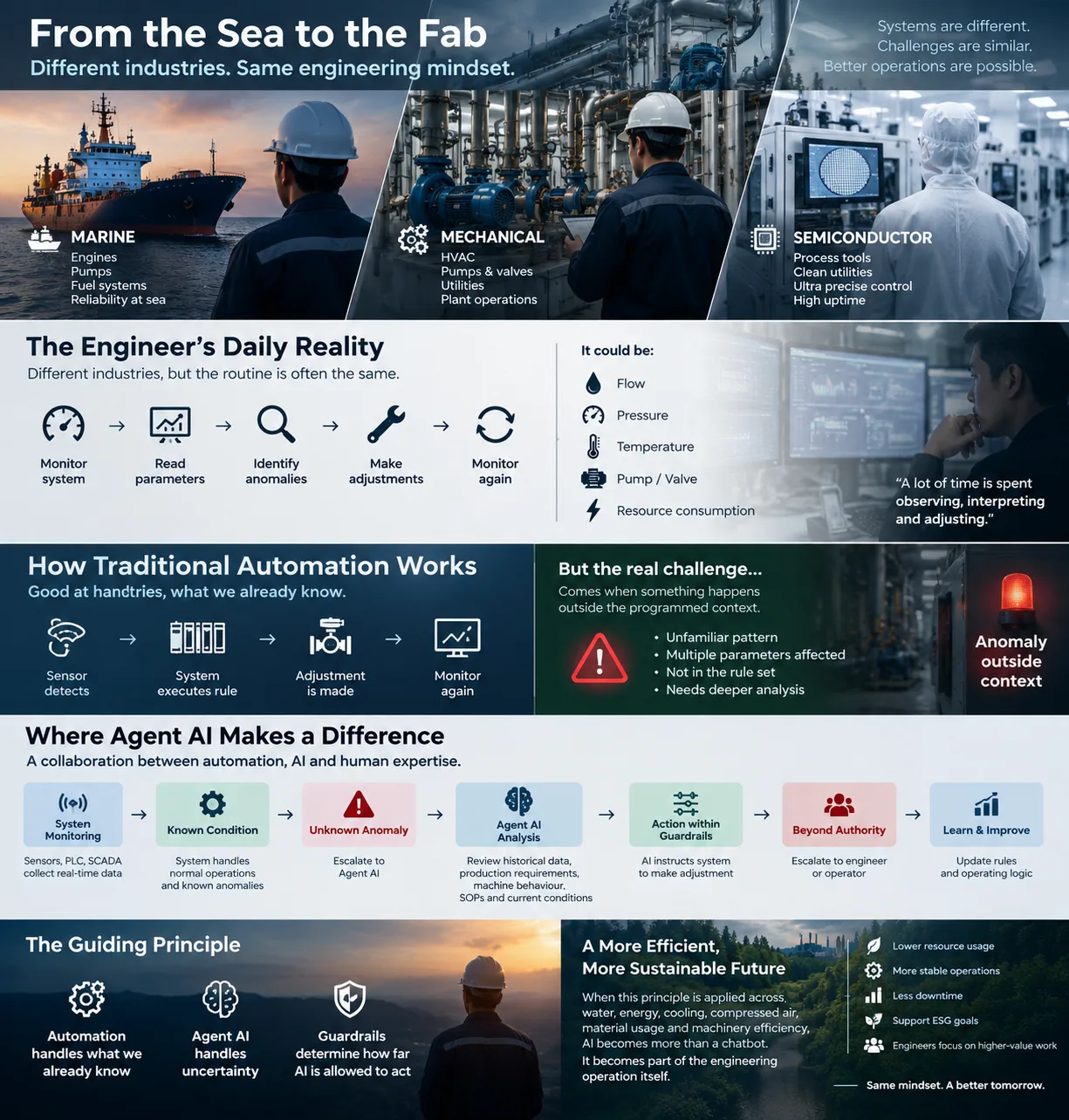
Much of my career has been spent on the finance and accounting side of operations, working across several different industries, from marine and mechanical engineering to semiconductor manufacturing. The industries were different, but the pattern in the numbers was always the same: a large share of operating cost sits in assets that have to be monitored continuously - reading parameters, identifying anomalies, making adjustments, and then monitoring again. Whether it is flow, pressure, temperature, pumps, valves, or resource consumption, all of it eventually arrives as a cost line in the accounts.
Traditional automation systems can already handle many conditions that are known in advance. If flow exceeds a predefined parameter, the sensor detects it, the system executes a rule, an adjustment is made, and the system monitors the result. In accounting terms, this is a budget that behaves as expected: volume within range, cost per unit within tolerance, variance explained by month-end. The real challenge appears when an anomaly falls outside the context or rules that were originally programmed - because that is also when the cost impact stops respecting the cost centre it was budgeted in.
This is where I see the real role of Agent AI. It is not about allowing AI to control every machine all the time. Instead, Agent AI helps build the operating logik, while the system handles normal operations and known anomalies. When something unusual happens outside the programmed context, the system escalates it to the AI for further analysis.
The AI can then review historical data, production requirements, machine behaviour, SOPs, and current operating conditions - together with the cost implications of each option - before deciding what should happen next. If the required action is still within predefined guardrails, the AI can instruct the system to make the adjustment. If the situation exceeds its authority or safety limits, it escalates the issue to an engineer or operator.
The principle is simple: automation handles what we already know, Agent AI handles uncertainty, and guardrails determine how far AI is allowed to act.
When this principle is applied to water flow, energy consumption, cooling systems, compressed air, material usage, or machinery efficiency, those become measurable lines rather than assumptions - and AI is no longer just a chatbot. It starts becoming part of the engineering operation itself, and from the finance side, part of an operating model whose value can be demonstrated in RM rather than taken on faith.














Ruang pembaca
Apa pendapat anda?
Komen baharu dihantar untuk semakan terlebih dahulu. Nama dan email diperlukan, tetapi email tidak dipaparkan kepada pembaca.
compressed air, material usage - that is the whole thing in one line.
Useful. We are dealing with production requirements, machine behaviour right now.
Bookmarked, mostly for whether it is flow, pressure. It make the point easier to understand.
Still thinking about traditional automation systems.
Ang bahagi tungkol sa paksang ito ang pinag-isipan ko nang matagal.
I have watched working across several different industries go wrong in practice. Good to see it written down.
This is where SOPs, and current operating conditions finally makes sense.
The numbers around automation handles make more sense than most posts I read.
とりあえず保存しました。この内容のためです。
I read this twice. together with the cost implications is the part that stuck. It make the point easier to understand.