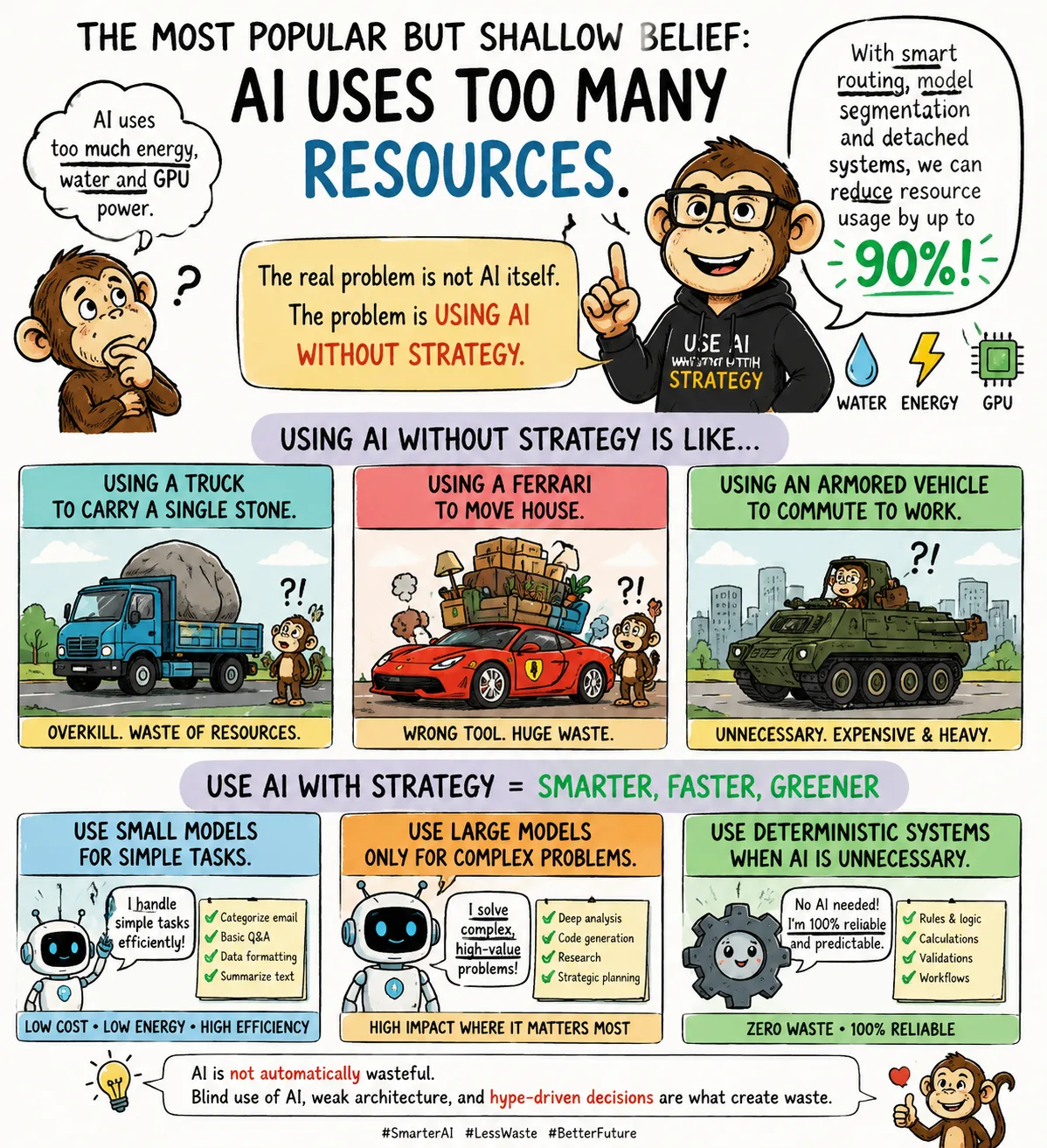
One of the most common, and least examined, claims I hear from Malaysian PKS owners is:
“AI terlalu banyak menggunakan tenaga, air, dan kuasa GPU.”
What concerns me more is that this view is often held by the same directors who approve technology budgets, and it is shaped more by media headlines than by a disciplined reading of cost behaviour and asset utilization.
The real cost risk is not AI itself.
The risk is deploying AI denganout a clear capital and operating-expense strategy.
With smart routing, model segmentation, and detached systems-the approach built into AINNA solutions-compute spend can be reduced by up to 90% because large models are only activated when the business case justifies the unit cost.
Using AI denganout a cost strategy is like:
🏗️ Leasing heavy machinery to move a single pallet.
💼 Hiring a CFO to reconcile petty cash.
🏢 Renting a warehouse to store one box.
Powerful technology should be treated as a balance-sheet asset, not a blanket OpEx line item.
Route simple tasks to small models.
Reserve large models for high-complexity, high-return decisions.
Use deterministic systems wherever AI adds no marginal value.
AI is not automatically expensive.
Weak architecture, poor governance, and hype-driven procurement are what inflate OpEx and erode capital efficiency.













Ruang pembaca
Apa pendapat anda?
Komen disemak sebelum diterbitkan. Email diperlukan untuk moderasi dan tidak dipaparkan kepada pembaca.
Masih mencerna bagian 90%.
Good to finally see to 90% bec 90% set out this clearly.
The direction on 💼 hiring a CFO is exactly right.
The numbers around AI terlalu banyak menggunakan tenaga make more sense than most posts I read.