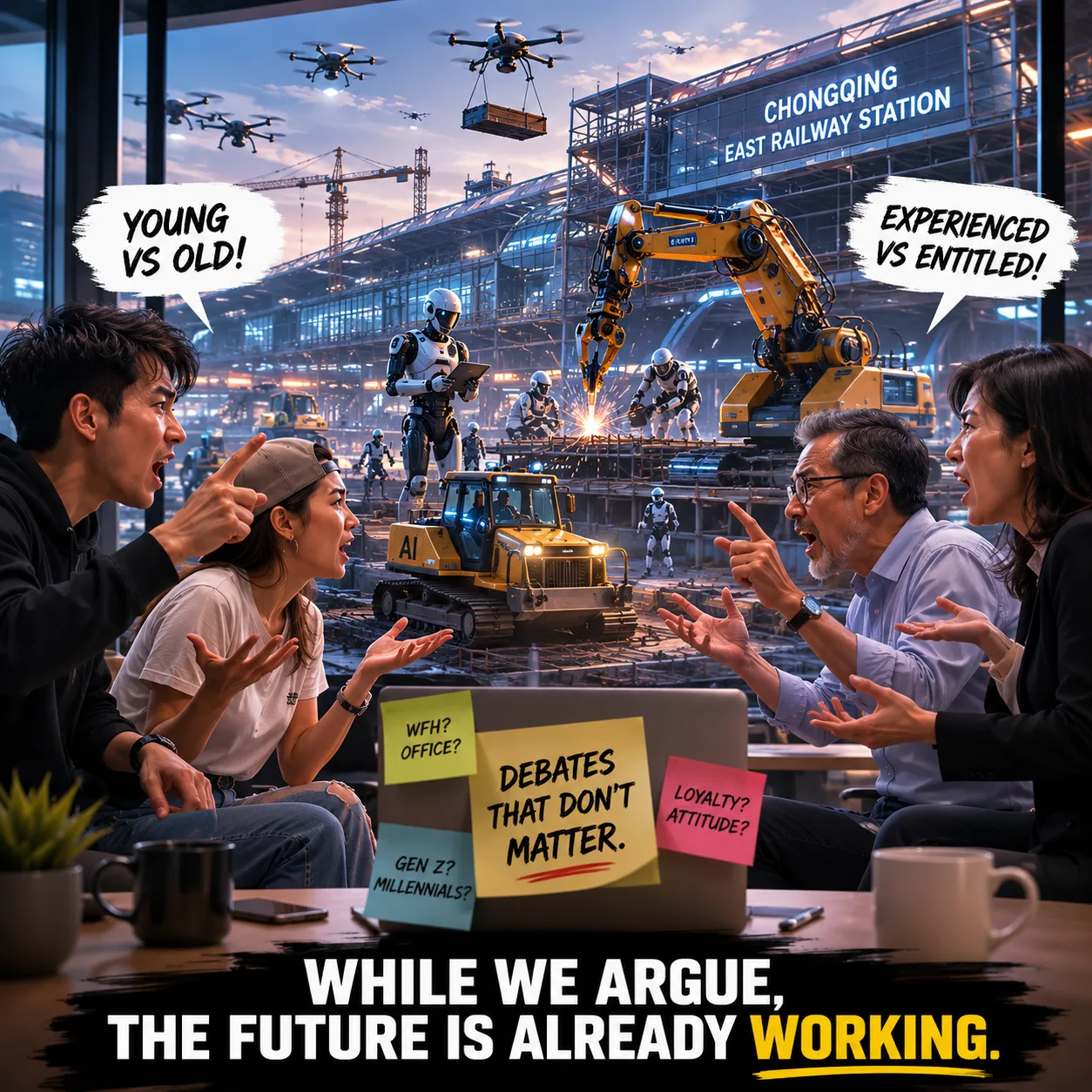
The industry is still running legacy debates-Gen Z versus Millennials, WFH versus WFO, which cohort has the better work ethic. Meanwhile, production systems in the field have already moved on. The real conversation now is about the architecture of work itself: which sensors, models, agents and control layers are wired into the workflow, and how they are maintained.
Take China's Chongqing East Railway Station. What is happening there is not a generational policy experiment; it is a deployed system-of-systems. AI vision, robotics, LiDAR point clouds, automation controllers and 5G backhaul are integrated end-to-end. The result is higher throughput, fewer manual touchpoints and, reportedly, safety incidents down by roughly 90%. The engineering takeaway is clear: the conversation has shifted from who executes the task to how the system is designed, monitored and updated.
The uncomfortable reality is that the workforce is still being trained for an obsolete stack while the next stack is already in production. Many organisations are still optimising attendance registers, job titles and reporting lines, while in the field AI agents are learning workflows, inference pipelines are consuming telemetry, and decision support is running lebih pantas than any manual review cycle could match.
For a long time, the assumption was that the highest-value contributor was the smartest, most credentialed or most experienced person in the room. Those attributes still matter, but they are not sufficient on their own. Increasingly, the highest-value contributor is the one who can place human judgement at the right point in an automated loop-someone who can validate model outputs, handle edge cases and keep the system aligned with real-world constraints.
The biggest misconception is that AI will replace humans. In practice, it rarely works that way. What actually happens is that a small, well-integrated team-one with the right models, automation tooling and data pipelines-can deliver what used to require a much larger team. The competition is not human versus machine; it is humans operating inside a mature intelligence-augmentation system versus humans who are not.
Ironically, the whole point of automation was to remove drudgery. As engineers, we wanted fewer repetitive tasks, lebih pantas cycles and less toil. But by raising system efficiency so dramatically, we have also rewritten the economics of headcount. Any organisation will eventually ask whether the same output still requires the same number of operators.
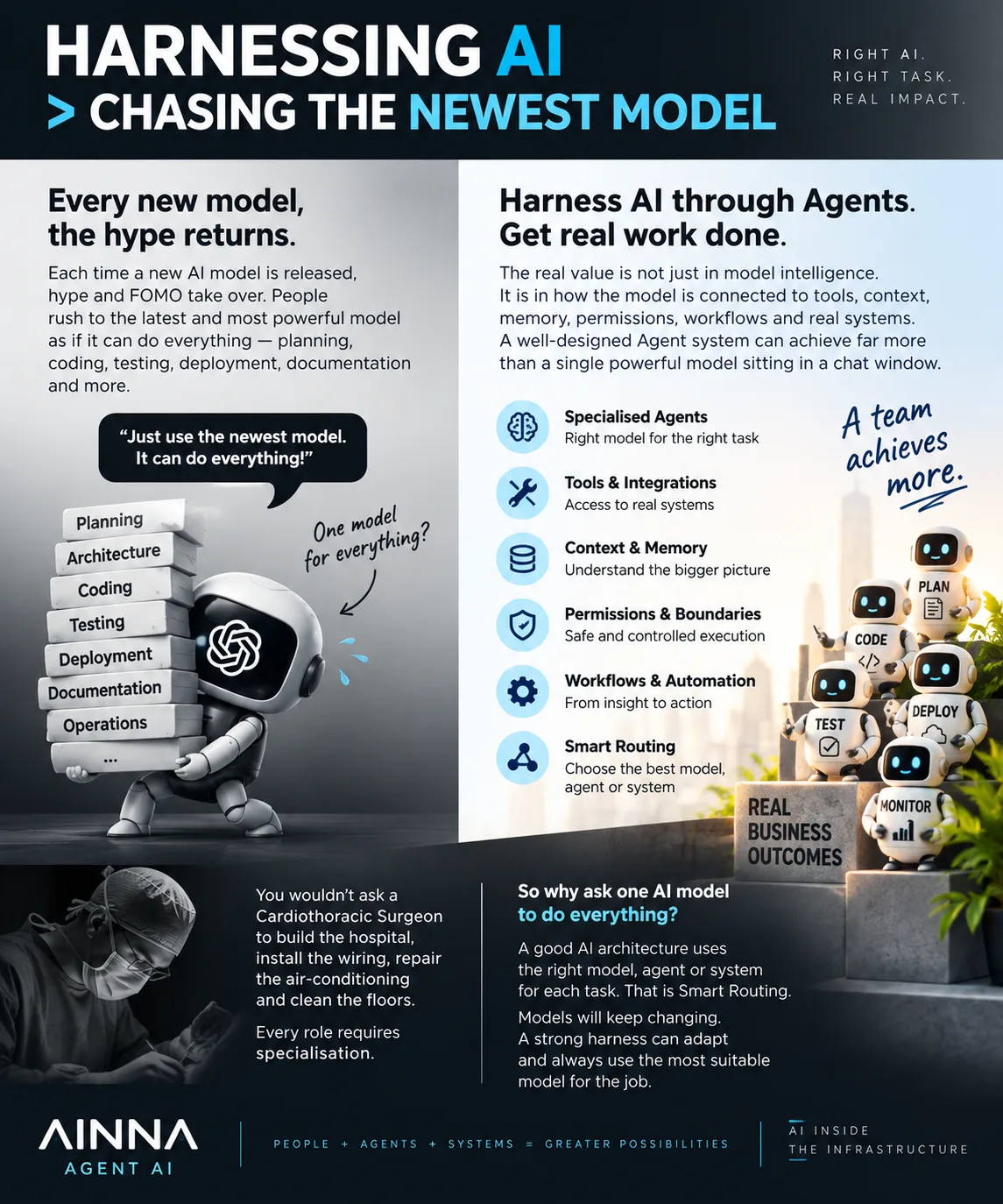
So the discourse is stuck on the wrong variable. The future will not be settled by Gen Z versus Millennials, or by WFH versus the office. It will be settled by teams that stop treating AI as a user interface and start treating it as infrastructure-something to architect, deploy, monitor and continuously retrain. The edge will not go to the individual with the highest IQ. It will go to the practitioner who knows how to amplify intelligence through a working system.















Ruang pembaca
Apa pendapat anda?
Komen disemak sebelum diterbitkan. Email diperlukan untuk moderasi dan tidak dipaparkan kepada pembaca.
Ang 9 ang ipapadala ko sa boss ko.
Short and clear. by roughly 9 90% is worth sending to my team.
First piece I have read that treats automation controllers and 5G backhaul honestly.
نواجه 9 في العمل الآن. مفيد.
The bit about what actually happens is what I keep coming back to.
The direction on take china's chongqing east railway is exactly right.
Orang yang tulis ni memang buat kerja rumah pasal 9.
Worth reading just for job titles and reporting lines.