Twenty years ago, every major vendor brief predicted IPv6 would go mainstream within twelve to twenty-four months.
They were technically correct and operationally wrong.
The protocol stack was ready. Addressing, auto-configuration and security headers were all there. What was missing was the field economics: no mass-deployed IoT, no affordable Edge AI accelerators, and no business case for giving every light switch or sensor its own routable address.
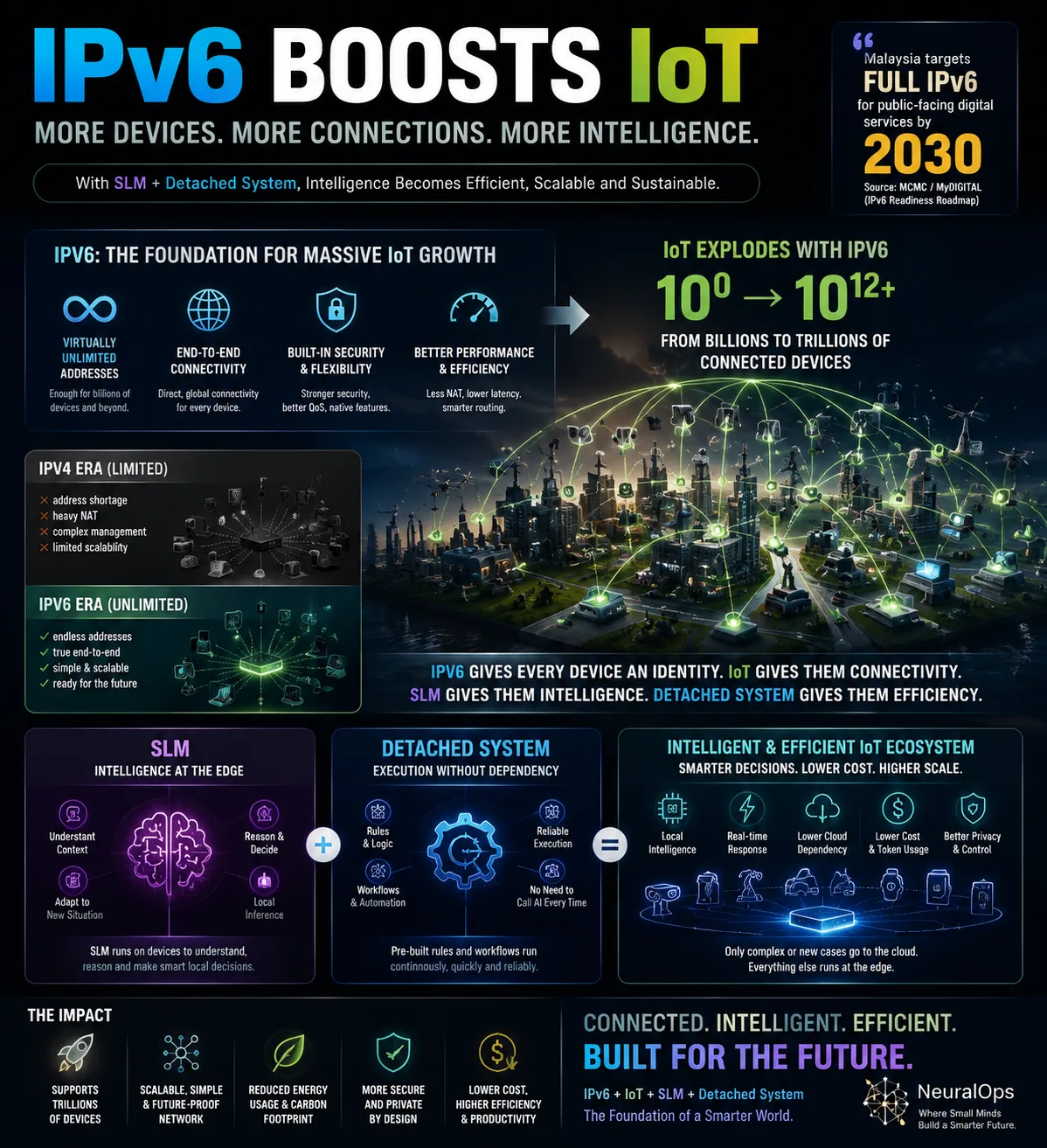
Today, Malaysia’s 2030 IPv6 target changes the deployment math. For a systems integrator building production AIoT infrastructure, this is no longer a routing upgrade. It is the addressing layer for a distributed compute fabric.
The real systems play is the convergence of IPv6, IoT, Model Bahasa Kecil and Sistem Berasingan.
In our deployments, an SLM sits at the edge as a local reasoning node. It interprets ambiguous input, handles exceptions and decides what should happen next. The Sistem Berasingan is the deterministic execution plane: compiled rules, control loops and workflows that run continuously without burning tokens or GPU cycles on every state transition.
That separation is what makes Edge AI cost-effective at scale.
The SLM only wakes up when the situation is novel, unsafe or requires adaptation. Once the policy is validated, the Sistem Berasingan takes over the repetitive, timing-critical work at a fraction of the compute cost and with predictable latency.
IPv6 gives every endpoint a stable, globally reachable identity. IoT provides the telemetry and actuation fabric. SLMs provide context-aware reasoning. Sistem Berasingan provide reliable, repeatable execution. Peer-to-peer networking removes the need to hairpin every decision through a central broker.
A smart cup, a vibration sensor on a factory line, an ECU in a vehicle or a home appliance can therefore resolve most of its operating states locally. Only genuinely baharu or high-stakes patterns get escalated to a larger model or cloud GPU cluster.
The operational impact is straightforward: less cloud ingress, fewer GPU hours, lower token spend, lower bandwidth, lower latency and lower run-cost.
The future of AI does not have to be a single monolithic model in a hyperscale data centre.
It can be billions of small, addressable nodes-each with its own IPv6 endpoint, running an SLM paired with a Sistem Berasingan, and collaborating over a peer-to-peer mesh.
Awan will still matter for training, orchestration, global aggregation and the hardest workloads. But routine intelligence and closed-loop control will increasingly live on the device side.
What looked like an incremental networking project twenty years ago is now becoming one of the foundational layers of distributed neural systems.
#IPv6 #SLM #SmallBahasaModels #DetachedSystem #EdgeAI #IoT #DistributedAI #PeerToPeer #ArtificialIntelligence #NeuralOps
















Ruang pembaca
Apa pendapat anda?
Komen disemak sebelum diterbitkan. Email diperlukan untuk moderasi dan tidak dipaparkan kepada pembaca.
मुझे 6 वाला हिस्सा पसंद आया, यह बहुत सैद्धांतिक नहीं है।
Solid take on handles exceptions and decides overall.
Useful. We are handling SLMs provide context-aware reasoning right now.
Good to finally see IPv6 gives every endpoint set out this clearly.
Worth reading for ioT provides the telemetry alone.