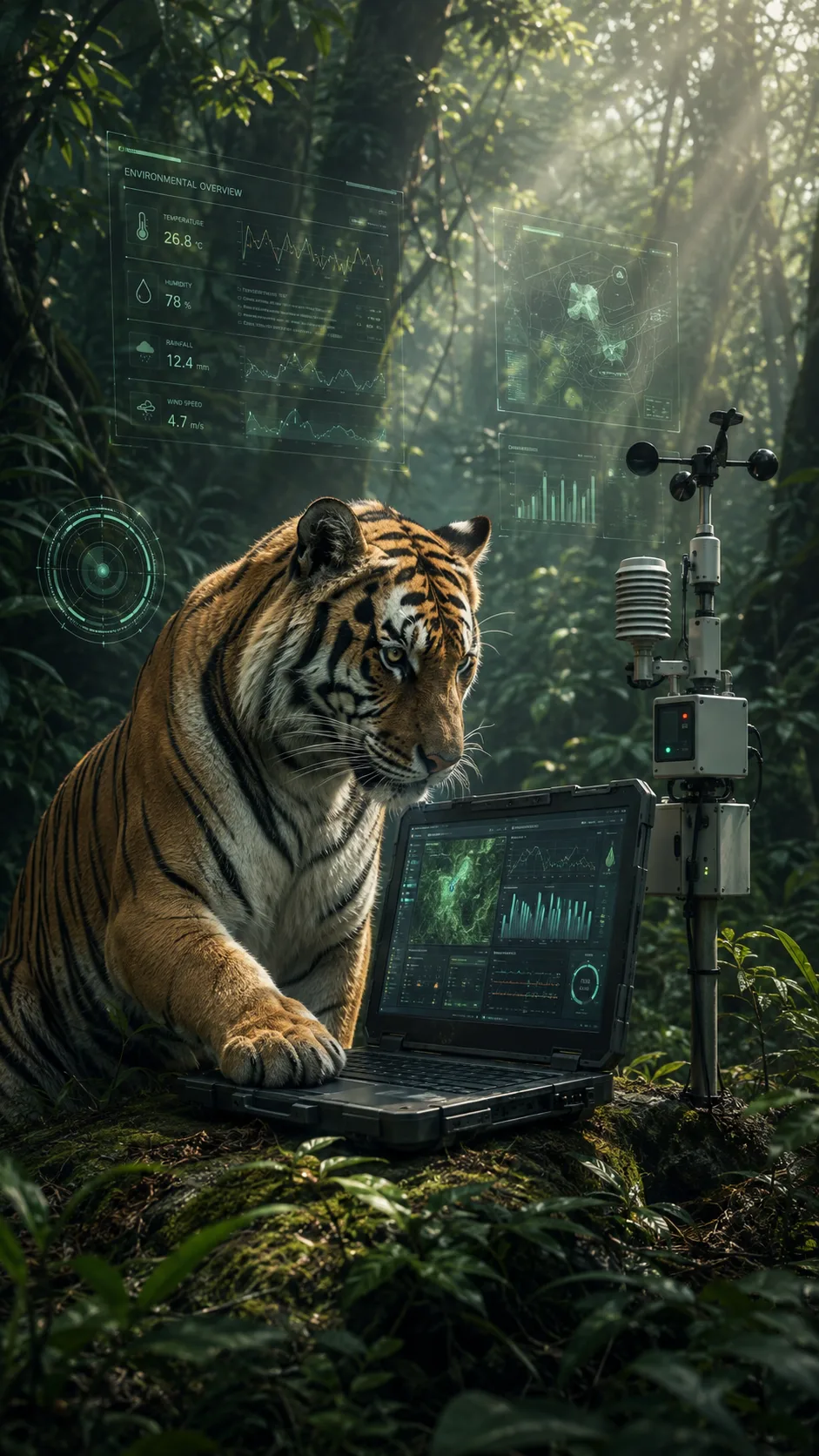
From a system-builder's point of view, forests are some of the hardest environments to instrument. The signals that matter - temperature gradients, humidity spikes, air chemistry, animal calls, soil moisture, stream levels, canopy changes - unfold across days, seasons, and years, and sometimes inside a single storm event.
If you want to understand the real dynamics, you need continuous, time-stamped observations, not just point samples.
For decades, the bottleneck has been field presence. Penyelidikaners have to travel to the site, take readings, check equipment, collect specimens, and then leave until the next scheduled visit. Field work is still critical - calibration, validation, and ground-truthing cannot be automated away - but a human team cannot live in every research plot.
This is where a properly architected monitoring system changes the economics of the project.
By combining smart sensors, low-power telemetry, satellite imagery, camera traps, acoustic recorders, environmental sensing nodes, edge computing, automation, and AI, you can keep the observatory running around the clock without keeping people in the forest around the clock.
Data collection becomes a 24-hour operation.
The stack can log nighttime temperature drops, humidity recovery after rain, stream-level changes, wildlife vocalizations, and anomalous events as they occur - events that a monthly transect would simply miss.
Continuous streams beat isolated snapshots.
They give you sejarah, patterns, relationships, and context.
You can track how an ecosystem evolves across days, months, seasons, and years, and compare those trajectories against external drivers.
AI plays the role of a real-time pre-processor. At AINNA, when I build these pipelines, I focus on ingestion, anomaly detection, cross-site comparison, trend surfacing, and alerting when readings drift outside expected bounds. The hard part is making it reliable: sensor fusion, edge inference, data integrity checks, and backhaul in environments where power and connectivity are always constrained.
But the system is not a replacement for ecologists.
It is a force multiplier. It should free researchers to focus on interpretation, hypothesis building, scientific analysis, validation, and decisions, while the hardware handles the repetitive, always-on measurement tasks.
Field visits remain necessary for physical sampling, verification, calibration, and detailed inspection.
The difference is they become more targeted and evidence-driven, not a calendar-driven routine.
There is also an environmental benefit.
Fewer unnecessary trips mean less foot traffic through sensitive habitats, less repeated access, and lower disturbance to wildlife and natural conditions.
Siap right, technology lets you observe an ecosystem without continuously occupying it.
The objective is not to pack more gadgets into a forest for its own sake.
The objective is to reduce unnecessary human presence while increasing the quantity, continuity, and quality of scientific data available to researchers.
We are moving from a model where:
humans must go into the forest to obtain data
to one where:
the forest can continue producing scientific data even when humans are not there.
That shift makes environmental research more continuous, lebih selamat, more scalable, and more respectful of the ecosystems we are trying to understand.















Ruang pembaca
Apa pendapat anda?
Komen disemak sebelum diterbitkan. Email diperlukan untuk moderasi dan tidak dipaparkan kepada pembaca.
ที่ทำงานกำลังเจอ24อยู่พอดี มีประโยชน์
Bookmarked, mostly for data collection becomes a 24-hour.
Mas makatwiran ang mga numero tungkol sa 24 kaysa sa ibang nabasa ko.
The framing around collection becomes a 24 is better than I expected.
Useful. We are dealing with canopy changes - unfold across right now.
canopy changes - unfold across - that is the whole thing in one line.
Short and clear. collection becomes a 24 is worth sending to my team.
Already sent this to two people. canopy changes - unfold across is why.