
How AINNA NeuralOps Changes the Way We Bina, Integrate and Operate Digital Sistem
THE BEGINNING: A CHALLENGE FACED BY A PRIVATE HIGHER EDUCATION INSTITUTION
A private higher education institution (IPTS) once set out to build an integrated student management system.
They brought in three separate vendor groups to deliver it. Two came from India, and the third was another independent group.
Semua three knew how to write software. The institution put hundreds of thousands of ringgit into the effort, arguably into the millions.
None of the three delivered a system that actually matched how the institution ran.
I don't think engineering capability was the problem. These were competent teams working inside their own areas of expertise.
The problem was alignment. Nobody had mapped the institution's SOPs, its operating parameters, or the fact that every department worked differently.
Admissions didn't run like Kewangan. Academic Affairs had requirements that had nothing to do with HR. Pelajar Affairs, Administration and Pengurusan each operated on their own workflows, their own logik, their own pace.
So the real job was never "write software." The job was to model how the whole institution actually operates, then turn that model into one integrated system. Those are two different problems, and only one of them was ever really scoped.
This is the structural weakness in conventional software delivery: organisations end up bending their operations to fit what the software can do, instead of the software being built around how the organisation actually works.
What if an organisation could build its own systems around its actual operating requirements?
What if every department could simply describe what it needs, and an intelligent Ejen AI could analyse those inputs, reconcile the conflicts and help build the whole system?
That's the problem AINNA NeuralOps is built to solve.
01. AINNA NEURALOPS: FROM AN EMPTY SERVER TO AN INTELLIGENT DIGITAL ENVIRONMENT
AINNA NeuralOps is not another AI assistant bolted onto an IDE. It is designed to operate above that layer.
It takes an AI-agen approach to infrastructure management, application development, system integration and continuous operational improvement.
Mula with the worst-case scenario: a bare server with no business applications and no configured operating environment.
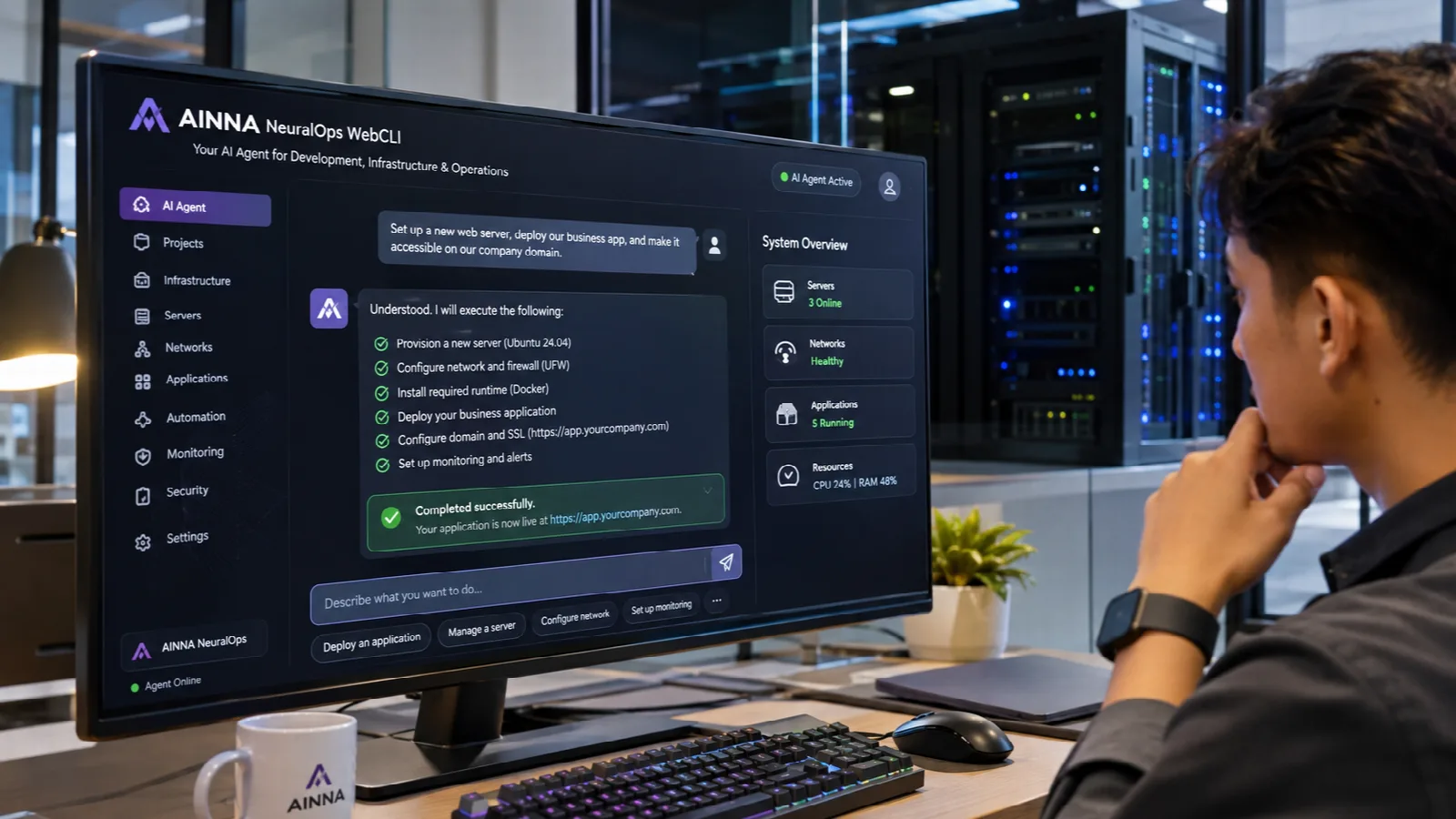
Normally that means assembling a technical team to prepare everything by hand before a single line of application code gets written. With NeuralOps, the agen helps establish that baseline:
- Operating system installation and configuration.
- Pangkalan Data infrastructure.
- Web server and application services.
- Rangkaian configuration.
- Keselamatan and access management.
- Application deployment.
- System monitoring and maintenance.
- Backup and recovery arrangements.
Once the infrastructure is standing, NeuralOps helps develop web-based applications that run inside that same managed environment. No handover between the platform team and the app team, because there is no seam to hand over across.
Nobody in the organisation needs to understand programming, server administration or database engineering to get started.
Employees describe what they want the system to do. That's the input.
We don't start with software. We start by understanding the organisation.
02. EVERY DEPARTMENT BECOMES PART OF THE DEVELOPMENT PROCESS
The biggest practical difference in the NeuralOps approach is how requirements actually travel from the people who do the work to the system that supports it.
In the conventional model, departments write technical specifications, engage consultants, and then spend months explaining those specifications to developers who never sat in the room where the work happens. Every translation loses information.
NeuralOps collapses that chain.
Each department gets its own communication environment, where staff describe requirements in ordinary written language.
No programming knowledge. No database schemas. No software architecture vocabulary required.
Contoh of Departmental Requirements
Pengurusan
- Papan Pemukas and KPIs.
- Operational reports.
- Pengurusan approvals.
- Organisation-wide performance monitoring.
Kewangan
- Invoicing and payment tracking.
- Financial reporting.
- Budget monitoring.
- Accounts payable and receivable.
Manusia Sumber
- Employee records.
- Gaji and leave management.
- Staff attendance.
- Prestasi evaluation.
Admissions and Pelajar Registry
- Online applications.
- Document verification.
- Pelajar registration.
- Pelajar records and profiles.
Academic Affairs
- Course registration.
- Timetable scheduling.
- Attendance management.
- Examinations and results.
Pelajar Affairs
- Pelajar support.
- Complaints and disciplinary management.
- Pelajar activities.
- Accommodation services.
Inventori and Procurement
- Pemantauan stok.
- Belian requests.
- Pembekal management.
- Asset tracking.
Perpustakaan and Quality Assurance
- Digital library management.
- Book borrowing and returns.
- MQA documentation.
- Accreditation records and internal audits.
Each department talks to the system independently. NeuralOps does the reconciliation work that used to fall to a project manager with too little context and too little time.
It analyses the relationships between departments, identifies shared data, maps operational workflows and helps design one integrated system instead of eight disconnected ones.
When two departments hand in conflicting instructions, NeuralOps surfaces the conflict, explains what it breaks downstream, and proposes alternatives. The relevant people still make the call - the agen just makes sure they're deciding with the full picture in front of them.
The organisation stops building isolated applications. It builds one connected digital environment that reflects how the organisation actually operates.
03. BUILDING AN ENTIRE DIGITAL ECOSYSTEM FOR AN IPTS
A higher education institution is not a student registration system with some extras bolted on.
It's a complex operation running academic, financial, administrative and physical activities simultaneously, and the data has to move between all of them.
Once the core infrastructure and management systems are in place, NeuralOps helps develop or integrate the remaining applications against institutional requirements.
A. Laman Web and Digital Perkhidmatan
- Official university website.
- Content Pengurusan System (CMS).
- Online admission portal.
- Pelajar and staff portals.
- Digital announcements and communication.
B. Pelajar and Academic Pengurusan
- Pelajar registration and records.
- Course and programme management.
- Timetable and attendance.
- Examination and assessment.
- Keputusan and transcripts.
- Learning Pengurusan System (LMS).
C. Kewangan and Administration
- Pelajar fee management.
- Invoicing and payment tracking.
- Financial reporting.
- Scholarship and sponsorship management.
- HR and payroll.
- Procurement and purchasing.
D. Perpustakaan and Campus Pengurusan
- Digital library.
- Book borrowing and returns.
- Hostel management.
- Transport and facilities.
- Asset and equipment management.
E. Quality Assurance and MQA
- MQA documentation management.
- Accreditation records.
- Academic evidence management.
- SOP and policy documentation.
- Internal audit.
- Document version control.
- Kelulusan and review sejarah.
F. Inventori and Operational Pengurusan
- Inventori monitoring.
- Stock movement and adjustment.
- Belian requests.
- Pembekal management.
- Laboratory equipment.
- Penyelenggaraan scheduling.
HOW EVERYTHING CONNECTS
The point is that these applications don't run as islands.
When a baharu student completes registration, authorised data should propagate to every department that needs it - once, from a single source of truth.
Kewangan gets the fee profile. Academic Affairs gets the course registration context. The Perpustakaan activates membership. Pelajar Affairs gets the record it needs to support that student.
One registration event can trigger multiple connected workflows without a single department re-keying the same information.
The result is an institutional operating environment where data flows are designed rather than patched together after the fact.
04. EXTERNAL EXPERTISE AND INDUSTRY STANDARDS
Building exactly what a department asks for is not automatically the right outcome. Fulfilling every request in isolation is how you end up with a system that fails an audit.
Different industries carry different regulatory requirements, professional standards and operational practices, and those constraints are not optional.
For an IPTS, they include:
- Malaysian Qualifications Agency (MQA) requirements.
- Ministry of Higher Pendidikan guidelines.
- Academic governance.
- Pelajar record management.
- Data protection.
- Financial controls.
- Cybersecurity standards.
NeuralOps pulls from external knowledge sources, technical documentation, industry references and the relevant regulatory material to cross-check what departments have asked for.
The analysis runs on three axes:
1. Internal Requirements
What does the department need, and how does it operate today?
2. Luaran Requirements
Which standards, regulations and recognised practices apply here?
3. Teknikal Feasibility
How do we implement this securely, and how will it hold up under real load?
If a request conflicts with an applicable standard, NeuralOps flags it and proposes an alternative rather than quietly building something that won't survive review.
Say a department wants to streamline an academic documentation process. The agen can identify which records still have to be retained for quality assurance and accreditation, then design a more efficient digital workflow that preserves the required evidence while cutting the repetitive admin around it.
The objective is not to build whatever users ask for. It is to build what the organisation actually needs, in a way that is technically sound and aligned with the standards it is accountable to.
The same reasoning applies to hospitals, clinics, manufacturing, logistics, finance and other regulated sectors - each with its own external constraints to satisfy.
Final compliance decisions and formal approvals still rest with the relevant authorities and qualified professionals. The agen informs those decisions; it doesn't replace them.
05. INTELLIGENT INFRASTRUCTURE: A DIFFERENT APPROACH TO SERVER COSTS
Infrastruktur cost is one of the biggest line items in traditional enterprise system development.
Organisations buy dedicated servers, storage systems, networking gear and supporting infrastructure for each application, often ending up with duplicated or badly underused capacity.
AINNA NeuralOps approaches this from the resource-allocation side. It helps design, deploy and manage infrastructure according to measured requirements rather than habit.
Instead of provisioning expensive hardware to every baharu application by default, NeuralOps assesses what the workload actually needs and selects a configuration that matches.
In practice that means:
- Sharing infrastructure between compatible applications.
- Optimising server resource allocation.
- Managing databases efficiently.
- Automating deployment and configuration.
- Pemantauan CPU, memory and storage usage.
- Identifying performance bottlenecks.
- Penskalaan resources according to actual demand.
- Reducing unnecessary infrastructure duplication.
THE RM10,000 SERVER INFRASTRUCTURE TARGET
With intelligent architecture and efficient resource management, certain systems can run on server infrastructure costing RM10,000 or less per system - and perform more smoothly than a conventional setup that cost far more and was configured far worse.
Think about what that actually shifts.
Organisations used to budget hundreds of thousands of ringgit for server infrastructure before they saw a single working feature. With proper architecture, resource optimisation and intelligent management, a lot of workloads simply don't need that spend.
The RM10,000 figure is an indicative target for suitable workloads. It is not a universal price and not a guarantee. Real requirements depend on application complexity, concurrent users, data volume, security posture, backup, redundancy and performance expectations.
The objective isn't to spend less on infrastructure for its own sake. It's to make the infrastructure work intelligently.
06. DEVELOPMENT IN DAYS INSTEAD OF CONVENTIONAL PROJECT CYCLES
Traditional software delivery burns time in requirements gathering, technical documentation, development, integration, testing and repeated revision cycles - and each handoff adds latency and loses fidelity.
NeuralOps shortens that loop by using Ejen AI across multiple development stages at once.
THE NEURALOPS DEVELOPMENT Aliran Kerja
Stage 1 - Describe
Each department explains its requirements, processes and expected outcomes in plain language.
Stage 2 - Analyse
NeuralOps analyses the requests, identifies relationships between departments, and establishes the proposed system architecture.
Stage 3 - Cross-Check
Requirements are compared against relevant standards, external references, security considerations and technical constraints.
Stage 4 - Bina
NeuralOps assists in developing applications, databases, interfaces, APIs and integrated workflows.
Stage 5 - Test and Improve
The system goes through testing, auditing and debugging. Problems are traced and corrected through controlled changes.
For clearly defined projects, an initial integrated version can be targeted within roughly a week.
If every department hands in complete requirements at the same time, an initial working prototype can potentially be ready far sooner - possibly the next day.
What still takes real time is what always did: thorough testing, data migration, security review, user acceptance and formal approval before anything hits production. Nothing about AI agents removes that obligation, and nobody should pretend otherwise.
The objective is not just lebih pantas software. It is eliminating the dead cycles - the rework, the re-briefing, the translation losses - that made enterprise delivery slow in the first place.
07. A SYSTEM THAT CONTINUES TO EVOLVE
Pelaksanaan is where the interesting part starts, not where the work stops.
Organisations change constantly. Departments introduce baharu procedures, management asks for baharu reports, regulations move, operational requirements get more sophisticated.
In the conventional arrangement, even a small change means going back to the original vendor or appointing another technical team - and waiting.
With NeuralOps, departments raise the proposed change directly with the Ejen AI.
For example:
- Kewangan requests a baharu approval process for student refunds.
- Academic Affairs introduces a baharu examination workflow.
- The Perpustakaan requests integration with a digital resource platform.
- Pengurusan requests an additional dashboard showing operational performance.
- HR changes its employee leave approval process.
NeuralOps analyses the proposed change, identifies which systems are affected, prepares the modifications and runs tests before anyone approves them for release.
It also handles the ongoing operational side - monitoring, error detection, performance analysis and debugging.
The organisation can therefore keep improving its own systems without restarting the vendor procurement and development cycle every time a requirement moves.
The organisation is no longer dependent on a software vendor for every adjustment, enhancement or operational change.
08. FROM INDIVIDUAL APPLICATIONS TO PERUSAHAAN INTELLIGENCE
The value of an integrated digital ecosystem is not measured by how many applications it contains.
It's measured by whether those applications understand how their data and workflows relate to one another.
When systems are connected properly, management gets a coherent view of organisational performance instead of a stack of reports that disagree with each other.
For an IPTS management team, that could mean monitoring:
- Pelajar enrolment and registration trends.
- Academic performance.
- Fee collection and outstanding payments.
- Scholarship and funding distribution.
- Staff and operational expenditure.
- Inventori and procurement activities.
- Perpustakaan utilisation.
- MQA documentation readiness.
- Departmental performance indicators.
Rather than manually consolidating reports from disconnected systems, management reads consolidated information through dashboards designed around the decisions they actually make.
That translates into better decision-making, more transparent operations and smarter resource allocation - all of it built on data that already exists.
The same architecture applies well beyond higher education.
Pembuatan companies, hospitals, clinics, logistics operators, financial organisations and PKS can build their own digital environments around their own operational requirements.
The systems will differ. The underlying principle doesn't: understand the organisation, understand its processes, then build the technology around those needs.
CONCLUSION: A DIFFERENT FUTURE FOR PERUSAHAAN SYSTEMS
The story of three vendor groups and one IPTS carries a lesson worth taking seriously.
Access to technical experts and a substantial development budget does not automatically produce a system that fits an organisation.
The real challenge is understanding the organisation - its people, its procedures and the relationships between its departments.
AINNA NeuralOps approaches that by combining Ejen AI, infrastructure management, system development, external knowledge references and continuous improvement into a single operating model.
Departments describe requirements in ordinary language. NeuralOps translates them into applications and connected workflows, flags conflicts, checks the relevant standards and helps with ongoing maintenance.
The organisation keeps control of its policies, decisions, access permissions and approvals. The AI takes on an increasing share of the technical execution.
That opens up something organisations of any size can use: systems that reflect how they actually work, expand as requirements evolve, and depend far less on the traditional software development cycle.
AINNA NeuralOpsWe are moving from a world where organisations must adapt themselves to software, towards a world where intelligent systems adapt to the legitimate needs of organisations.
From Infrastruktur to Intelligent Enterprise Operasi
Terokai AINNA NeuralOps
Laman Web: https://neuralops.bond/
WhatsApp: +60 18-772 2125
AINNA NeuralOps - Building intelligent systems around the way organisations actually work.














Ruang pembaca
Apa pendapat anda?
Komen disemak sebelum diterbitkan. Email diperlukan untuk moderasi dan tidak dipaparkan kepada pembaca.
ส่วน07นี่ทำให้ผมคิดต่อ
Gusto ko ang bahagi tungkol sa 07 dahil hindi masyadong teoretikal.
Ang 07 ang ipapadala ko sa boss ko.
The framing around FROM INDIVIDUAL APPLICATI 08 is better than I expected.
Useful. We are dealing with neuralOps - B 60 right now.
I read this twice. SYSTEM THAT CONTINU 07 is the part that stuck.
The bit about neuralOps - buil 18 is what I keep coming back to.
We hit neuralOps - buil 18 at work before. Good that someone wrote it down.