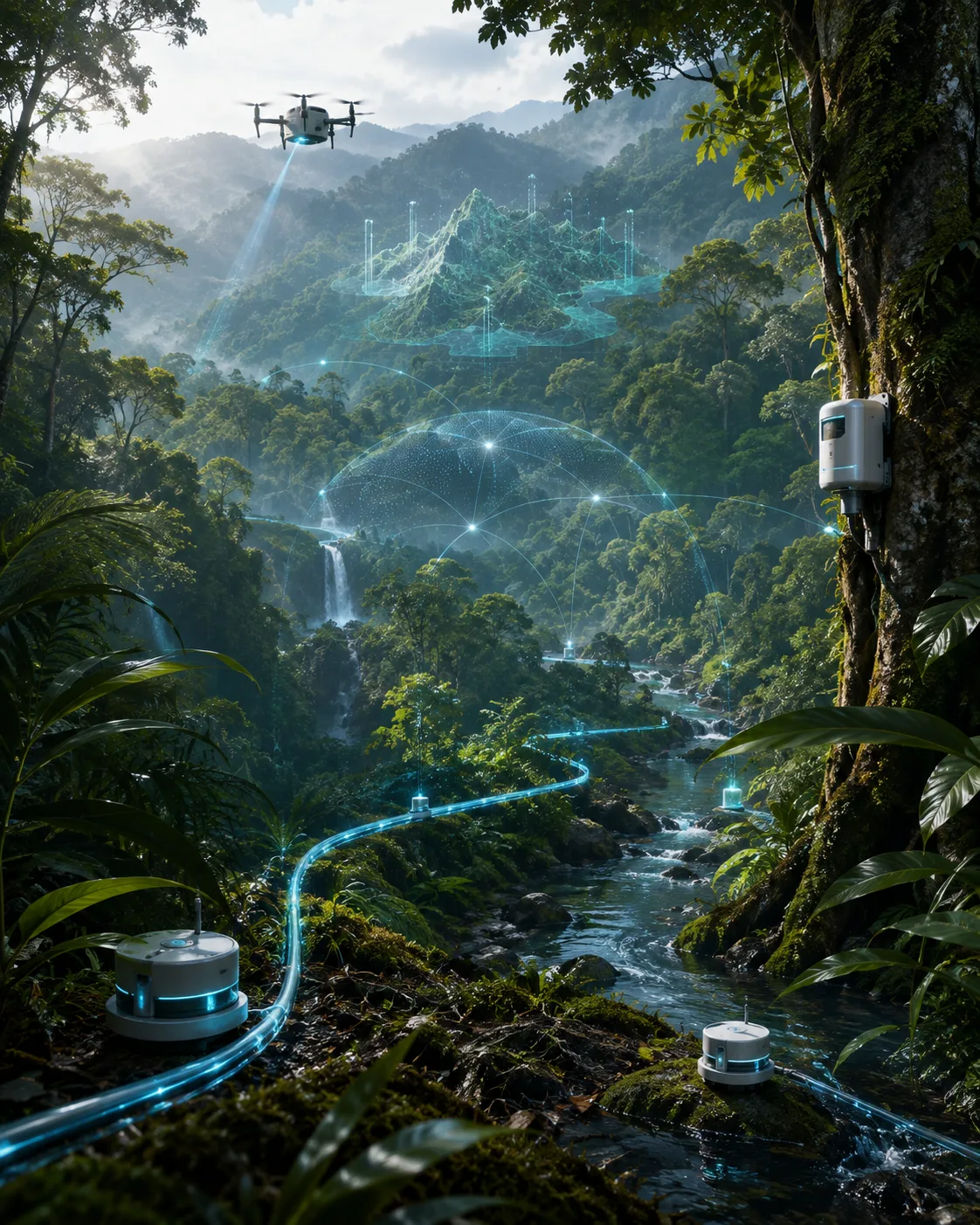
When we design NeuralOps forest observatories at AINNA, the first systems rule is: do not add a node if the existing infrastructure can already carry the measurement. That is why the architecture stays Fibre-First, using fibre optic for distributed sensing through DAS, DTS and DSS. Where the cable already runs, we extract acoustic, temperature and strain data continuously without adding powered devices under the canopy.
But fibre cannot measure everything. Parameters such as soil moisture, water pH, dissolved oxygen, turbidity, water level, leaf wetness and tree inclination still need physical sensors at specific locations. That is where LoRa is used-not as a dense forest array, but as a small, low-power Autonomi Scientific Sensor Pod tailored to the research objective.
Each pod operates on a Sleep → Sense → Validate → Store → Transmit if required → Sleep cycle. Continuous transmission is not required.
Readings are buffered locally, and only summaries, anomalies or priority events are sent. If canopy or terrain interrupts connectivity, the data remains in local storage and is forwarded later, or recovered during retrieval.
Lagi importantly, NeuralOps does not send every reading straight to the LLM. Data passes through deterministic validation, QA/QC and cross-sensor correlation first. AI is used only when reasoning is actually necessary.
For example, if rainfall increases, soil moisture shifts, a watershed pod detects movement, and DTS shows a change in thermal profile, NeuralOps can fuse these into a single, more meaningful scientific event for researchers.
Our approach:
Fibre = continuous distributed sensing
LoRa pods = specialised point sensing
UAV/LiDAR = spatial observation
Temporal Digital Twin = changes over time
NeuralOps = intelligence and cross-sensor correlation
For me, technology sustainability is not just about lebih kecil batteries or lebih murah devices. It is also about deploying only when necessary, retrieving after the study, calibrating, reusing and redeploying. We should not fill the forest with electronics simply because the technology is available.
AINNA's goal with NeuralOps is not to build a "smart forest" loaded with infrastructure. The goal is a low-impact research observatory that delivers more forest knowledge with fewer people, less manpower, less permanent infrastructure and a lebih kecil technology footprint.
We should not damage forests in the name of studying how to protect them.
#NeuralOps #AINNA #LoRa #IoT #Forestry #ConservationTech #PersekitaranPemantauan #AI #Kelestarian #ESG #DigitalTwin #PenyelidikanInovasi
Official Cross-Rangkaian Resource














Ruang pembaca
Apa pendapat anda?
Komen disemak sebelum diterbitkan. Email diperlukan untuk moderasi dan tidak dipaparkan kepada pembaca.
Bahagian how can we increase forest tu yang paling kena dengan saya.
anomalies or priority events is what I would forward to my boss.
Short and clear. QA/QC and cross-sensor correlation first is worth sending to my team.