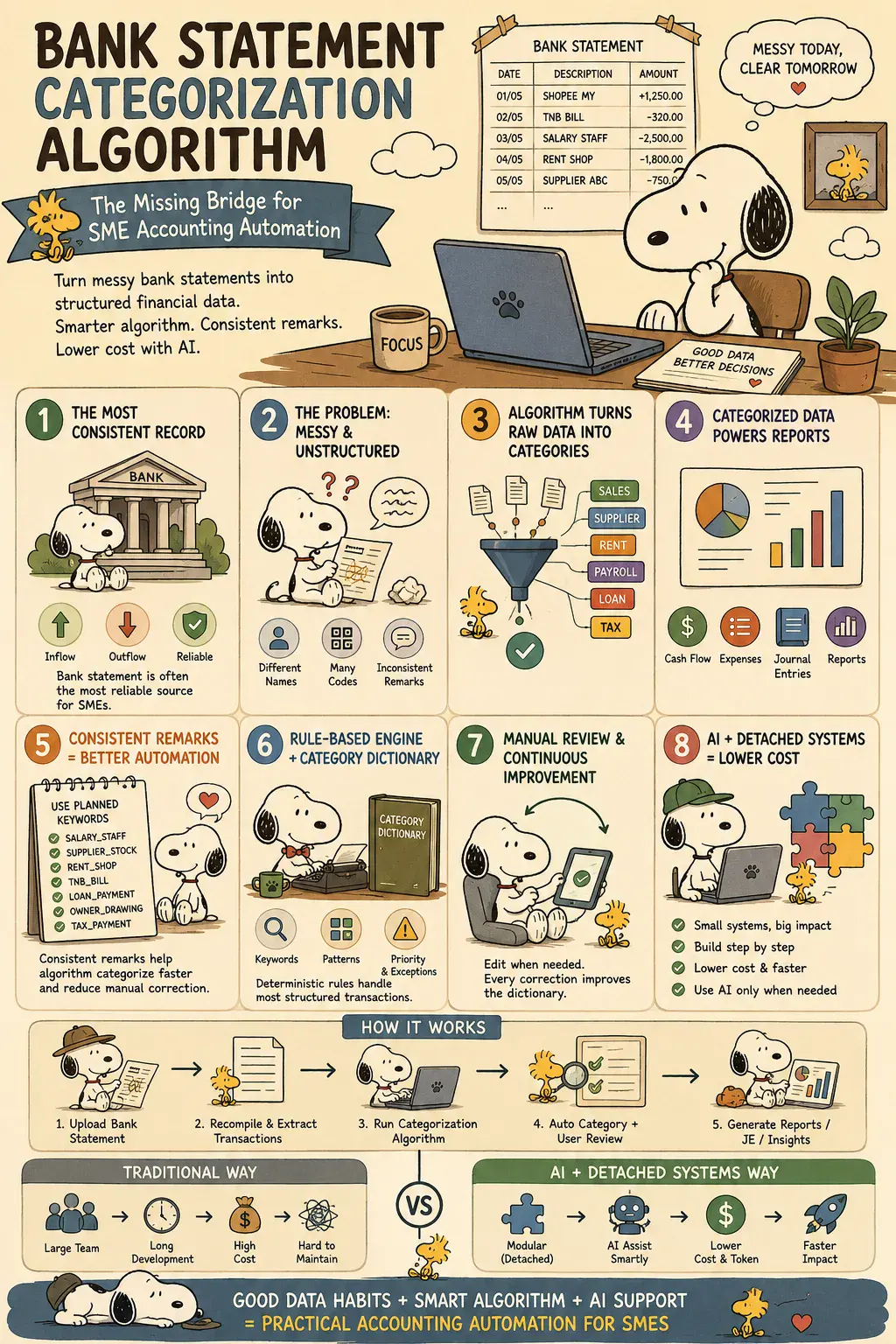
From an accounting operations standpoint, the bank statement is often the single source of truth untuk PKS Malaysia. Jualan ledgers may be informal, invoices may not always be issued, and bookkeeping updates can fall behind day-to-day trading. Yet every cash movement-whether revenue, supplier payment, or owner withdrawal-still leaves a trace in the bank account.
This makes bank statement automation a high-impact starting point for PKS accounting transformation. The challenge is not the lack of data. It is the lack of structure. Transaction descriptions blend merchant names, reference numbers, payment gateway codes, QR references, bank identifiers, inter-account transfers, and inconsistent user remarks. Standard accounting workflows struggle to turn this into reliable ledger entries.
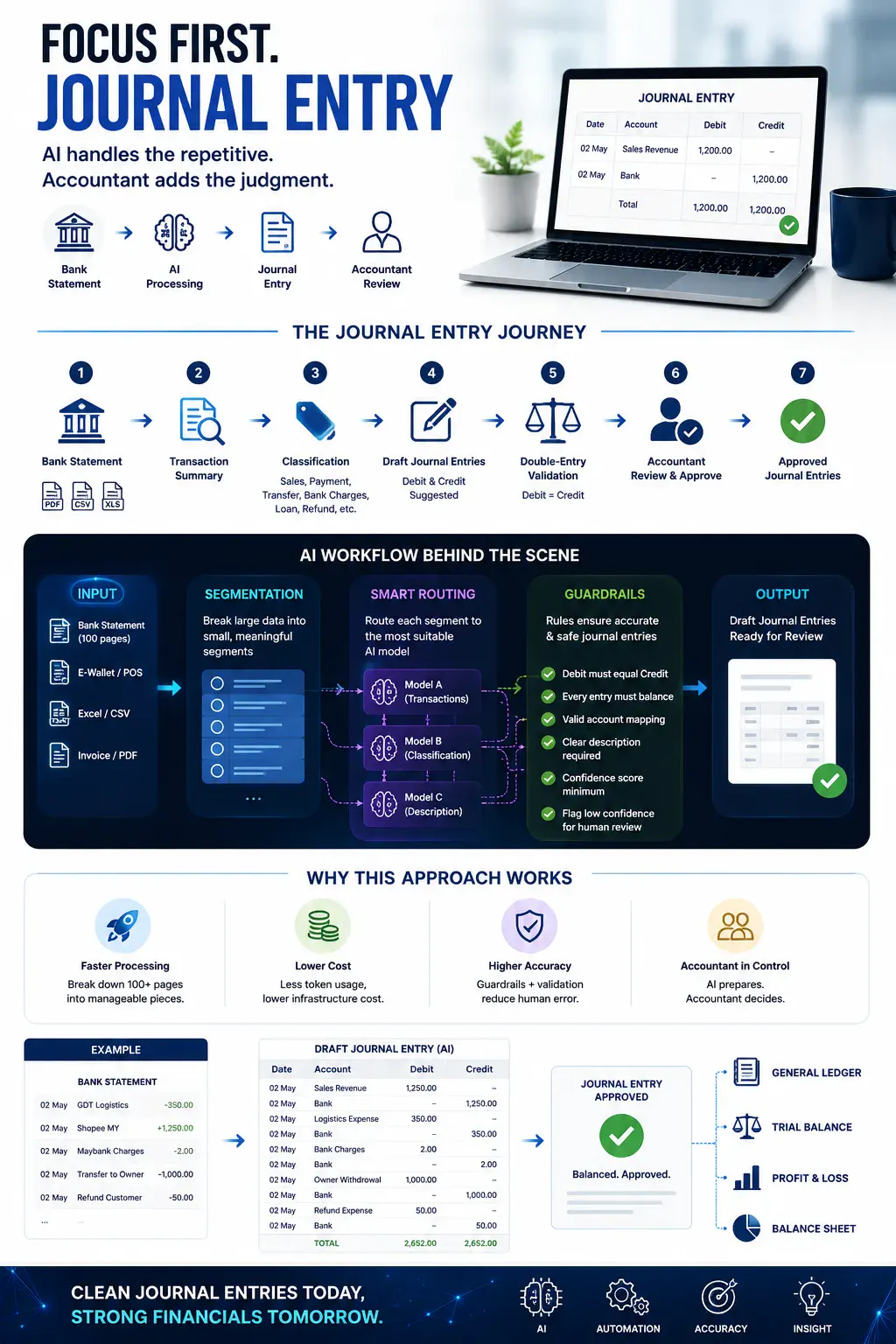
A structured Bank Statement Categorization Algorithm solves this by mapping each transaction to predefined accounts: sales revenue, supplier payments, rental expenses, payroll, utilities, loan repayments, tax remittances, owner drawings, marketplace settlements, refunds, and bank charges. Once classified, the same dataset supports cash position summaries, expense analysis, draft journal entries, and management reports.
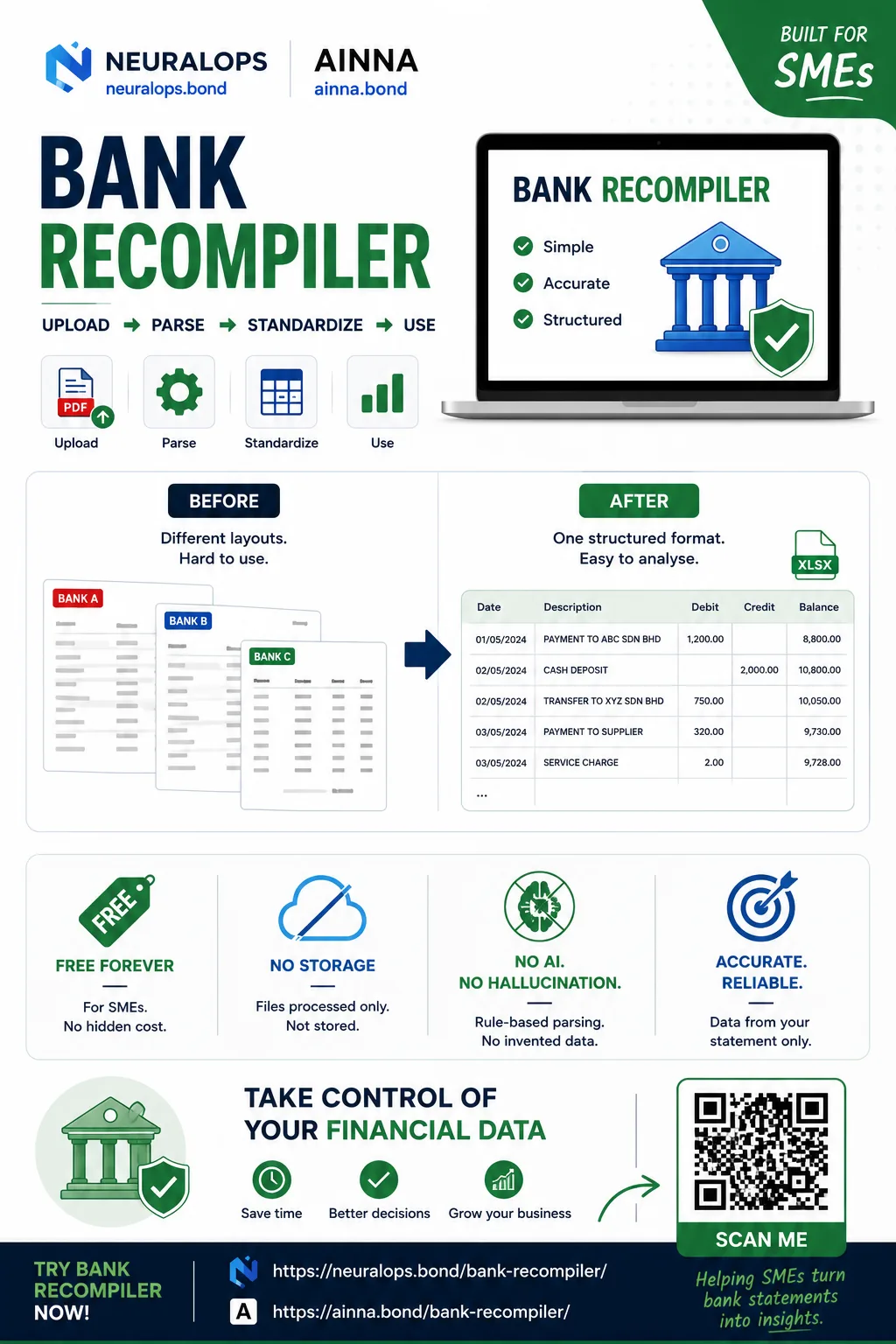
A bank statement should not stop at being a monthly PDF for filing. It should become a structured feed into the general ledger.
Automasi, however, only works when transaction behavior supports it. PKS can reduce reconciliation time by adopting consistent transaction remarks. Rather than vague descriptions such as “payment,” “transfer,” or “settle,” businesses should standardise on meaningful keywords such as SALARY_STAFF, SUPPLIER_STOCK, RENT_SHOP, TNB_BILL, LOAN_PAYMENT, OWNER_DRAWING, and TAX_PAYMENT.
This discipline directly affects the quality of financial reporting. Consistent remarks improve categorisation accuracy, reduce manual adjustment entries, and shorten the month-end close. Clean outputs require clean inputs.
The right architecture is hybrid, not purely AI-driven. A deterministic rule-based engine with a Category Dictionary should handle high-volume, repetitive transactions, while AI is reserved for exceptions where the description is ambiguous or incomplete. This approach gives finance teams a clear audit trail and controlled automation.
Modern AI has also made modular financial systems more accessible to PKS. Instead of replacing an entire accounting platform, businesses can implement focused components: a statement reader, a categorisation module, a ringkasan generator, and a journal entry preparer. That is how AINNA helps bridge the gap between informal PKS record-keeping and disciplined accounting automation-one controlled financial workflow at a time.














Ruang pembaca
Apa pendapat anda?
Komen disemak sebelum diterbitkan. Email diperlukan untuk moderasi dan tidak dipaparkan kepada pembaca.
Kalau ada lanjutan tentang once classified, saya pasti baca.
Terus terang, once classified menarik juga.
Useful. We are dealing with yet every cash movement-whether revenue right now.
First piece I have read that treats transaction descriptions blend merchant names honestly.
This is where PKS can reduce reconciliation time finally makes sense.
Once classified is the part I would forward to my boss.