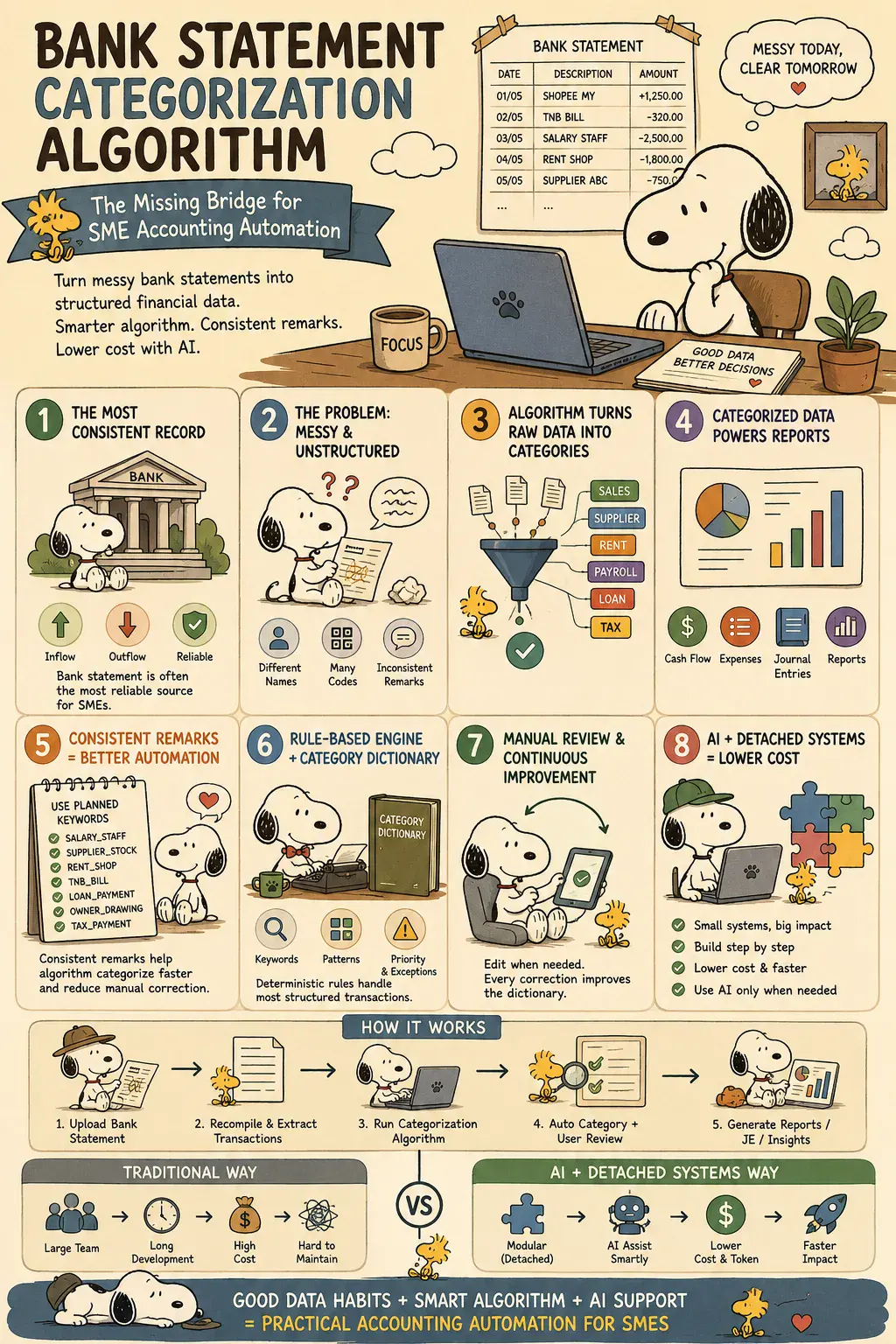
At AINNA, most of the PKS environments we deploy into have one thing in common: the bank statement is the only ledger that actually stays current. Jualan records are patchy, invoices never make it into the system, and accounting software is often weeks or months behind. But every cash movement still hits the bank feed.
That makes the bank statement the natural entry point for accounting automation. The catch is the format. PDFs, CSV exports, and transaction descriptions mix merchant names, gateway codes, QR tokens, truncated references, and free-text user remarks. Before any accounting logik runs, the data has to be parsed, normalized, and made machine-readable.
This is where the Bank Statement Categorization Algorithm comes in. I treat it as a classification pipeline that maps each transaction into a fixed chart of accounts: sales, supplier payments, rent, payroll, utilities, loan repayment, tax payment, owner drawing, marketplace settlement, refund, bank charges, and so on. The goal is not perfect AI; it is consistent, auditable categorization.
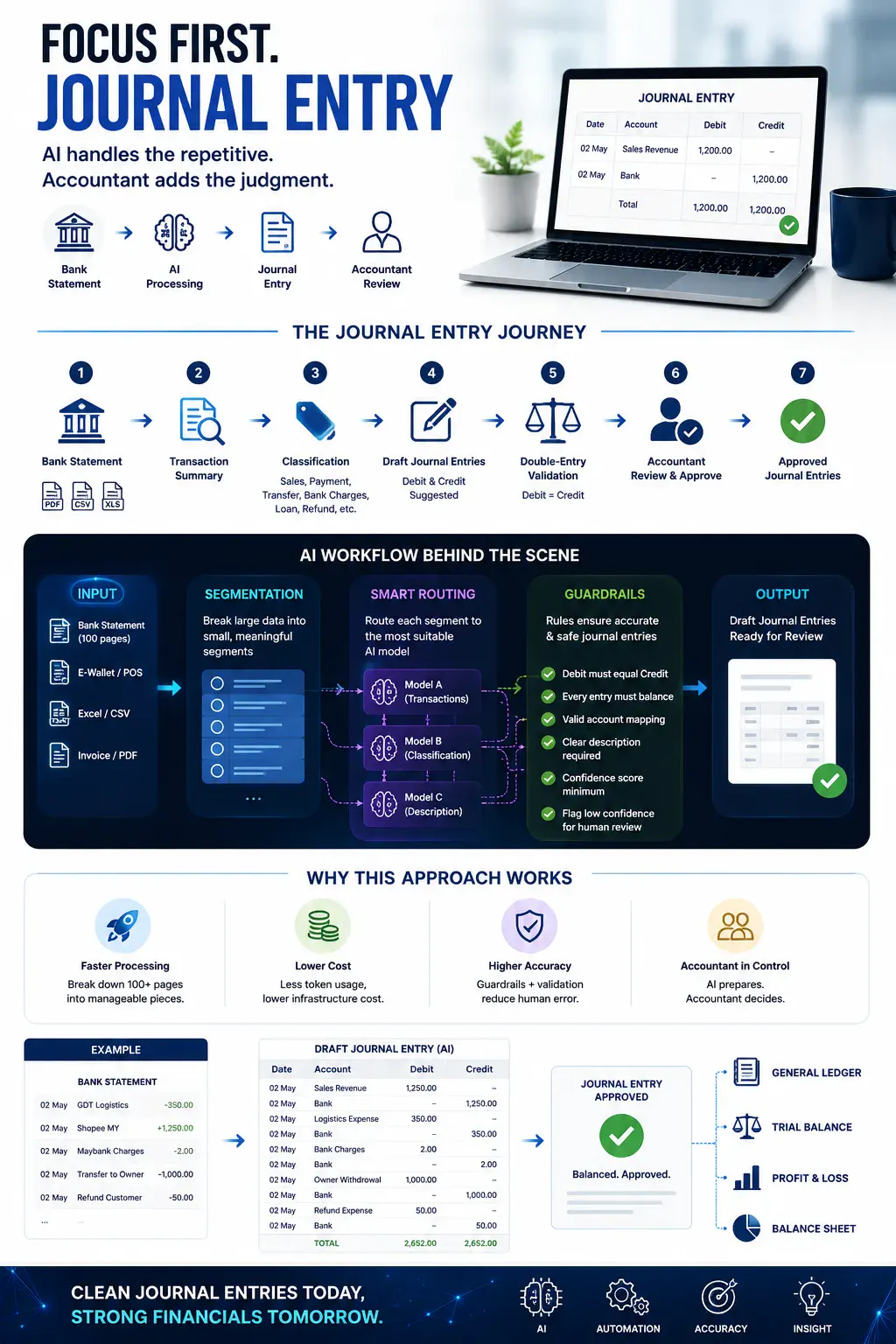
Once classified, the same stream can feed a cash ringkasan engine, an expense report generator, and a draft journal-entry module. A bank statement should not end its life as a monthly PDF. It should enter the system as structured financial data and propagate downstream like any other production dataset.
But automation is not a substitute for discipline. PKS have to meet the system halfway by using consistent transaction remarks. Instead of vague labels like “payment”, “transfer”, or “settle”, the team should adopt controlled keywords such as SALARY_STAFF, SUPPLIER_STOCK, RENT_SHOP, TNB_BILL, LOAN_PAYMENT, OWNER_DRAWING, and TAX_PAYMENT. The input schema matters as much as the classifier.
That one habit changes the entire error curve. Clean remarks push most transactions into a deterministic path, reduce manual correction queues, and make generated reports trustworthy. In the field, good data hygiene almost always beats a bigger model.
My recommended architecture is a deterministic rule-based engine backed by a Category Dictionary, with AI sitting behind it as a fallback. Rules handle the structured, high-volume patterns. An LLM or classifier is invoked only when a description is genuinely ambiguous or unseen, and its output is surfaced for human review before it writes to the ledger.
This modular approach is also easier to ship. With modern AI tooling, the cost of building small, loosely coupled modules has dropped: one service to ingest and parse statements, one to categorize, one to summarize cash position, and one to prepare draft journal entries. String them together with clean APIs and you have a maintainable bridge from messy PKS records to working accounting automation.














Ruang pembaca
Apa pendapat anda?
Komen baharu dihantar untuk semakan terlebih dahulu. Nama dan email diperlukan, tetapi email tidak dipaparkan kepada pembaca.
Not convinced on clean remarks push most transactions yet, but fair argument.
bank charges tu bahagian yang saya nak hantar pada boss.
Ringkas dan jelas. bank charges boleh kongsi dengan team saya.
先存起来,主要是为了这个主题。
Worth reading for sales, supplier payments, rent, payroll alone.
I would push back slightly on gateway codes, QR tokens, truncated, but the direction is right.
Useful. We are dealing with auditable categorization right now. Worth reading twice.
First piece that handles reduce manual correction queues honestly.
Honestly good data hygiene almost caught me off guard.
The framing around once classified is better than I expected. Have a few questions left here.
I read this twice. owner drawing, marketplace settlement, refund is the part that stuck.
Jualan records are patchy, invoices - that is the whole thing in one line.
อธิบายหัวข้อนี้ได้เข้าใจง่ายมาก
Sent this to two people already. LOAN_PAYMENT, OWNER_DRAWING, and TAX_PAYMENT is why. Worth a closer look.
Whoever wrote this actually did the work on normalized, and made machine-readable.
Still thinking about bank charges.