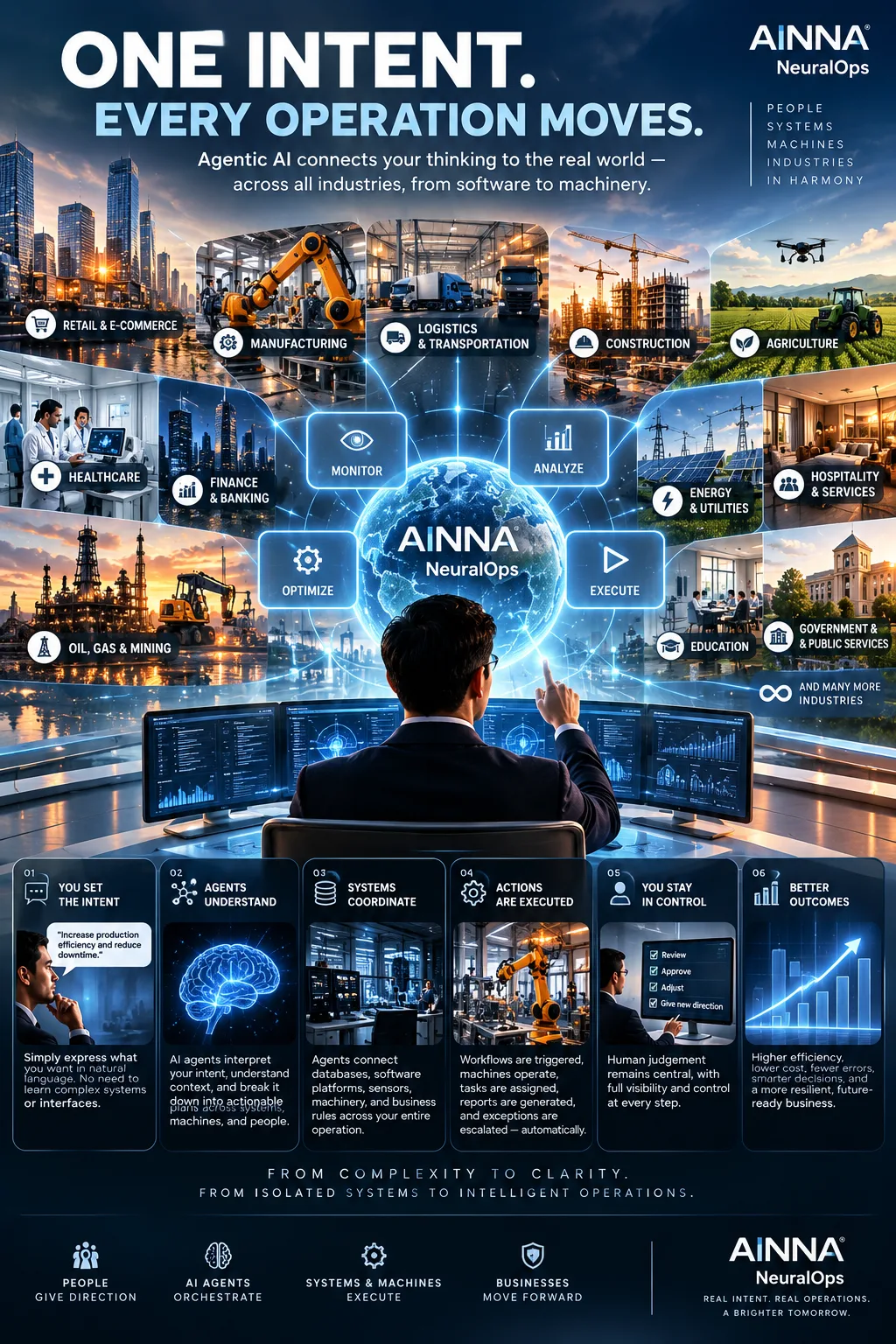
The next major shift I see coming in the stack isn't another app, another dashboard, or even another generation of smarter software. It's the line between human intent and machine execution dissolving. On the systems side, that isn't a slogan - it's an architectural change. AI Ejenik is what I'd call the operational layer: the piece that connects people directly to the software, equipment, and machinery already running around them.
For decades, we designed it the other way around. Humans were the flexible layer, so people adapted to the machines. Operators memorise control panels. Kewangan teams learn accounting systems. Logistik teams learn warehouse software. Farmers learn equipment interfaces. Engineers learn industrial systems. Managers hop between dozens of applications just to keep operations moving. The next era flips that model - the technology starts adapting to how people think, communicate, decide, and work.
A manager should be able to state an outcome and step away from the interfaces: increase production efficiency, reduce downtime, monitor energy consumption, detect abnormal machine behaviour, schedule maintenance, rebalance inventory, prepare financial reports, optimise delivery routes, escalate an operational risk. The agen layer takes it from there, coordinating software, databases, sensors, APIs, industrial equipment, automation systems, and business rules behind the scenes.
That's the point where AI Ejenik stops being a chatbot and starts being infrastructure. It becomes an orchestration layer spanning whole industries - manufacturing, agriculture, logistics, retail, construction, energy, finance, healthcare, hospitality, transportation, and services. Machinery is no longer an isolated asset. Data no longer sits trapped in disconnected systems. Each component becomes part of one coordinated operational environment pointed at the same objective.
The principle isn't to replace human judgement. It's to strip out the unnecessary complexity sitting between a decision and its execution. I split the work by what each layer is actually good at: AI handles interpretation and coordination. Automasi handles repetition. Deterministic systems handle consistency. Machines execute physical tasks. Humans stay on direction, boundaries, approvals, and strategic decisions.
At AINNA, this is the future we're building toward with AI Ejenik and NeuralOps: moving from organisations that run separate software and separate machinery, toward environments where digital systems and physical machines respond coherently to human intent. What looks advanced today will soon be standard infrastructure - a world where the technology around us operates more like an extension of how we think, decide, and lead.















Ruang pembaca
Apa pendapat anda?
Komen disemak sebelum diterbitkan. Email diperlukan untuk moderasi dan tidak dipaparkan kepada pembaca.
อธิบายคำอธิบายนี้ได้เข้าใจง่ายมาก
Worth reading for it's an architectural change alone.
Good to finally see kewangan teams learn accounting systems set out this clearly.
Pinag-iisipan ko pa ang bahaging ito.
Honestly, engineers learn industrial systems surprised me.
Still thinking about it's the line between human.