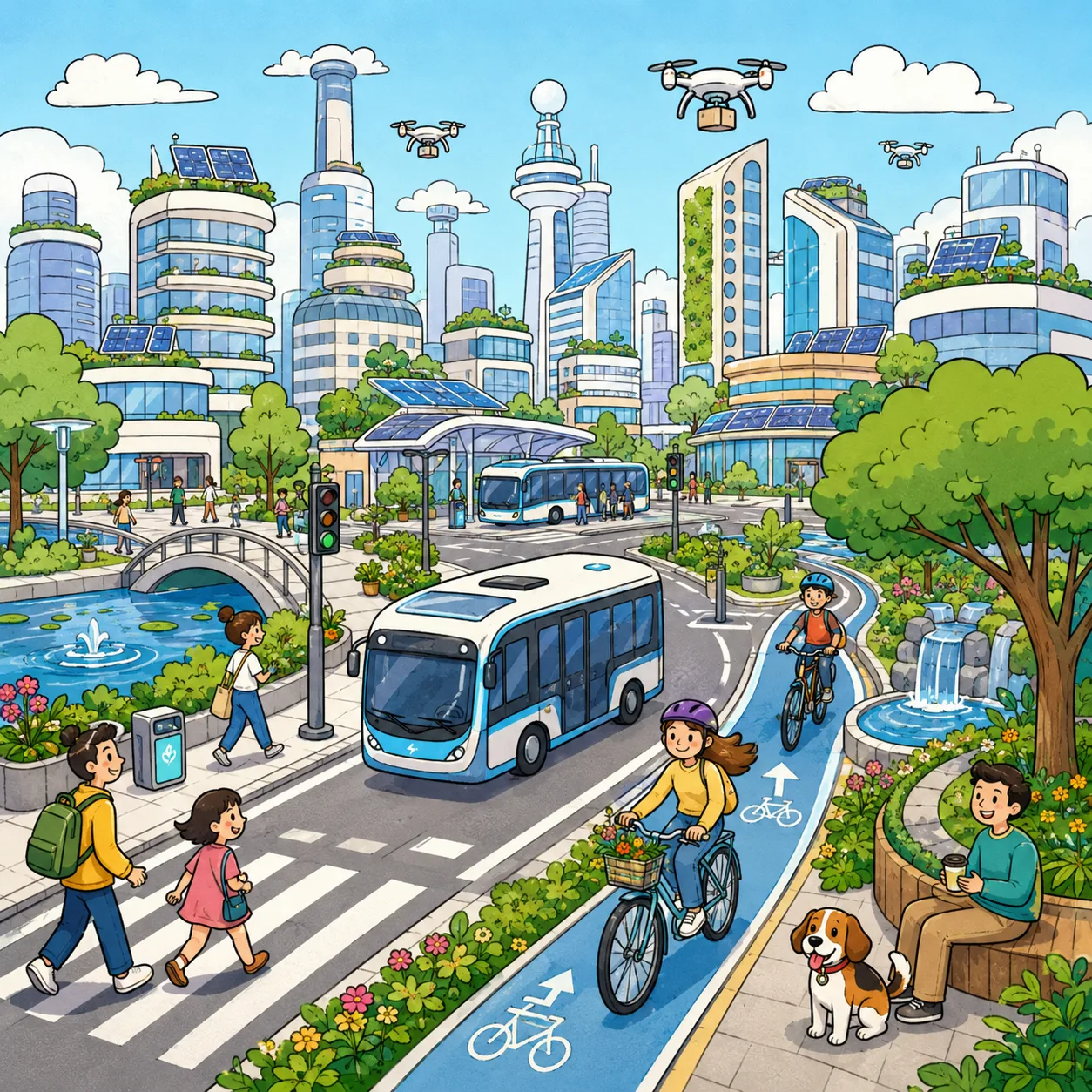
SMART CITY: DIRECT AI VS NEURALOPS
A city of 1 million people can push out roughly 8.3 million tonnes of CO₂e every year. That is the scale we are optimizing against.
If we run traffic, energy, water, waste, buildings, and infrastructure through smarter orchestration, a 6% efficiency gain avoids roughly:
498,000 tonnes of CO₂e per yearThat is roughly equivalent to shutting down:
46 days of output from an average coal-fired power plantThe real engineering question is not whether a city has AI.
It is how efficiently that AI is actually invoked.
Direct AI approach
In a direct AI stack, every request-status checks, threshold alerts, simple calculations, routine workflows-gets routed to a large model.
In production that means:
❌ Higher token burn
❌ Longer GPU occupancy
❌ Higher electricity draw
❌ Higher data-centre and cooling load
❌ A larger AI carbon footprint
NeuralOps approach
NeuralOps is built around:
✅ Smart Routing
✅ Sistem Berasingan
✅ Model Segmentation
✅ Specialised Ejen AI
✅ Deterministic Validation
✅ Model kecils for simple tasks
✅ Large models only for complex decisions
Inside AINNA’s own deployed operations, we reduced estimated inference workload from approximately 32 billion tokens to 2–3 billion tokens.
That is a 90.6%–93.8% drop in computational workload at the inference layer.
That does not translate to emissions falling one-for-one, but it directly cuts inference demand, GPU hours, electricity use, cooling load, and infrastructure cost.
As the IPCC notes:
“An increasing share of emissions can be attributed to urban areas.”
We should not score a Smart City by model count or GPU footprint.
We should score it by how much waste, cost, energy use, and carbon it removes from live operasi.
Direct AI asks:
Which model should answer this?
NeuralOps asks:
Does this task need AI at all?
If it does:
What is the smallest, most efficient model that can complete it accurately?
Less computation.
Better decisions.
Lower operating costs.
Lower emissions.
#NeuralOps #AINNA #SmartCity #GreenAI #SmartRouting #DetachedSystems #AgenticAI #CarbonReduction #ESG #EnergyKecekapan















Ruang pembaca
Apa pendapat anda?
Komen disemak sebelum diterbitkan. Email diperlukan untuk moderasi dan tidak dipaparkan kepada pembaca.
Terus terang, 1 menarik juga.
ยังคิดเรื่อง1อยู่
Clearer than the vendor decks I get about a city of 1 million.
The direction on 46 days of output is exactly right.
Honestly, to 2–3 billion 32 billion surprised me.
1 هو الجزء الذي سأرسله لمديري.
Direct AI approach is the part I would forward to my boss.
Worth reading for to 2–3 billion 32 billion alone.