
Responsible AI Adoption: Cutting Corporate Carbon at the Lapisan Inferens
AI workloads are now part of standard operations in most enterprises. From a systems-integration standpoint, the carbon footprint is not driven by whether you use AI, but by how requests are routed, batched, and executed.
Take a typical mid-size company with 1,000 employees running AI-assisted tasks every working day. The aggregate inference load adds up fast.
Reference workload:
- 1,000 employees
- 20 AI interactions per employee per day
- 22 working days per month
That gives: 1,000 × 20 × 22 = 440,000 AI requests/bulan
If every one of those calls hits a top-tier LLM without optimisation, the ops stack feels it directly:
- Spiked GPU utilisation
- Higher energy draw per request
- Lagi cooling, networking, and redundant capacity
Estimated footprint:
≈352 kg CO₂e/bulan
≈4.2 tonnes CO₂e/year
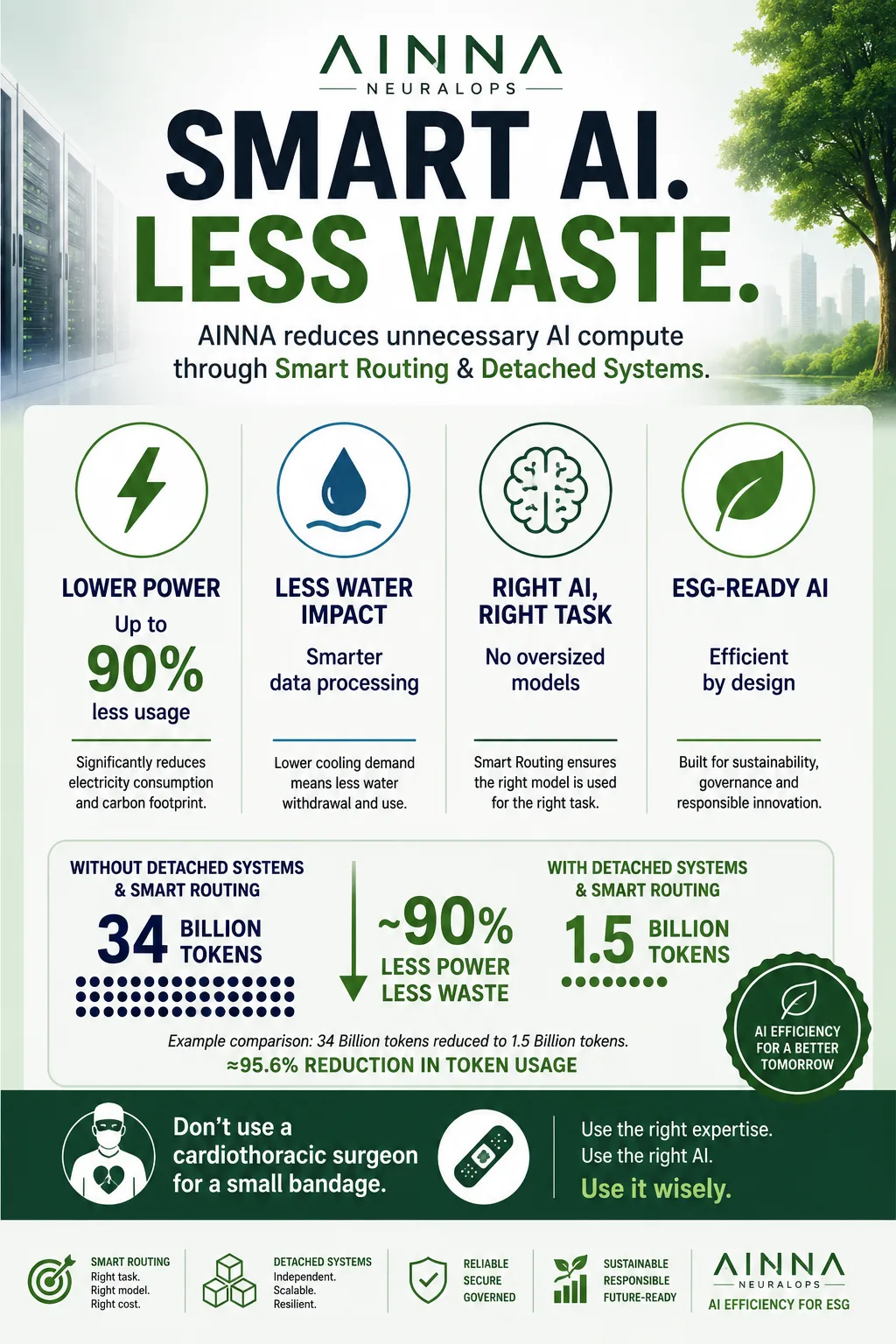
With a structured AI architecture like NeuralOps by AINNA, the same workload can be tuned by the system rather than brute-forced by the largest model:
✅ Smart Routing
Route each request to the smallest model that can still deliver acceptable quality, instead of defaulting to the flagship LLM.
✅ Specialised Ejen AI
Deploy function-specific agents that solve narrow problems with lebih kecil, fine-tuned models or deterministic handlers.
✅ Sistem Berasingan Seni Bina
Layer validation, rule engines, and deterministic logik around the model so AI only runs when it is actually needed.
✅ Compute & Token Optimisation
Shorten prompts, deduplicate context, and trim generated output so inference cost and energy drop without cutting productivity.
With a 70% reduction in wasted compute:
Estimated footprint:
≈106 kg CO₂e/bulan
≈1.3 tonnes CO₂e/year
Real-world saving for a 1,000-employee deployment: ≈2.9 tonnes CO₂e/year
The point is not to dial back on intelligence.
The point is to stop paying a premium in carbon for inference that could have been served by a lighter path.
A well-architected AI system gives you:
- Lower energy consumption
- Lower operational cost
- Higher AI throughput per watt
- Smaller carbon footprint
Efficient Infrastruktur AI is AI Mampan Infrastruktur.
#ArtificialIntelligence #GreenAI #ESG #MampanTeknologi #CarbonFootprint #AIInfrastruktur #NeuralOps #AINNA #DigitalTransformation #ResponsibleAI















Ruang pembaca
Apa pendapat anda?
Komen disemak sebelum diterbitkan. Email diperlukan untuk moderasi dan tidak dipaparkan kepada pembaca.
22の部分はまだ考え中です。
Clearer than the vendor decks I get about 70% reduction in 70%.
Worth reading just for employee per day 22.
The figures on kg CO₂e/bulan ≈1 106 k make more sense than most posts.
Bookmarked, mainly for 20 × 2 22.