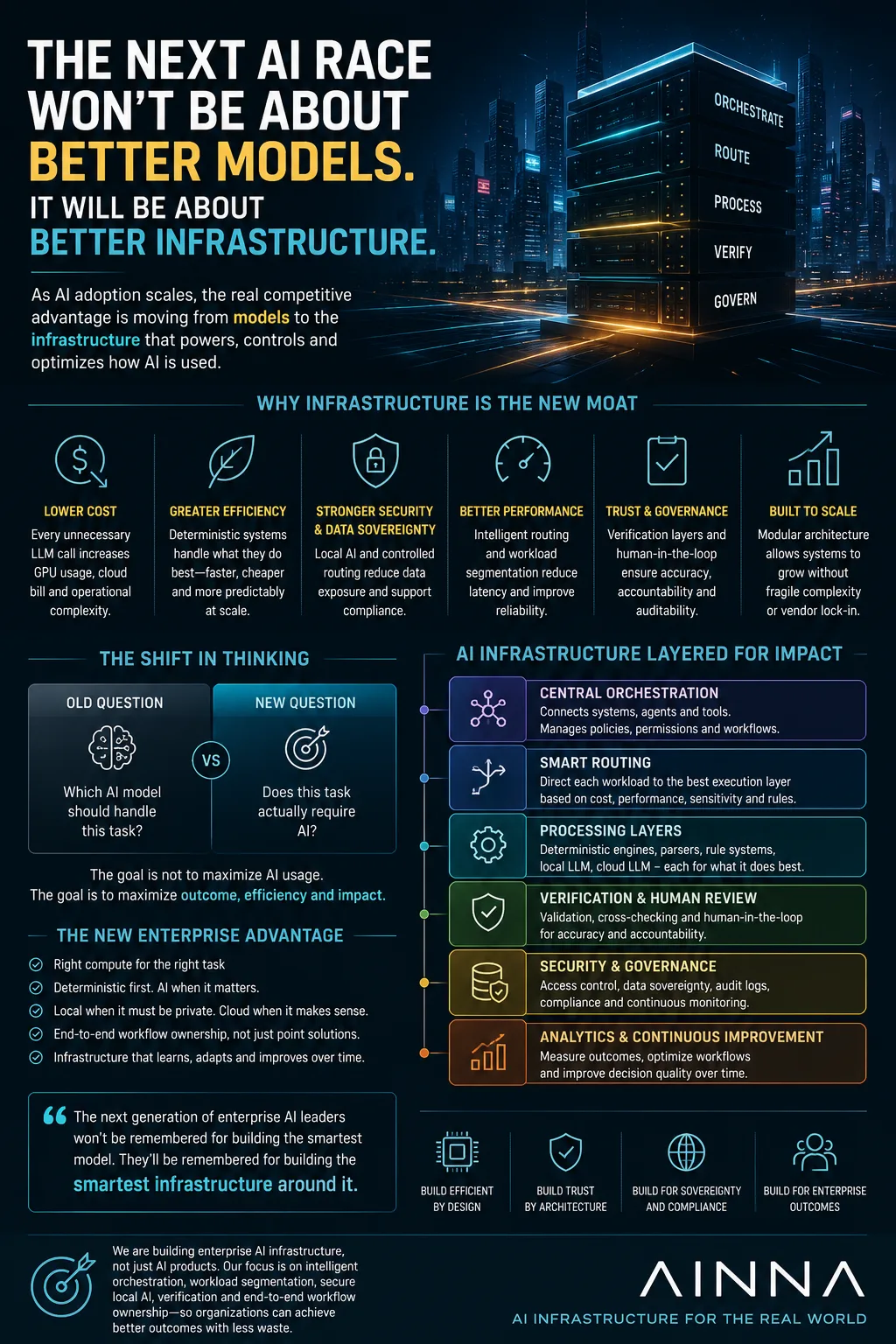
For many Malaysian PKS, the AI conversation has been dominated by model performance and feature expansion. But as finance and operations leaders move from pilots to production, the real challenge is no longer the intelligence layer itself. It is how AI workloads are orchestrated, governed and absorbed into the organisation's cost base.
Every unnecessary AI call adds to GPU consumption, cloud spend, energy costs and processing delay. Many business processes-data parsing, validation, routing, calculations and structured rules-are deterministic. They do not require probabilistic reasoning, and running them through a large language model inflates operating costs without improving accuracy.
This reframes the procurement and architecture decision: instead of asking "Which AI model should handle this task?", finance and operations should first ask "Does this task actually require AI?" The answer materially affects opex, capex, scalability, auditability and risk exposure.
In my view, enterprise AI is entering a value-optimisation phase. Success will depend less on using the most powerful model and more on designing the right execution architecture. Deterministic systems, intelligent routing, local AI infrastructure, verification layers and cloud AI each carry different cost profiles and risk characteristics. The firms that gain advantage will be those that combine them efficiently, not those that route every request through an LLM.
This architectural approach also strengthens data sovereignty, governance and auditability. It reduces recurring infrastructure spend and produces systems that are easier to depreciate, maintain and scale. In many cases, using less AI-but using it where it genuinely changes the economics-delivers better operational outcomes than maximising AI usage indiscriminately.
At AINNA, this thinking shapes how we build solutions untuk PKS Malaysia. Rather than maximising AI features, we are investing in orchestration that segments workloads, separates deterministic processing from probabilistic reasoning, routes each task to the most cost-effective execution layer, and supports secure local AI alongside cloud services. The objective is not to increase AI consumption, but to improve return on technology spend and protect margins.
The next generation of enterprise AI value may not come from the most capable model. It may come from the most efficient infrastructure around it. Over a multi-year jumlah cost of ownership horizon, infrastructure discipline-not raw model performance-is likely to become the real source of competitive advantage.















Ruang pembaca
Apa pendapat anda?
Komen disemak sebelum diterbitkan. Email diperlukan untuk moderasi dan tidak dipaparkan kepada pembaca.
Orang yang tulis ni memang buat kerja rumah pasal governed and absorbed into.
还在消化这个主题这一段。
This is where maintain and scale finally makes sense.
separates deterministic processing is the part I would forward to my boss.
Useful. We are dealing with value-optimisation right now.
Clearer than the decks I usually get on every unnecessary AI call adds.
Already sent this to two people. finance and operations should first is why.
Penjelasan tentang governed and absorbed into mudah dipahami dan relevan untuk tim kecil.