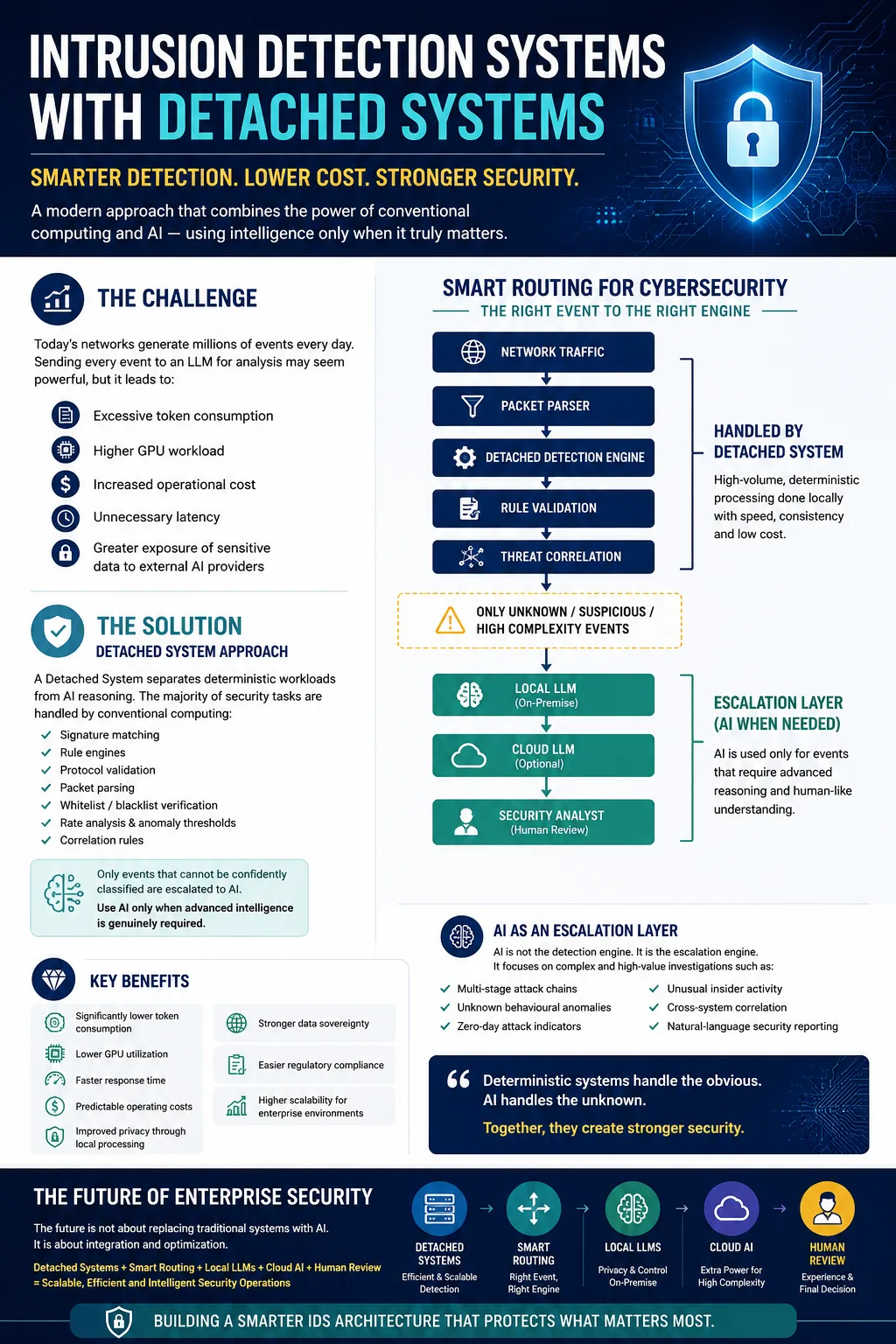
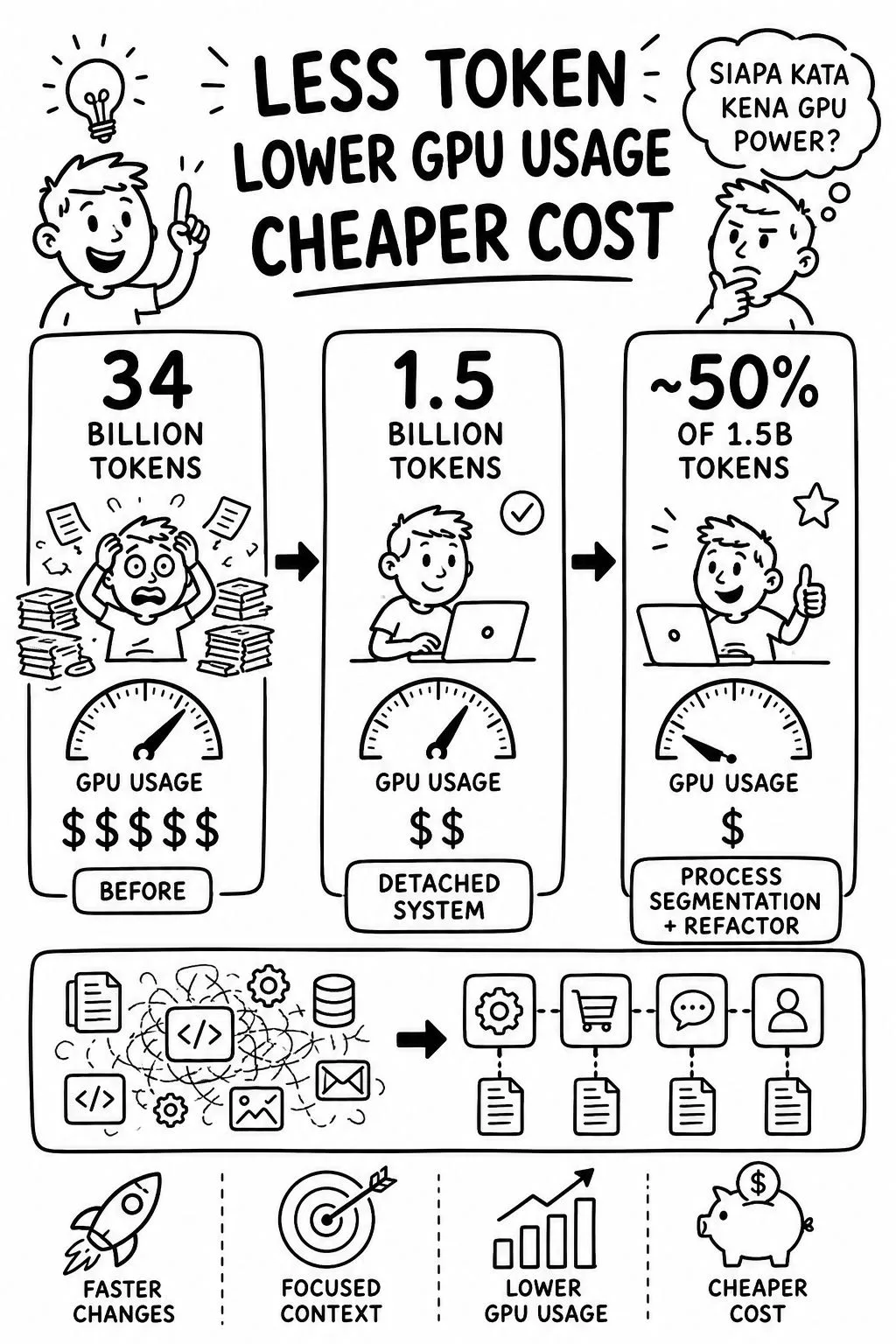
From a financial operations standpoint, traditional Intrusion Detection Sistem, or IDS, are facing an unmanageable escalation in processing cost as enterprise network activity grows. Every packet, login attempt, API request, DNS query and application event represents a potential line-item expense when routed through an AI inference pipeline. In practice, some organizations send almost every security event to an LLM for analysis. While this looks innovative, it inflates the operating budget through excessive token consumption, higher GPU utilisation, infrastructure scaling, slower mean-time-to-response and increased risk exposure when sensitive security data is shared with external AI providers.
A Sistem Berasingan provides a more capital-efficient operating model by separating deterministic security workloads from AI reasoning. Rather than assigning every event to an LLM, the bulk of network activity is handled through conventional compute methods such as packet parsing, signature matching, protocol validation, whitelist and blacklist verification, rate analysis, anomaly thresholds and predefined correlation rules. These workloads run at a fraction of the unit cost, deliver consistent output and scale linearly without the recurring inference expense that erodes margin.
Within this architecture, Smart Routing functions as a cost-allocation mechanism. Normal and clearly identifiable traffic stays within the lower-cost Sistem Berasingan, while suspicious, unknown or highly complex events are escalated to a local LLM, cloud-based AI or a human security analyst. This ensures premium AI resources are consumed only when the business case justifies the higher unit cost.
The financial advantage is that AI shifts from a primary operating expense to a targeted escalation layer. The Sistem Berasingan absorbs repetitive, deterministic and high-volume detection, while AI is reserved for high-value exceptions such as multi-stage attacks, unusual behavioural patterns, potential zero-day indicators, insider threats, cross-system correlation and natural-language security reporting. This allocation protects the AI budget for incidents that genuinely affect enterprise risk.
By integrating IDS with Sistem Berasingan, Malaysian PKS can reduce token usage, lower GPU demand, shorten response time and stabilise monthly operating costs. Sensitive security data can also remain on controlled local infrastructure, which supports data residency requirements, strengthens cybersecurity governance and reduces the compliance and audit risks that translate into unexpected remediation costs.
At AINNA, we view this not as replacing conventional cybersecurity with AI, but as constructing a financially disciplined security architecture. By combining Sistem Berasingan, Smart Routing, local LLMs, cloud AI and human review, Malaysian PKS can scale their security operations without letting AI spend outpace business value. The objective is clear: allocate technology budget where it produces measurable outcomes, and preserve margin everywhere else.














Ruang pembaca
Apa pendapat anda?
Komen disemak sebelum diterbitkan. Email diperlukan untuk moderasi dan tidak dipaparkan kepada pembaca.
Angka tentang DNS query and application event lebih masuk akal daripada kebanyakan pos.
The part on DNS query and application event is the bit I keep re-reading.
Whoever wrote this actually did the work on smart routing functions.