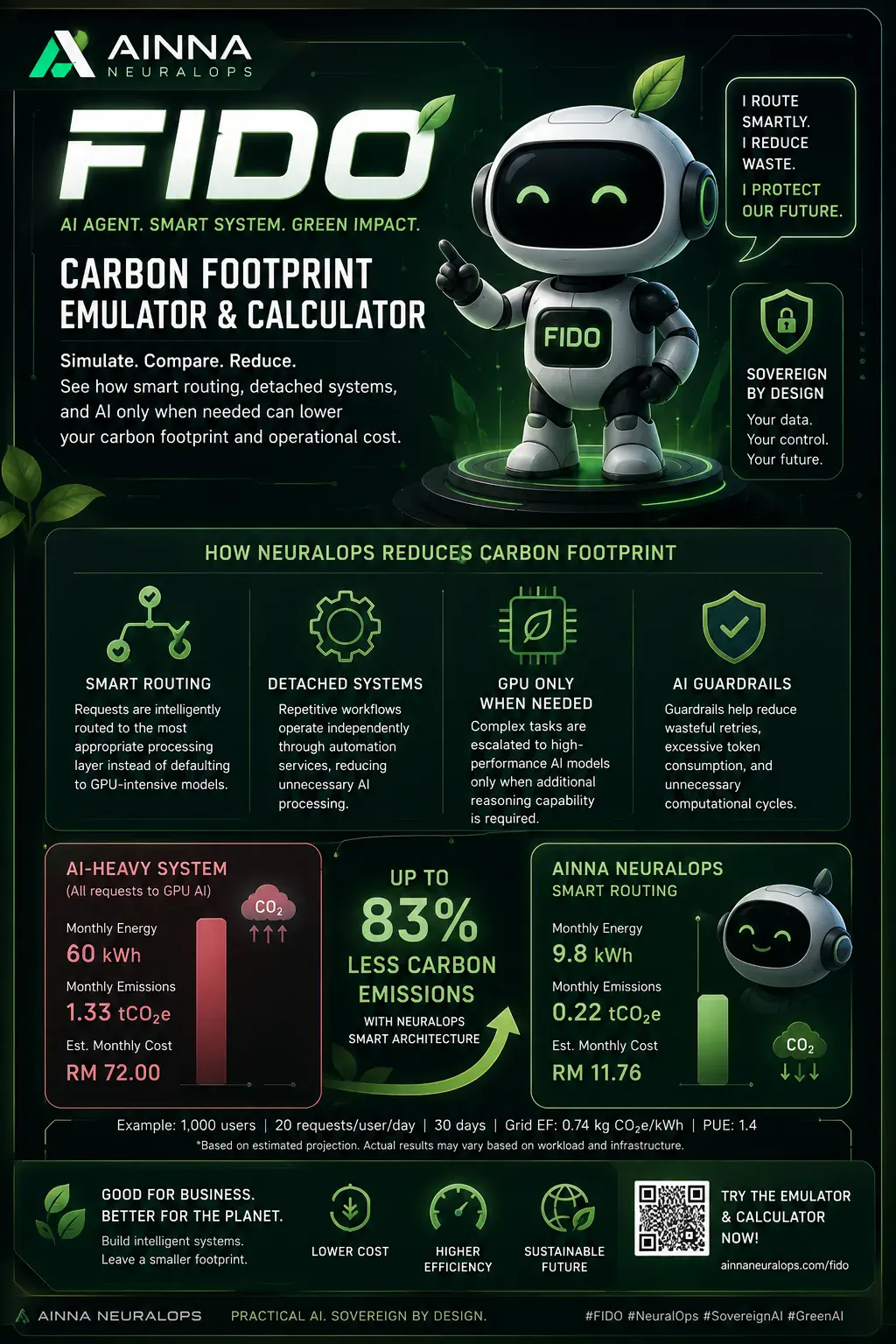
Today, many digital systems are built with a “send everything to AI” cost model. Every request, classification, ringkasan, and workflow is pushed into large models, even when a simple rule, database query, automation script, or lightweight process could deliver the same outcome at a fraction of the unit cost.
That is where Ainna NeuralOps becomes a financial operations decision.
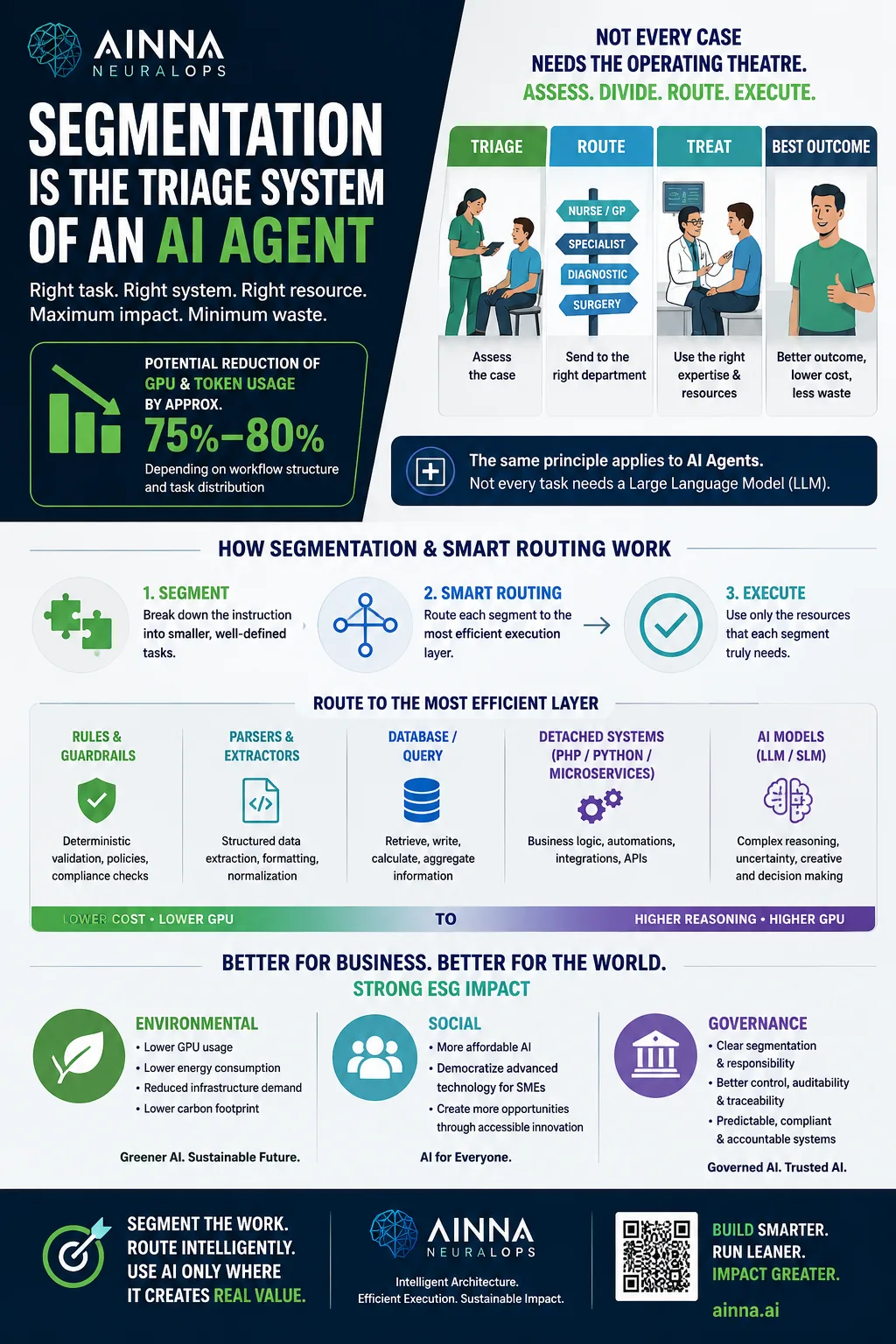
NeuralOps is not about using less AI because we distrust the technology. It is about applying better capital discipline. Smart routing sends each request to the right processing layer. Sistem terasing handle repetitive workflows independently. AI Berat GPU is reserved for tasks that genuinely require deep reasoning. Guardrails reduce wasteful retries, excessive token consumption, failed outputs, and unnecessary compute cycles that show up directly in monthly cloud bills.
This is why we are building the Ainna NeuralOps Jejak Karbon Emulator & Kalkulator.
The objective is straightforward: give users a way to model the jumlah cost of ownership and carbon exposure of different processing architectures. For example, compare a system where 100% of requests go to AI Berat GPU against a NeuralOps system where the majority of workloads are handled by detached systems, rule-based automation, CPU processing, or lightweight AI, with only genuinely complex tasks escalated.
This matters because AI infrastructure is no longer just a software line item. It is becoming a measurable energy and operating cost. The Antarabangsa Tenaga Agency projects global data centre electricity consumption could more than double to around 945 TWh by 2030, with AI being a significant driver of that growth.
So instead of making vague claims like “our AI is green”, the better questions for any finance and accounting team are:
Can we measure the cost and carbon per request? Can we compare the alternatives? Can we reduce both by design?
The calculator will estimate jumlah requests, routing percentage, energy use in kWh, carbon footprint in kg CO2e, estimated cost, and reduction percentage between AI-heavy processing and NeuralOps-optimized processing. It will also make the assumptions clear, because this is an estimation tool, not a certified carbon audit. For PKS, that distinction matters when using outputs for internal budgeting or preliminary ESG disclosures.
For Malaysian PKS, this approach is particularly relevant. They cannot afford AI-heavy infrastructure for every simple workflow. Many daily business processes - bank statement parsing, categorization, inventory checking, report generation, and data cleaning - can be handled by detached systems first, with AI invoked only when necessary. The result is lower variable costs, more predictable operating expenses, and better return on technology investment.
That is the operating model I believe in:
Practical AI. Sovereign control. Lower waste. Better operasi.
AI should not just be powerful.
It should be efficient, accountable, and designed with purpose.
Ainna NeuralOps - Practical AI, Sovereign by Design.
#Ainna #NeuralOps #SovereignAI #PracticalAI #CarbonFootprint #GreenAI #ResponsibleAI #AIInfrastruktur #DetachedSystem #SmartRouting #SMEInovasi #ESG #MampanAI
Official Cross-Rangkaian Resource














Ruang pembaca
Apa pendapat anda?
Komen disemak sebelum diterbitkan. Email diperlukan untuk moderasi dan tidak dipaparkan kepada pembaca.
我们团队正好在讨论100,这篇来得及时。
First piece I have read that treats system where 100 100% honestly.
The bit about compare a system where 100% is what I keep coming back to.
Simpan, sebab 100.
Honestly smart routing sends caught me off guard.
Useful. We are dealing with TWh by 203 2030 right now.