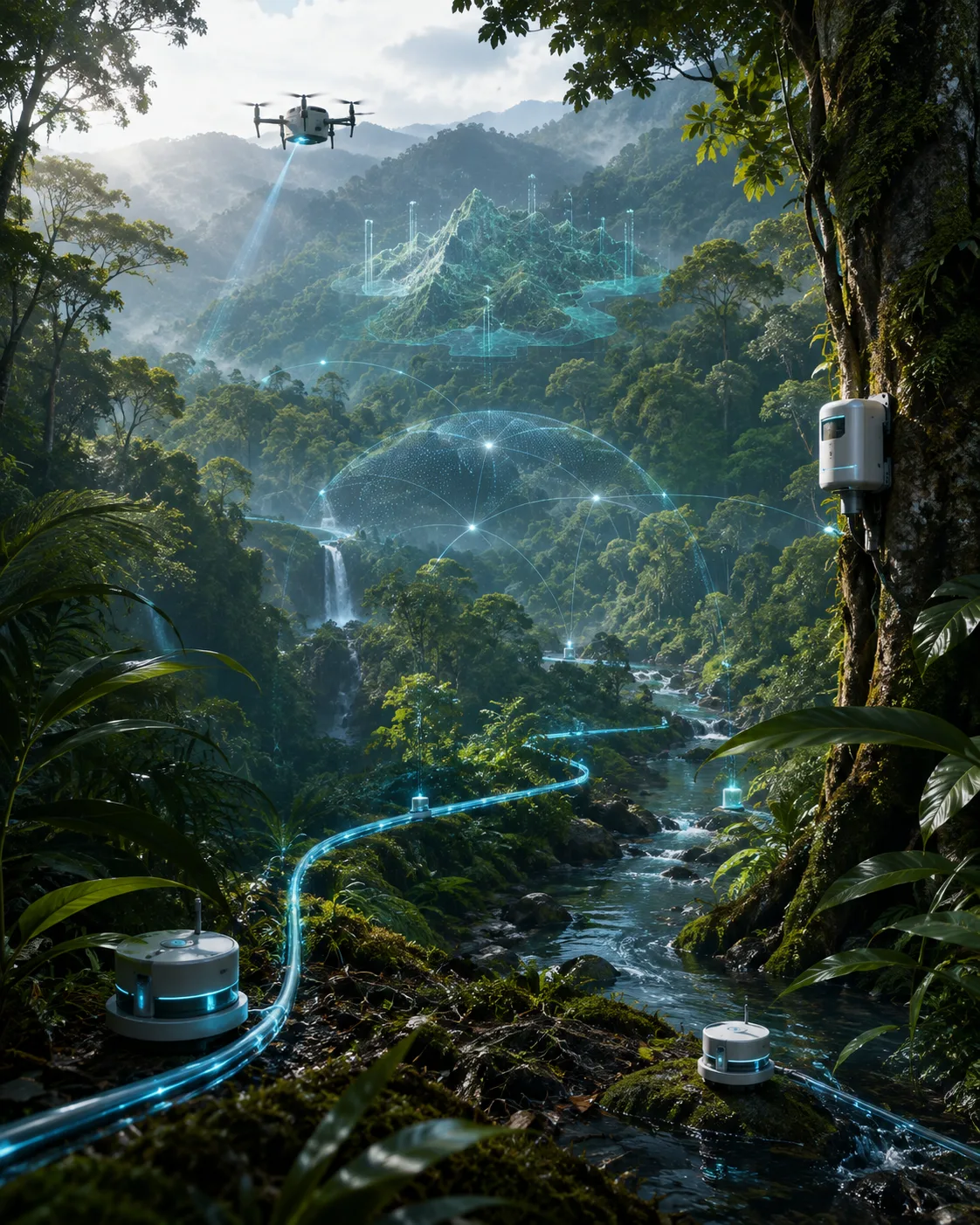
For Malaysian PKS and research consortia watching every ringgit of capex and opex, NeuralOps for forest research and monitoring is fundamentally a capital-discipline exercise. The principle I apply is simple: do not capitalise baharu field hardware if the same signal can be extracted from infrastructure that already exists. That is why the architecture remains Fibre-First, using fibre optic for distributed sensing through DAS, DTS and DSS. Leveraging existing fibre lowers initial capex, reduces the depreciable asset register, and cuts long-term maintenance liabilities.
But fibre cannot measure every parameter. Kelembapan tanah, water pH, dissolved oxygen, turbidity, water level, leaf wetness and tree inclination still need physical sensors at selected locations. This is where LoRa is deployed, not as a broad, high-density array, but as a small, low-power, research-specific Autonomi Scientific Sensor Pod. Each pod is a controllable, reusable asset rather than a permanent fixture.
Each pod can operate with the concept of Sleep → Sense → Validate → Store → Transmit if required → Sleep. It is not necessary to constantly transmit data. This pattern directly affects the operating model: lower power consumption extends asset life, lebih kecil data payloads reduce connectivity and cloud spend, and local buffering protects data integrity without redundant transmission costs.
Readings are stored locally, and only summaries, anomalies, or important events are sent. If connectivity is interrupted due to canopy or terrain, the data remains in local storage to be sent later or retrieved during retrieval. The result is lower variable opex and fewer write-offs from lost or corrupted datasets.
Lagi importantly, NeuralOps does not route every reading straight to the LLM. Data passes through deterministic validation, QA/QC and correlation first. AI is only used when reasoning is absolutely necessary. From a cost-control standpoint, that matters: LLM inference is a variable cost that scales with usage, so it should be treated as a discretionary expense rather than a default process step.
For example, when rainfall increases, soil moisture shifts, the watershed detects movement and DTS shows changes in thermal profile, NeuralOps can connect all of these into a more meaningful scientific event for researchers. Instead of paying for four separate data streams and ad-hoc analysis, the system produces one correlated, actionable insight. That is a better return on data assets.
Our approach:
Fibre = continuous distributed sensing at low marginal cost
LoRa pods = specialised point sensing with controlled capital deployment
UAV/LiDAR = spatial observation for periodic, high-value surveys
Temporal Digital Twin = a living depreciation-aware record of change over time
NeuralOps = intelligence and cross-sensor correlation that turns sensor spend into decision value
For me, technology sustainability is not just about using lebih kecil batteries or lebih murah devices. It is also about deploying only when necessary, retrieving after study, calibrating, reusing and redeploying. We should not fill the forest with electronics just because the technology is available. Every unneeded device adds capex, depreciation, logistics cost and disposal risk to the project's financial statements.
AINNA's goal for NeuralOps is not to build a "smart forest" loaded with infrastructure. The goal is for a low-impact research observatory to have more knowledge about forests, with fewer people, less manpower, less permanent infrastructure and a lebih kecil technology footprint. Translated into finance terms: higher knowledge output per ringgit of fixed asset and per ringgit of operating spend.
We should not destroy forests in the name of studying how to protect forests.
#NeuralOps #AINNA #LoRa #IoT #Forestry #ConservationTech #PersekitaranPemantauan #AI #Kelestarian #ESG #DigitalTwin #PenyelidikanInovasi
Official Cross-Rangkaian Resource













Ruang pembaca
Apa pendapat anda?
Komen disemak sebelum diterbitkan. Email diperlukan untuk moderasi dan tidak dipaparkan kepada pembaca.
सच कहूँ तो इस विषय ने चौंकाया।
First piece that handles leveraging existing fibre lowers initial honestly.
Useful. We are handling neuralOps for forest research right now.
Clearer than the vendor decks I get about data passes through deterministic validation.
The case for reduces the depreciable asset register is well made.
Still thinking about how can a forest research.