
From where I sit in AINNA's Kewangan and Perakaunan function, the numbers behind our delivery velocity are striking. The team is now building no fewer than three detached validation systems every day and producing around four complete pitch decks weekly, with AI agents carrying much of the load.
Across development, research, coding, testing, documentation, analysis and iteration, our monthly AI workload can reach 3–5 billion tokens per month.
If that were priced at commercial premium LLM API rates, the equivalent line item could easily run to hundreds of thousands of ringgit monthly.
Now apply that to a Malaysian PKS or mid-market environment.
Imagine an organisation with hundreds or thousands of employees, each equipped with AI agents for research, analysis, reporting, coding, documentation, operations and decision support.
Token consumption would scale extremely fast.
At the same time, Malaysian businesses increasingly have little choice but to adopt AI agents.
Why?
Because small companies like ours can now achieve productivity levels that previously required hundreds or even thousands of employees.
AI is rapidly narrowing the productivity gap between small companies and large corporations.
But there is another side.
AI productivity does not have to mean massive AI expenditure.
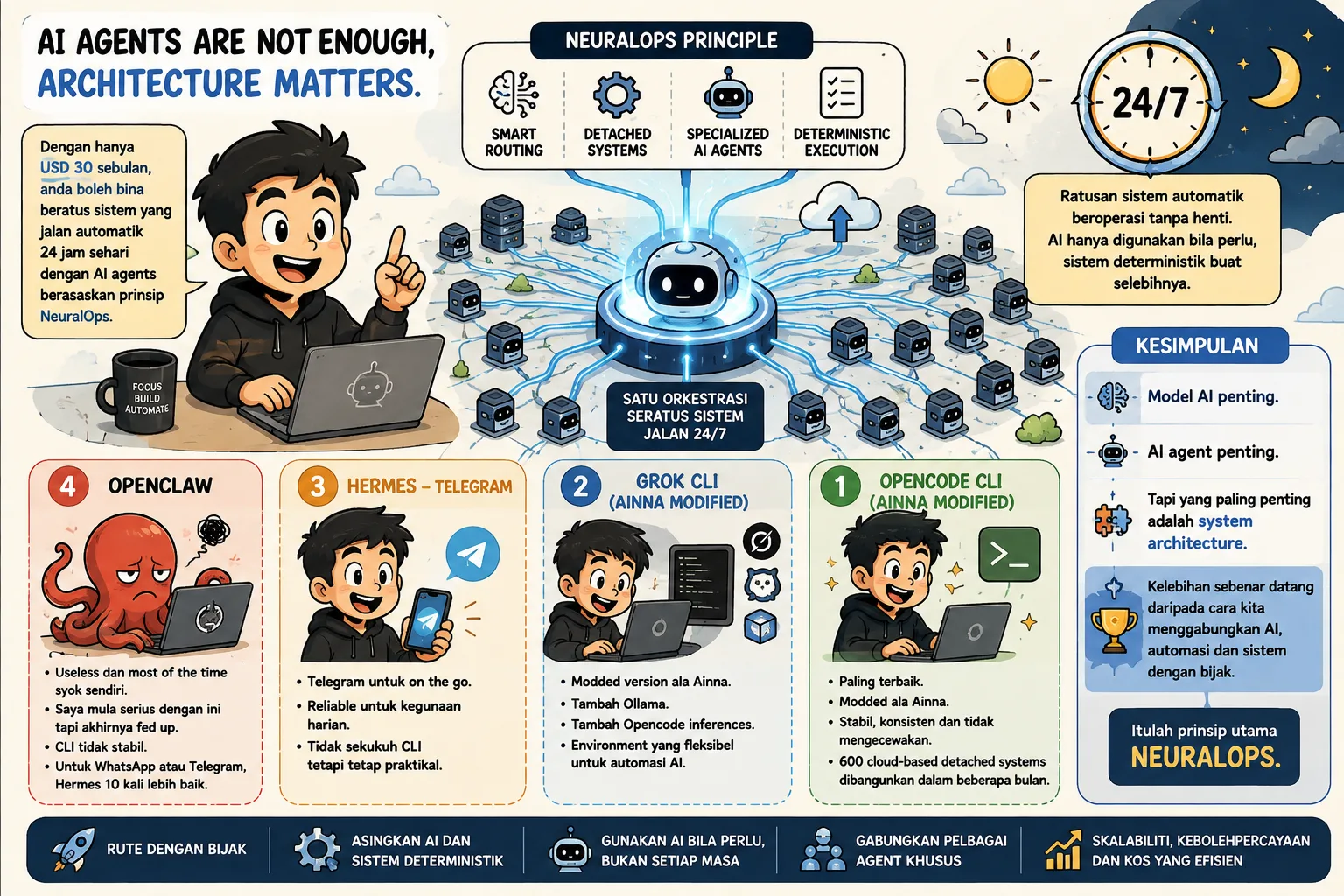
In our environment, even at around 3 billion tokens per month, direct AI cost can remain only about RM100–RM200 monthly.
The difference is not because we use less AI.
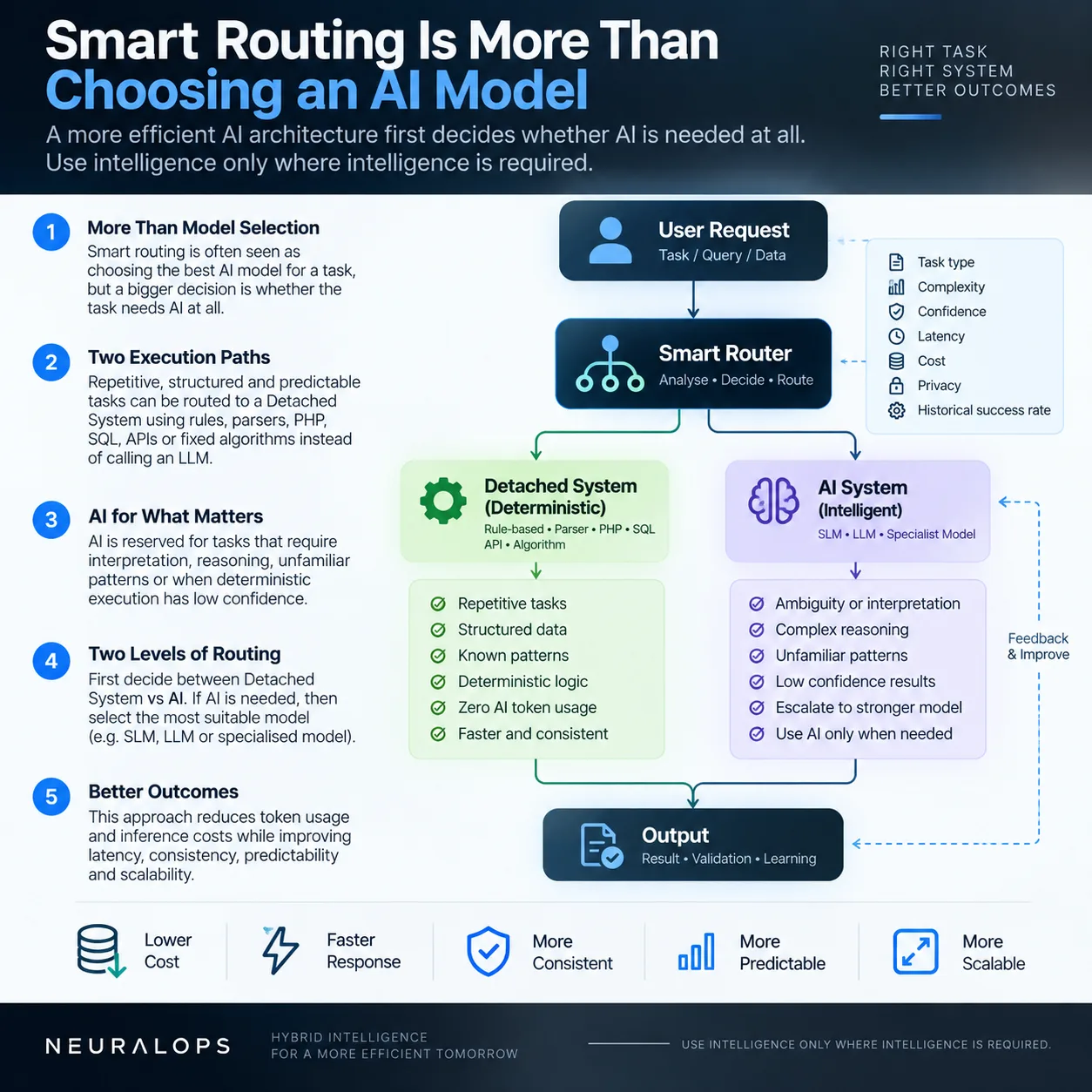
It is because we built a Smart Routing architecture around our AI agents.
Not every task should go to the largest or most expensive model.
Simple tasks → lightweight models.
Pengekodan tasks → specialised models.
Kompleks reasoning → stronger models.
Deterministic validation → detached systems.
Repetitive processing → automation and conventional computing.
The principle is simple:
Use premium intelligence only when the marginal business value justifies the marginal compute cost.
Our detached systems handle validation, calculations, filtering, reconciliation, rule-based decisions and structured processing that do not require an LLM.
This allows aggressive AI usage without paying as if every task needs the most powerful model.
For me, the future of Enterprise AI is not simply:
“Give every employee an AI agen.”
It should be:
“Give every employee an AI agen - but build intelligent cost-control infrastructure underneath it.”
Because when an organisation has 1,000 or 10,000 AI-enabled employees, the real question is no longer whether it uses AI.
The real question becomes:
How much intelligence is the organisation paying for that it never actually needed?
This is why we see Smart Routing, specialised models and detached systems as more than optimisation.
They are becoming AI cost-control infrastructure.
At enterprise scale, that difference could be worth millions of ringgit yearly.
The next phase of AI adoption will not only be about the most powerful models.
It will be about knowing when not to use them.
#ArtificialIntelligence #AIAgents #EnterpriseAI #SmartRouting #NeuralOps #Automasi #DigitalTransformation #AIInfrastruktur #LLM #Productivity














Ruang pembaca
Apa pendapat anda?
Komen disemak sebelum diterbitkan. Email diperlukan untuk moderasi dan tidak dipaparkan kepada pembaca.
Ringkas dan jelas. 3 boleh kongsi dengan team saya.
You can tell the writer actually worked on only about RM100–RM20 RM200.
Useful. We are handling can reach 3–5 5 billion right now.
That point about token consumption would scale is well put.