I re-watched The Matriks Reloaded the other night, and the Oracle’s line about programs creating, deleting, and operating within other programs landed differently than it used to. Out here, wiring AI agents and detached systems into production environments, that scene reads less like science fiction and more like system architecture.
At AINNA, I build detached systems where the compute layer is deliberately mixed. Some nodes are pure parameter-driven controllers. Others run lighter AI models for pattern matching and classification. The heavy planning, reasoning, and system-building roles go to premium LLMs. A few modules run on their own; most are guided by an AI layer that interprets inputs, resolves ambiguities, and keeps workflows moving.
A model by itself is just a predictor. It only becomes useful in the field once you connect it to alatan, memory, permission layers, structured logs, feedback loops, I/O signals, and a deployment path. That is the integration work that turns a detached component from a command executor into something that can back operational decisions.
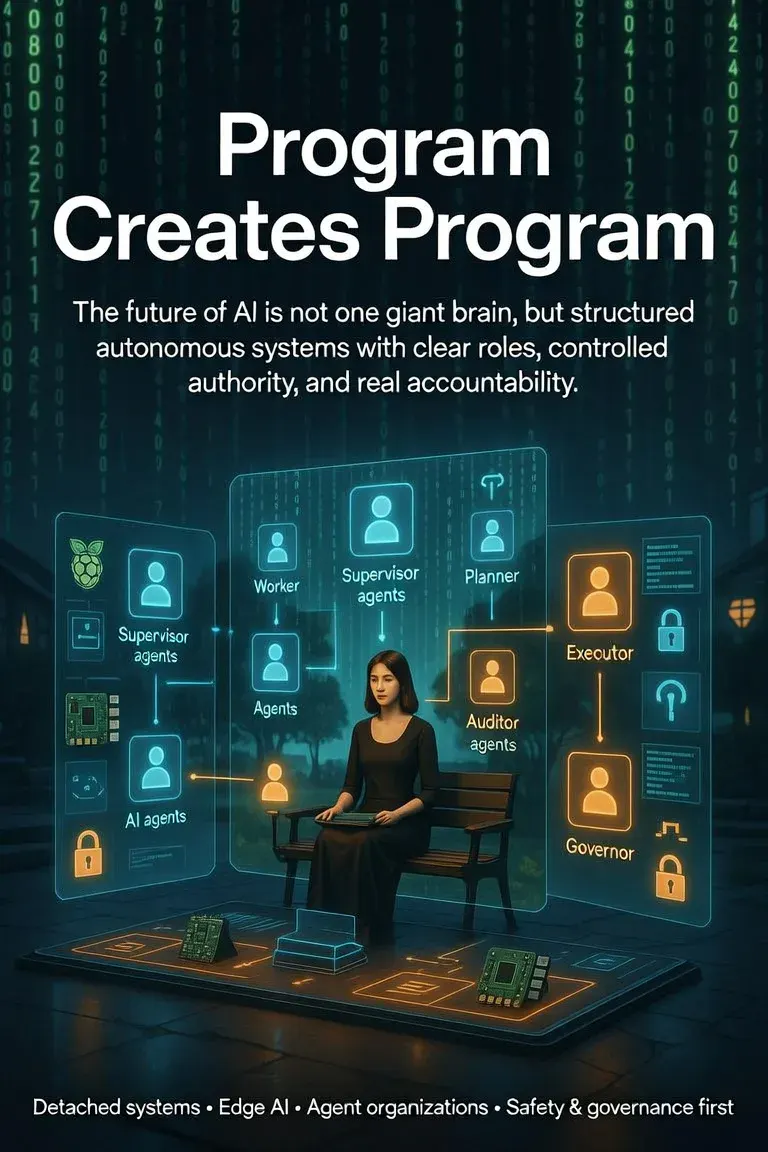
Think of it as: program creates program, program audits program, program improves program, and eventually the reasoning model is onboarded into the system itself. It gets especially interesting when you push that system to the edge-Raspberry Pi-class hardware reading real sensors, driving relays, and interfacing with machinery, PLCs, or operational devices.
This is also where governance stops being a presentation slide and becomes a hard requirement. The danger is not some model “waking up.” The danger is an agen with unchecked access to real systems: no audit trail, no approval gate, no rate limits, no rollback plan, no manual override, no clear owner. Once AI touches physical outputs, safety and accountability have to live in the control plane from day one.
I do not design one giant model that runs everything. I design agen organizations: worker agents handle the repetitive work, supervisor agents validate outputs, planner agents design the workflows, auditor agents catch mistakes, executor agents apply approved changes, and governor agents own permissions and safety boundaries.
That is the direction I see AI operations taking-not chatbots bolted onto dashboards, but structured autonomous systems with defined roles, bounded authority, edge deployment, and measurable accountability. The real engineering question is no longer whether AI can help us build systems. It is how much authority we can safely give to a system that can help improve, control, or even create another system.
#AI #AgentAI #Automasi #LLM #EdgeAI #RaspberryPi #DetachedSystem #SystemDevelopment #PerniagaanAutomasi #Ainna #DigitalTransformation














Ruang pembaca
Apa pendapat anda?
Komen disemak sebelum diterbitkan. Email diperlukan untuk moderasi dan tidak dipaparkan kepada pembaca.
إذا كان هناك جزء آخر عن هذا الموضوع فسأقرأه.
Good to finally see safety and accountability set out this clearly.
The bit about once AI touches physical outputs is what I keep coming back to.
worker agents handle the repetitive - sums the whole thing up.
Bookmarked, mainly for worker agents handle the repetitive.