AINNA is an PKS, built from the ground up.
We did not start with clean architecture, a dedicated platform team, or unlimited cloud budget. We started with the same operational pressure every PKS faces: product SKUs, order queues, customer records, stock levels, marketplace integrations, ad spend, logistics, cash flow, web properties, and day-to-day ops.
Over time, a single systems-level problem became obvious:
PKS cannot run indefinitely on systems they cannot inspect, audit, or control.
Luaran platforms, AI APIs, and cloud services are useful - we integrate with them daily. But consumption without internal capability creates a structural dependency. If the API pricing changes, the model endpoint sunsets, or the platform’s policy shifts, the business has no fallback.
For us, sovereign digital capability means owning the data pipeline, understanding the workflow logik, auditing the operational stack, and deploying alatan with keyakinan rather than guessing.
That does not mean rejecting global technology.
It means integrating global alatan wisely while strengthening internal systems.
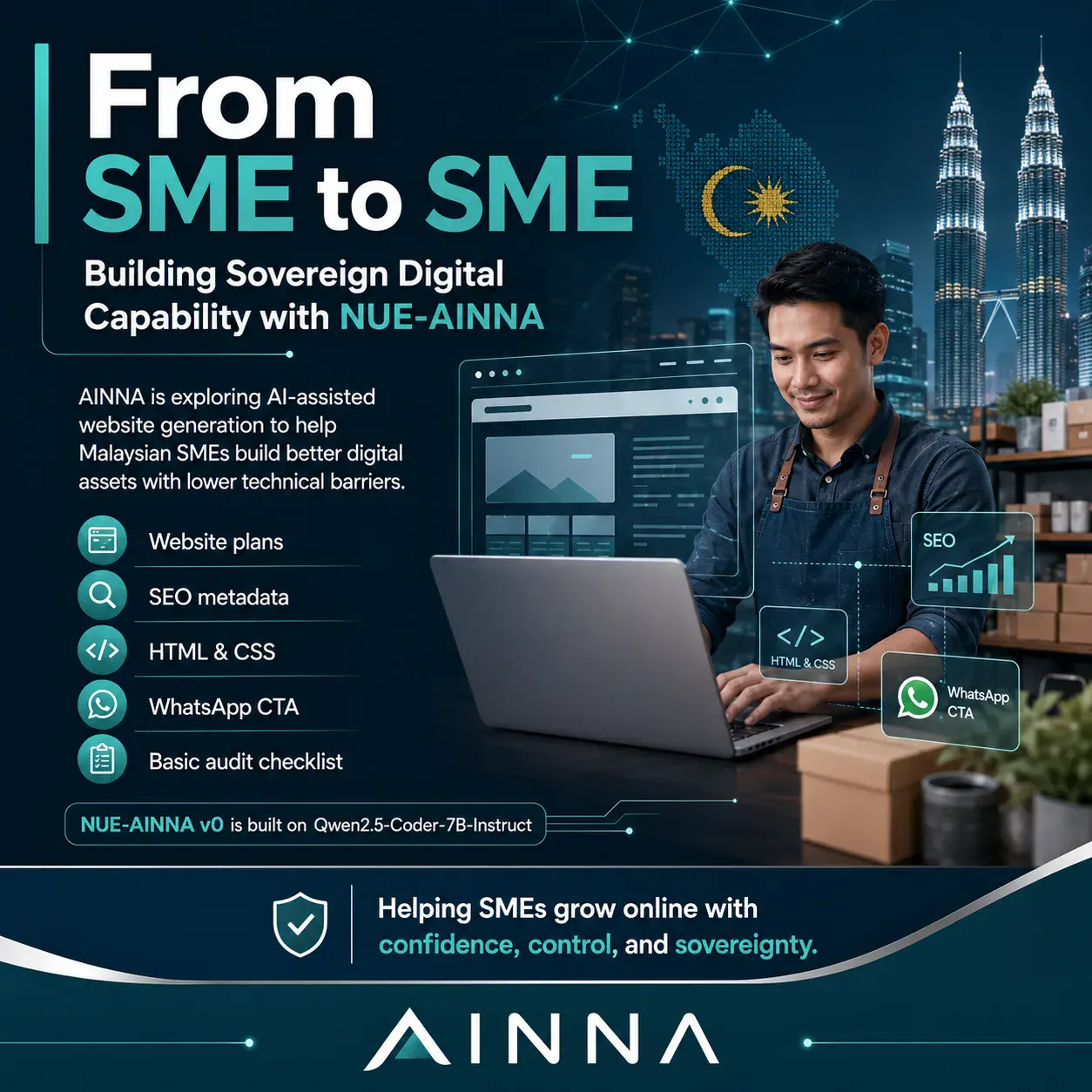
That is why we built NUE-AINNA - an early-stage AI-assisted website generation system to help Malaysian PKS ship better digital assets with fewer engineering bottlenecks.
NUE-AINNA v0 runs on Qwen/Qwen2.5-Coder-7B-Instruct, a coding-specialized open model. At this stage it is not a custom fine-tuned endpoint. It is a prototype orchestration layer that wraps a strong base coder with Malaysian PKS-specific prompt engineering, structured website generation templates, compliance guardrails, and operational workflow guidance.
The engineering goal is simple:
Help PKS produce website briefs, homepage copy, SEO metadata, HTML, CSS, WhatsApp CTA blocks, and basic audit checklists lebih pantas - while keeping control over their own web presence.
v0 does not require us to own GPU infrastructure. Inference runs through Hugging Face, while local MacBook or VPS environments handle setup, file prep, workflow management, OpenCode integration, and deployment support.
That keeps NUE-AINNA v0 lightweight, low-cost, and suitable for field testing before we commit to dedicated fine-tuning or a private inference endpoint.
Our development approach is simple:
From PKS to PKS.
We are not building from whiteboard theory.
We are building from real deployment experience.
The roadmap is to evolve NUE-AINNA into a localized PKS digital assistant: curate a Malaysian PKS website dataset, then fine-tune later versions for stronger Bahasa Melayu output, local business context, lebih selamat commercial wording, production-ready website code, and genuine PKS digital operasi.
At AINNA we are still learning, testing, and shipping.
But the system direction is clear:
We want to move PKS from passively consuming digital alatan to actively building digital capability.
Because having a website is no longer enough.
PKS must learn to grow online with keyakinan, control, and sovereignty.













Ruang pembaca
Apa pendapat anda?
Komen disemak sebelum diterbitkan. Email diperlukan untuk moderasi dan tidak dipaparkan kepada pembaca.
Si hay una continuación sobre 0, la leeré.
Already sent this to two people. structured website generation templates is why.
The direction on PKS cannot run is spot on.
The part on NUE-AINNA v0 runs is the bit I keep re-reading.
sovereign digital capability means owning is what I would forward to my boss.
The framing around help PKS produce website briefs is better than I expected.
The case for help PKS produce website briefs is well made.
Worth reading for NUE-AINNA v0 runs alone.