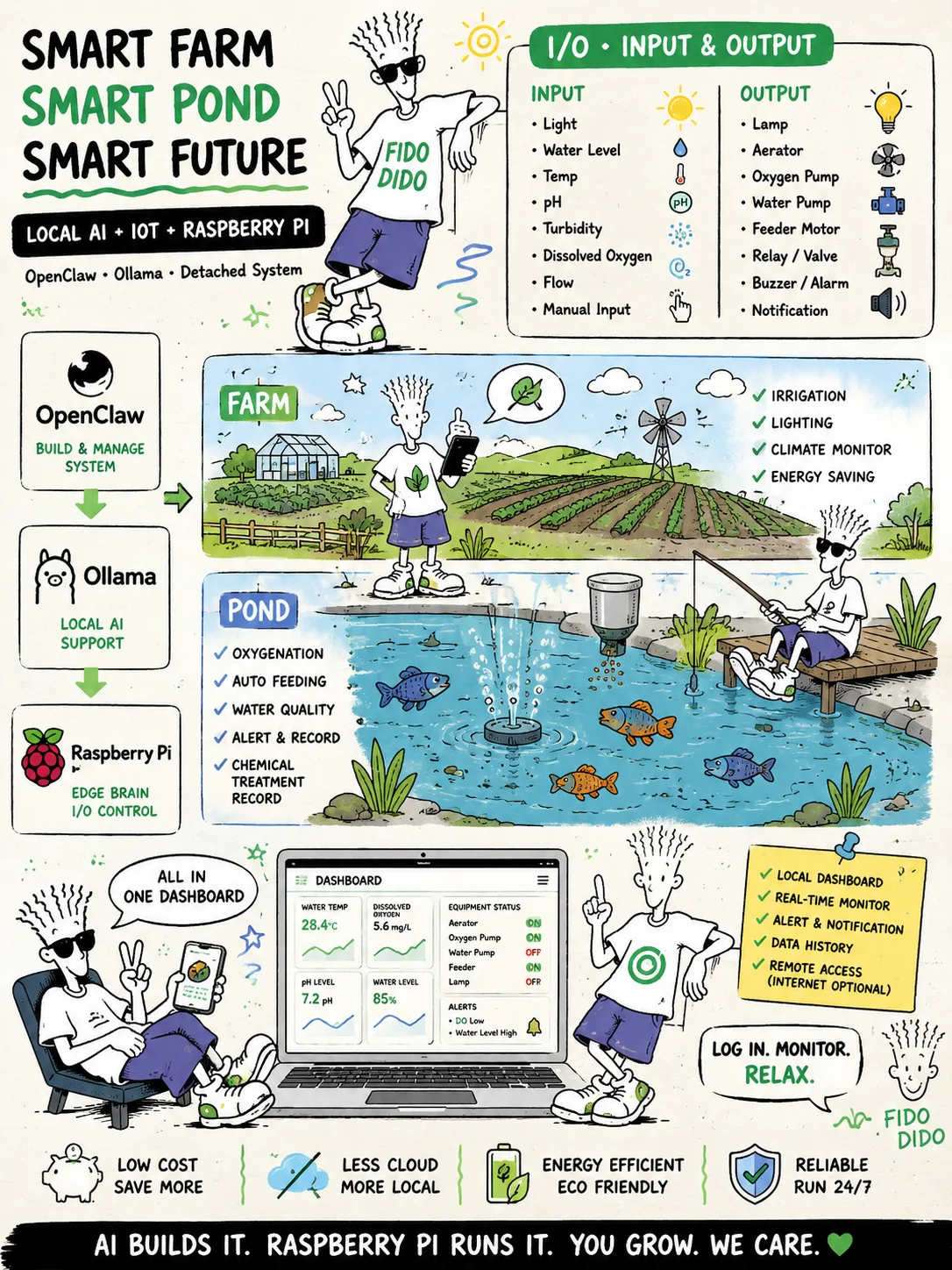
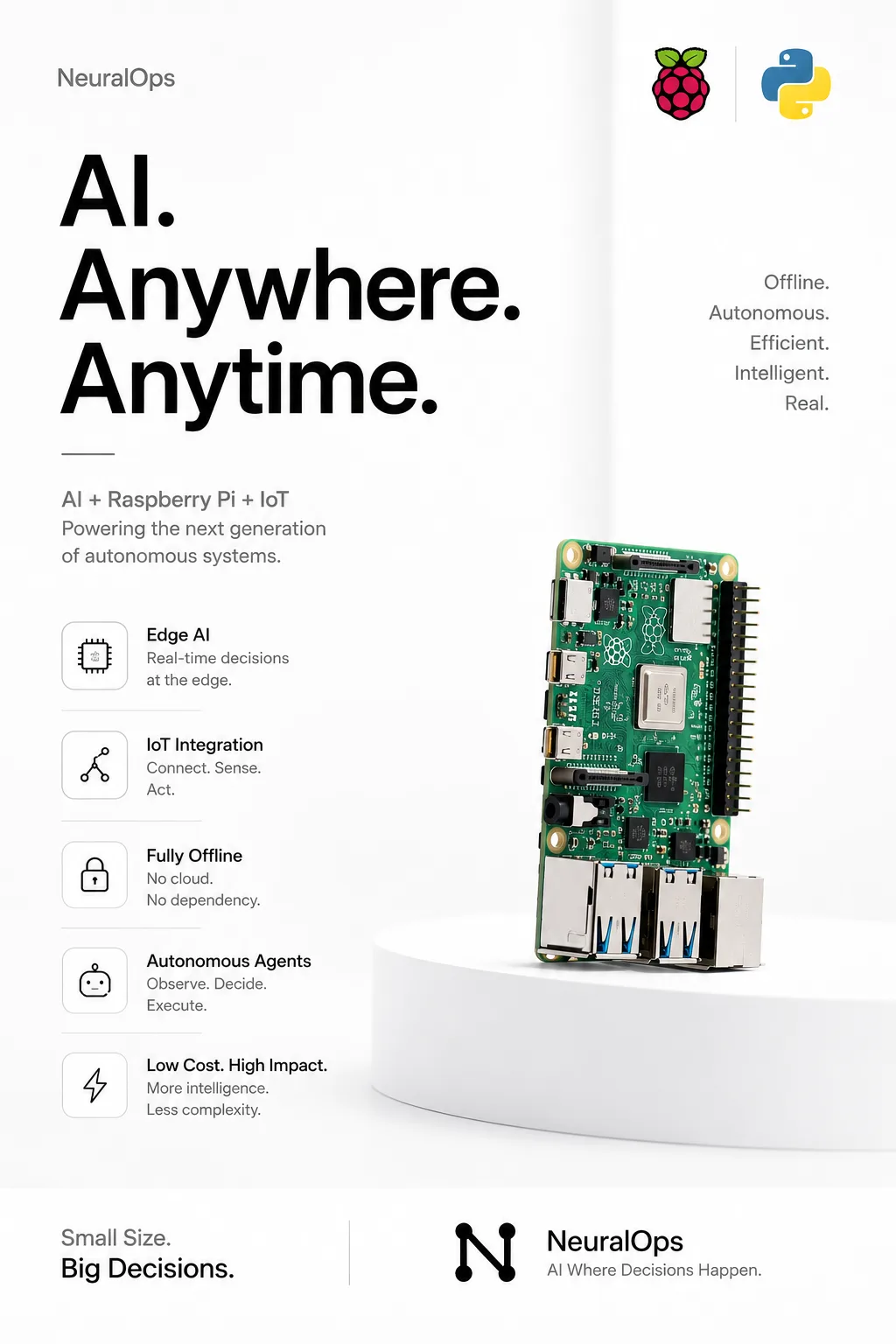
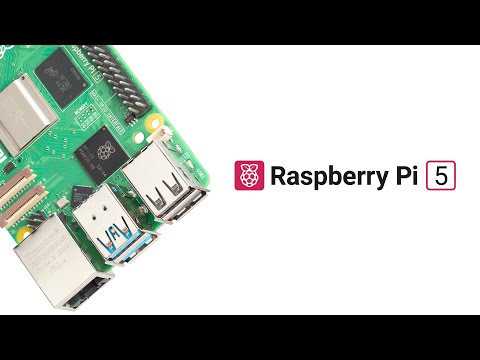
If you are building AI-IoT systems for agriculture, I recommend looking at Raspberry Pi, OpenClaw and Ollama as a local-first stack. For smart farms and fish ponds, it is one of the cleanest ways to run sensing, control and a small language model on the edge without relying on the cloud.
With OpenClaw, you can spin up a full LAMP server directly on the Raspberry Pi to serve a local dashboard. Ladang operators log in over the local network to view sensor telemetry, check actuator state, manage feeding schedules, monitor water conditions, record treatments, review alerts and inspect historical data.
Architecturally, the system is all about I/O. On the input side, you wire up light, water level, temperature, pH, turbidity, dissolved oxygen and flow sensors. On the output side, you drive lamps, aerators, oxygen pumps, water pumps, feeder motors, relay modules, buzzers and notification hooks.
For fish ponds, I usually implement the control logik as detached Python services. When dissolved oxygen falls below a configured threshold, one service automatically starts an aerator or oxygen pump. Feeding runs on a scheduler that respects time, pond zone and fish growth stage. When water quality drifts out of range, the system raises an alert and logs recommended actions for a human to review. Chemical treatment should always stay SOP-driven and require explicit human approval before any actuator fires.
The same pattern scales to crop farms. You can run irrigation, grow lights, greenhouse fans, misting systems, security lighting and general environmental monitoring from the same edge stack. I prefer to split each function into its own detached service: one script for oxygenation, one for feeding, one for lighting, and one for pushing telemetry and reports to the dashboard.
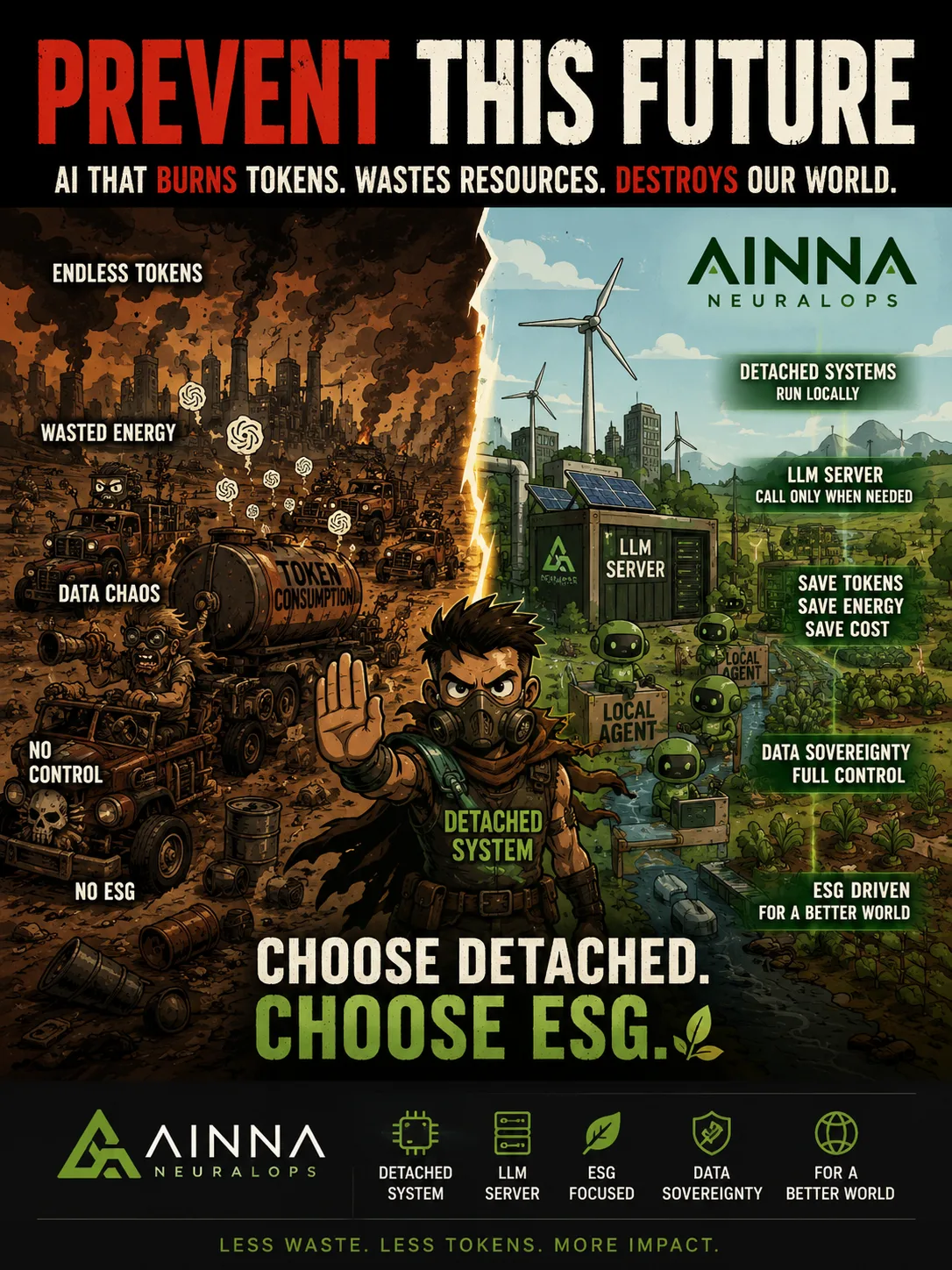
This is why I like detached AI-IoT systems. AI helps you design, audit, debug and improve the system during development, but day-to-day operation runs locally on the Raspberry Pi without burning tokens on every sensor reading.
That gives you:
Lower cloud dependency.
No token waste on routine operasi.
Reduced operating cost.
Better resilience for real-world rural deployments.
The future of AI in agriculture, from my perspective, is not asking a model what to do every morning. It is using AI to build local systems that read the real world through inputs, act on it through outputs, and keep running even when the AI layer is offline.












Ruang pembaca
Apa pendapat anda?
Komen disemak sebelum diterbitkan. Email diperlukan untuk moderasi dan tidak dipaparkan kepada pembaca.
Lebih jelas daripada dek vendor yang saya terima pasal openClaw and ollama.
Read this twice. Feeding runs on a scheduler is what stayed with me.
The bit about dissolved oxygen and flow sensors is what I keep coming back to.
Useful. We are dealing with control and a small language right now.
Good write-up. pond zone and fish growth alone was worth the read.
सेव कर लिया, ख़ासकर इस हिस्से की वजह से।
Masih fikir tentang openClaw and ollama.
You can tell the writer actually worked on ladang operators log in over.