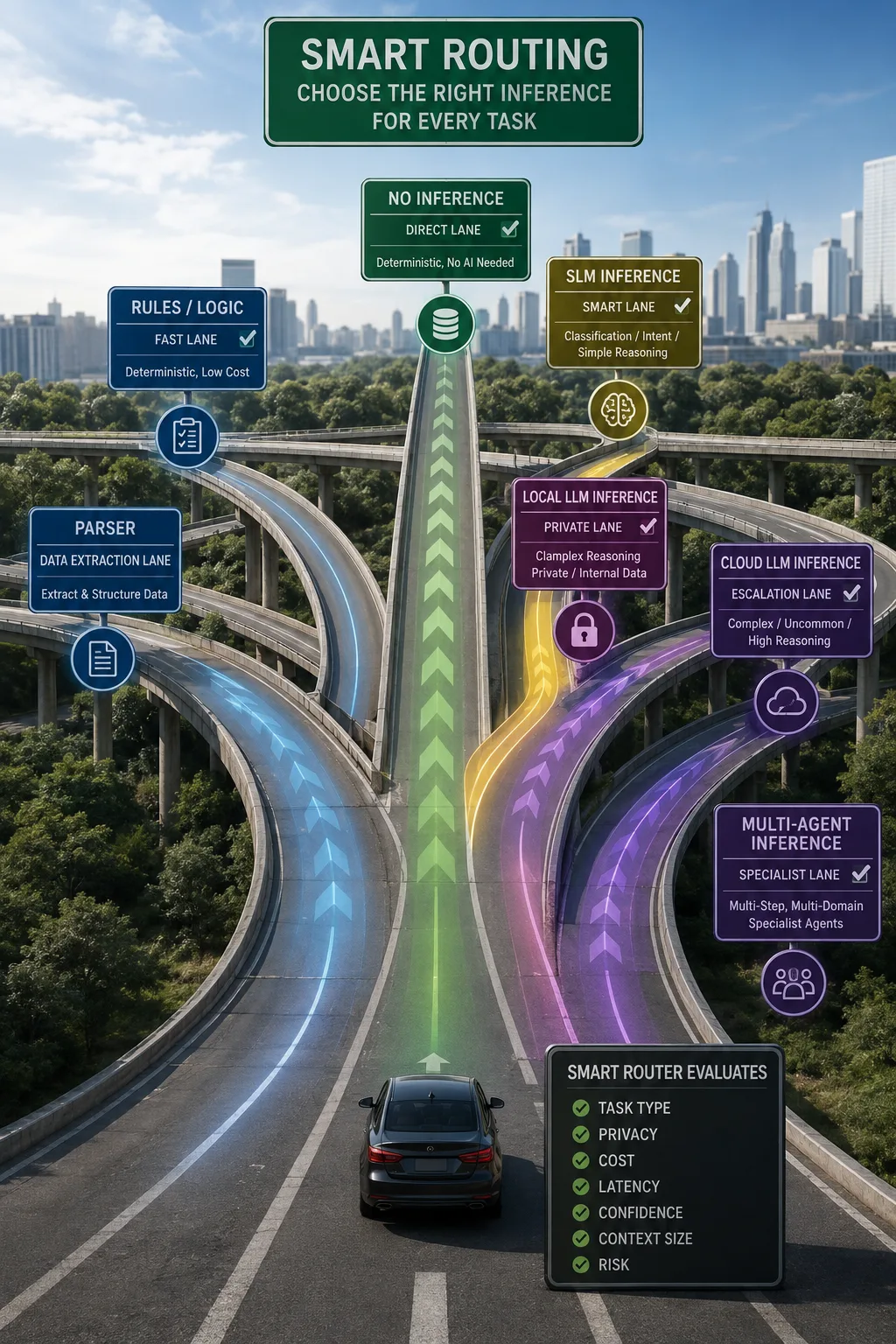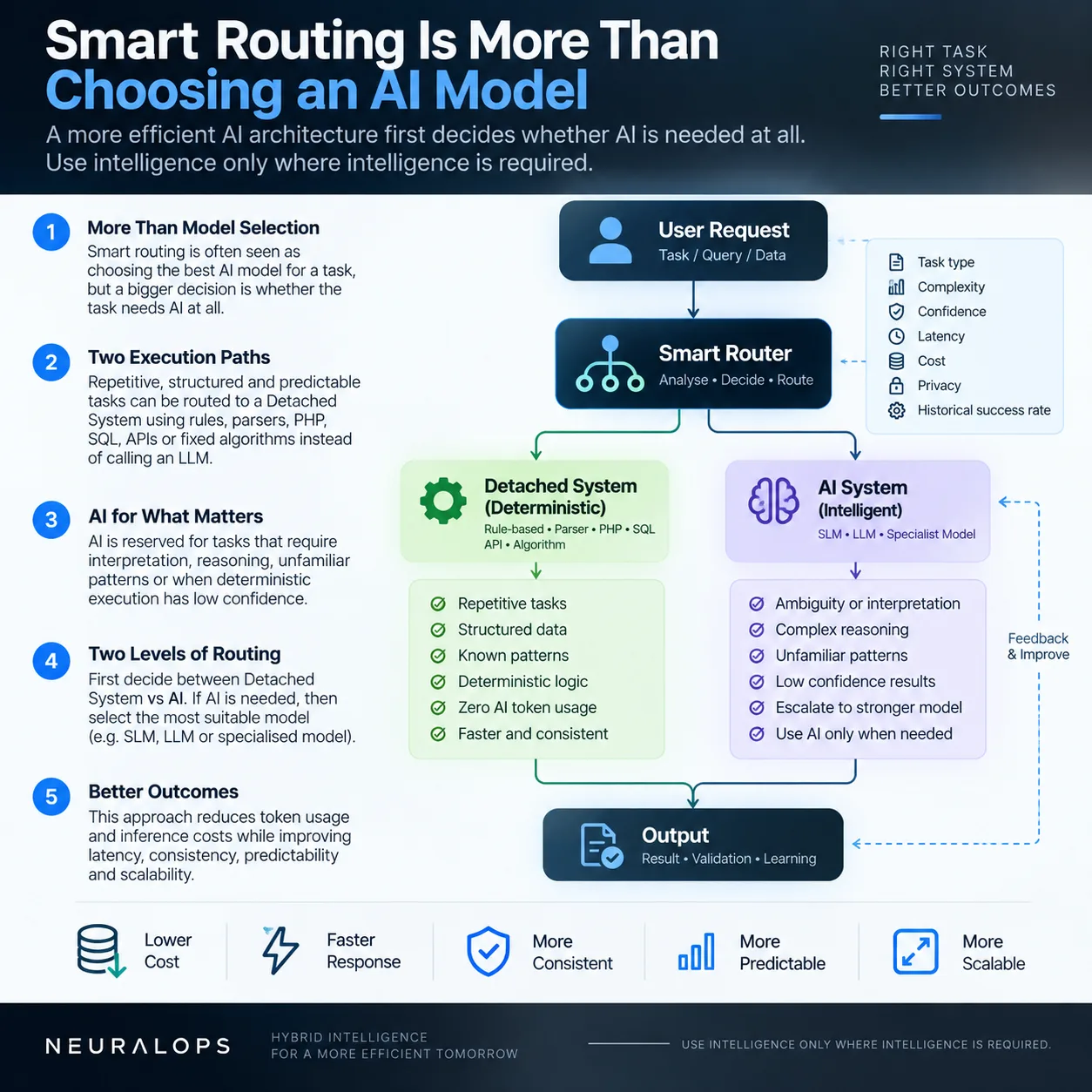
In a hybrid architecture, the Pintar Router can choose between an AI system and a Sistem Berasingan. Repetitive, structured, and predictable workloads can be executed by deterministic components such as rules, parsers, PHP, SQL, APIs, or fixed algorithms instead of repeatedly calling an LLM.
AI is then reserved for tasks that genuinely require intelligence , ambiguity, interpretation, reasoning, unfamiliar patterns, or situations where deterministic execution produces low keyakinan. The system can also escalate difficult cases from a lebih kecil model to a more capable model when necessary.
This creates two levels of routing. The first is execution routing: Sistem Berasingan vs AI. The second is model routing: which AI model should handle the task. This is fundamentally different from conventional multi-model routing, which starts with the assumption that every task must eventually be processed by AI.
The principle is simple: use intelligence only where intelligence is required. Instead of asking only, “Which AI should do this?”, a more efficient architecture first asks, “Should AI do this at all?” This approach can reduce token consumption and inference costs while improving latency, consistency, predictability, and scalability.
Official Cross-Rangkaian Resource