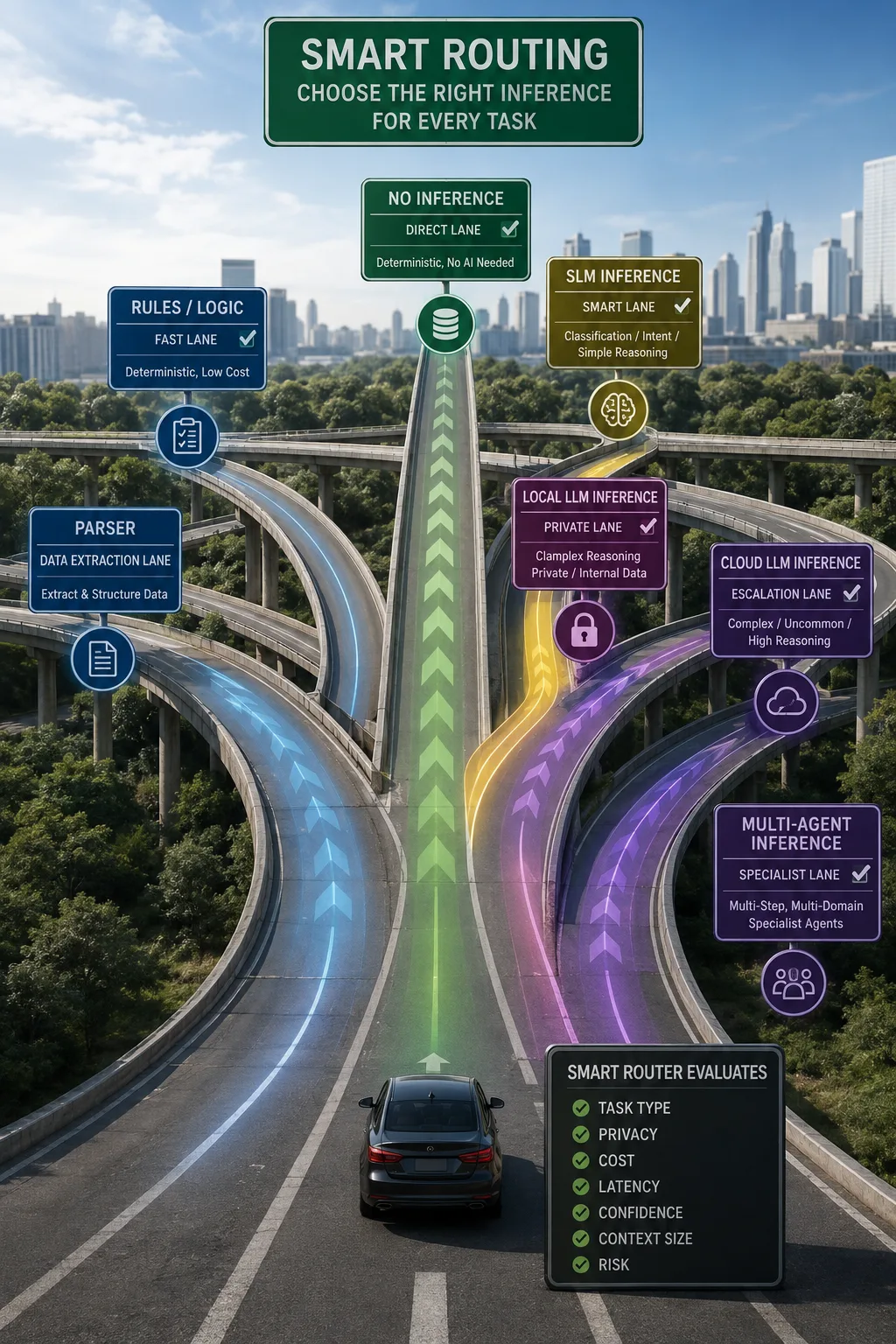
At AINNA, we see Smart Routing in NeuralOps as more than a technical model-selection step. From a finance and accounting standpoint, it is a cost-control discipline that matches each business task to the most economical execution path that still delivers the required accuracy and auditability. Some workflows require no AI inference at all and can be resolved through deterministic logik, business rules, database queries, or purpose-built parsers. Others need a small language model for classification and intent detection, a local LLM for sensitive internal data, a cloud LLM for exception handling, or multiple specialist agents for higher-complexity processes.
The router evaluates the same factors a finance operator would scrutinise: unit cost per task, data privacy exposure, latency, keyakinan level, context size, and operational risk. A routine order-status lookup should not be charged to an LLM token budget. Pengekstrakan invois may be a parser job. Pengelasan transaksi may be handled by a compact model. Larger models should only be invoked when the business case genuinely justifies the additional compute spend.
This is why, in NeuralOps, Smart Routing is not just Model Penghalaan. It is Inference Penghalaan + Execution Penghalaan + Validation Penghalaan. It gives finance leaders visibility and governance over where intelligence spend is going.
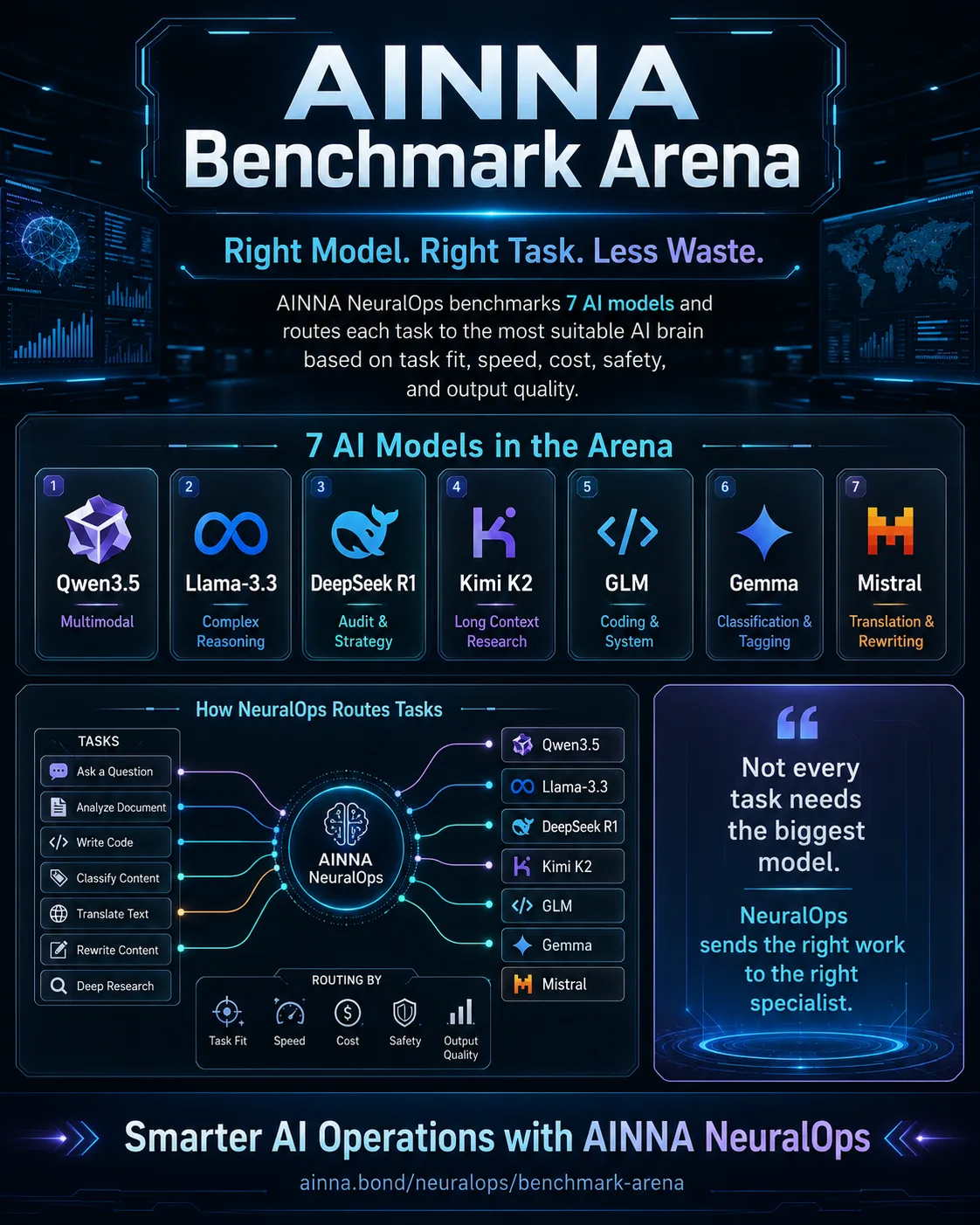
The objective is not to deploy the most AI possible. The objective is to use the smallest, most efficient and most reliable level of intelligence required for each task, measured in RM per business outcome.
#NeuralOps #SmartRouting #AIInfrastruktur #Inference #EnterpriseAI #AIAutomasi #LLM














Ruang pembaca
Apa pendapat anda?
Komen disemak sebelum diterbitkan. Email diperlukan untuk moderasi dan tidak dipaparkan kepada pembaca.
Ginagawa namin ito sa trabaho - artikulong ito. Kapaki-pakinabang.
Honestly, measured in RM per business surprised me.
The framing around pengekstrakan invois is better than I expected.
Short and clear. higher-complexity is worth sending to my team.