From where I sit in finance and accounting, AI today reminds me of the automobile industry during the 1960s through the 1990s. Orang rushed to own cars because they represented progress, status and economic mobility. Industri expanded rapidly to support that demand, but so did fuel costs, congestion and the capital required to maintain roads, fleets and infrastructure.
Kecekapan came later, and it showed up first on the balance sheet. As Japanese manufacturers pursued fuel efficiency, reliability, lean manufacturing and practical engineering, the mindset shifted from maximising production volume to optimising cost per unit and asset utilisation. The principle still applies: “If burning more fuel made a better car, a tank would be the perfect family vehicle.”
China went through a similar capital-efficiency transition. During its earlier stages of industrialisation, growth was aggressive, capital was deployed at scale, and the environmental cost was significant. But from the 2000s onward, automation improved return on assets, renewable energy reduced long-term energy liabilities, EVs lowered lifecycle fleet costs, and cleaner production became a material factor in cost of capital and investor risk.
China did not stop industrialising; it learned to industrialise with tighter capital discipline. Teknologi continued to advance, but the way it was procured, operated and depreciated became more practical and resource-conscious.
AI is now approaching the same crossroads from a CFO's point of view. Today, the pressure is to adopt bigger models, more agents, longer context windows, more GPUs and billions of tokens. There is almost an assumption that higher AI consumption equals a more advanced business. But that is like saying, “My car uses twice as much petrol, so it must deliver twice the return on investment.”
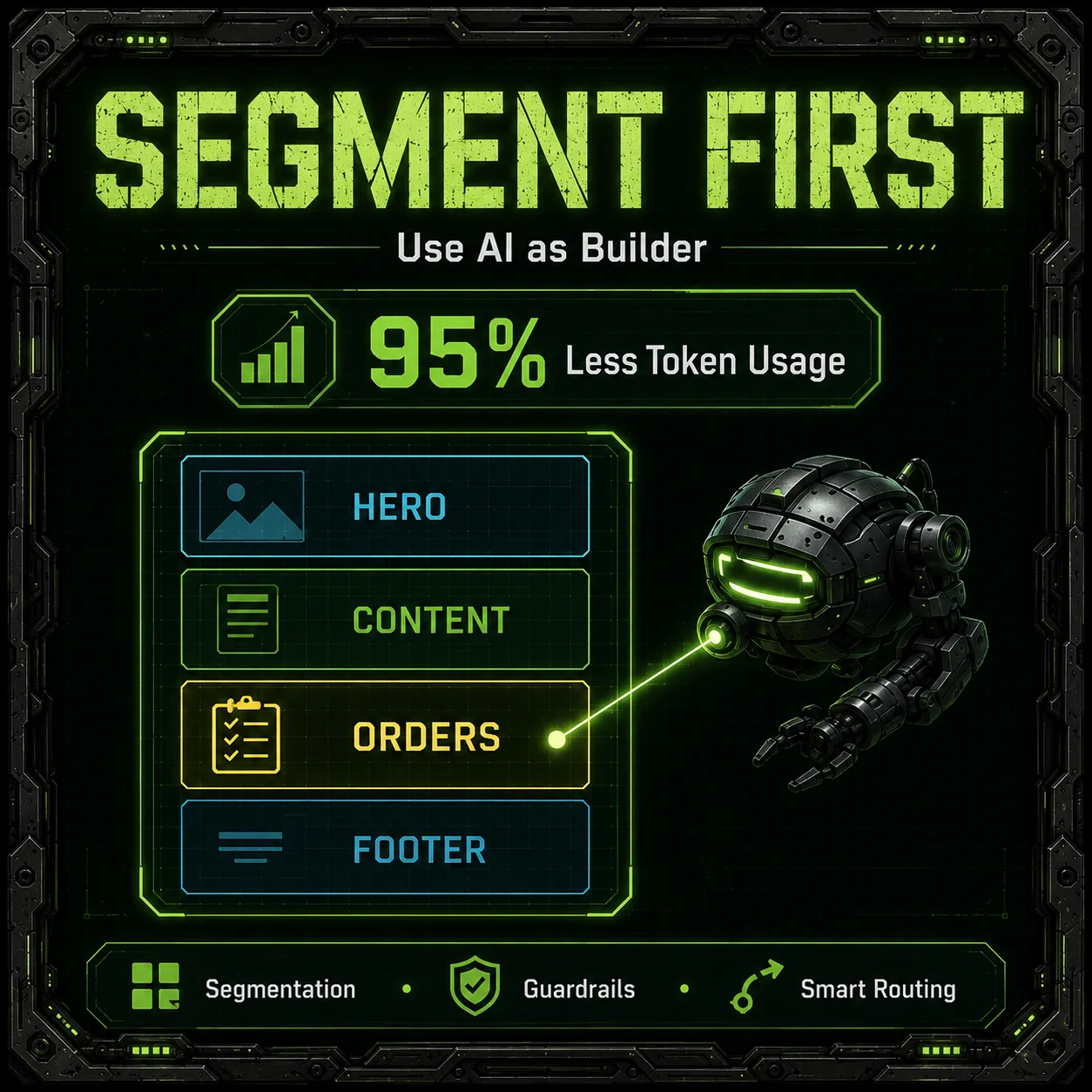
The real question on a finance dashboard should not be, “How much AI can we deploy?” It should be, “How little AI do we actually need to solve the problem correctly and protect our margins?” This is why architectures such as Smart Routing, Segmentation and Sistem Berasingan matter to any PKS managing limited capital.
Smart Routing sends routine tasks to lebih kecil models or conventional software, reserving advanced models for cases where deeper reasoning justifies the higher per-token cost. Segmentation breaks large workflows into discrete tasks, reducing unnecessary context, token consumption and compute spend. Sistem Berasingan move calculations, validation, filtering, database operations and deterministic rules outside the AI model, where they can run at predictable cost. AI handles judgment; software handles certainty.
When systems are designed this way, the financial impact is measurable: lower token spend, reduced inference costs, lighter GPU workloads, lebih kecil infrastructure commitments and lower energy bills, all while improving reliability and scalability. For Malaysian PKS, this is where AI efficiency and ESG reporting converge into one line item on the P&L and balance sheet. At AINNA, we see this as a capital allocation problem first: every RM of technology spend needs to show up as lower operating cost, lebih pantas process turnaround, or reduced compliance risk. We already know what happens when technology is procured first and rationalised later: capital is locked up, depreciation accelerates, and optimisation becomes a cost-recovery exercise rather than a value driver. The future of AI investment should not simply chase more intelligence, but more efficient intelligence - deploying advanced AI only when it genuinely improves return on capital.















Ruang pembaca
Apa pendapat anda?
Komen disemak sebelum diterbitkan. Email diperlukan untuk moderasi dan tidak dipaparkan kepada pembaca.
Es la primera vez que leo algo honesto sobre 1960.
Clearer than the decks I usually get on congestion and the capital required.
Saya baca dua kali. 1960 yang paling melekat.