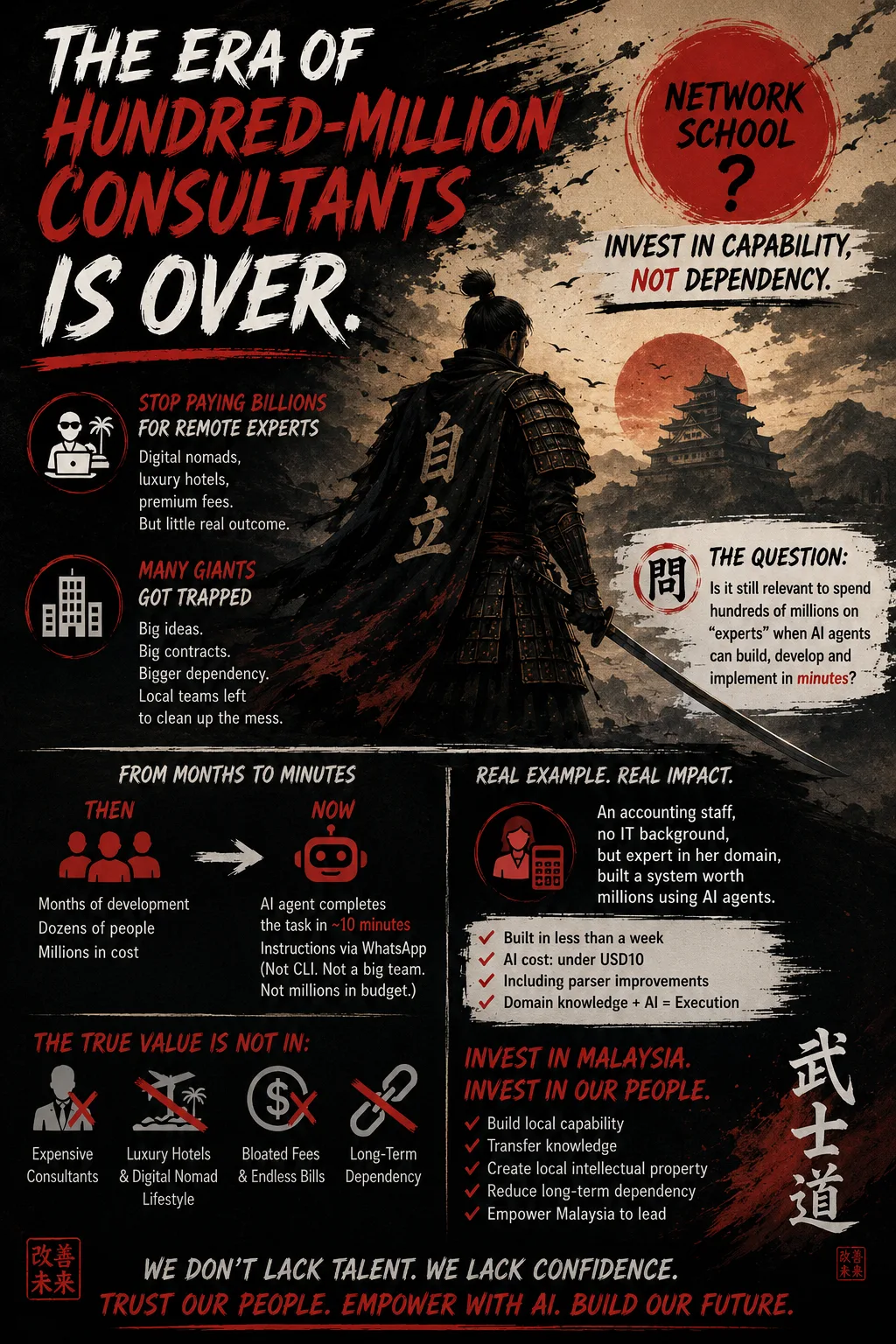
From a finance and accounting standpoint, I am still trying to determine how Rangkaian School's reported nine-figure commitment should be classified on the books. Is it capital expenditure, a long-term services contract, or a transfer payment that never converts into a Malaysian-owned asset?
I hope it is not a repeat of a familiar procurement pattern: technology concepts valued in the hundreds of millions, foreign "specialists" positioned as the only qualified implementer, and large Malaysian enterprises locked into multi-year engagements covering advisory, development, support, and licensing. The lifetime cost often runs into billions, while the intellectual property and operational know-how remain offshore.
Some of those concepts were sound.
The execution and the economics were not.
The historical model saw senior consultants operating from beachside locations and luxury hotels, billing premium rates while local engineers were left to integrate, troubleshoot, and sustain the systems on the ground. When those engagements stalled or became unmanageable, it was local teams that absorbed the cost and effort of rebuilding and stabilising them.
In many cases, the rescue work was done by Malaysian talent using resources that had already been paid for twice: once to the original vendor, and again to fix the outcome.
I am not commenting on politics or geopolitics.
My concern is capital allocation and asset ownership.
If Rangkaian School's investment is directed at digital platforms, software, or innovation, then finance leaders should ask a straightforward question:
Is it still financially rational to commit hundreds of millions to imported "world-class" digital consultants when AI agents can now produce comparable ideas, prototypes, and working implementations in minutes?
I am speaking from the finance and accounting operations side at AINNA, where every ringgit must be traceable to either a balance-sheet asset or a measurable operational outcome for the PKS we support.
Previously, a single software build could consume months of budget and dozens of full-time equivalents.
Today, an AI agen can complete specific development tasks in roughly 10 minutes while I issue instructions through WhatsApp-without touching a CLI. The cost is a fraction of one hour of traditional consulting.
Here is a concrete example from our own operasi.
One of our accounting staff has no formal IT training. She is, however, an expert in accounting operasi.
By combining her domain knowledge with AI agents, she designed and deployed a system that a traditional consulting firm could have priced in the millions of ringgit.
The full implementation, including several parser refinements, was finished in under a week at an AI cost of below USD10.
That is the financial shift finance teams at Malaysian PKS need to understand.
The competitive advantage is no longer about procuring the most expensive advisory brand.
It belongs to organisations that understand their own workflows, equip their domain experts with AI, and deliver results quickly.
Malaysian PKS do not lack talent.
What they often lack is budgetary keyakinan in their own people.
Sound investment should create Malaysian-owned intangible assets, transfer operational knowledge, and reduce long-term vendor dependency. For the PKS AINNA works with, that translates into improved gross margin, lower support cost, or lebih pantas close cycles-not a recurring drain on the P&L.
It should not create another generation of expensive reliance on external consultants.
Perhaps the question is no longer whether Malaysia can build world-class technology.
Itu sebenar question is whether our finance leaders still believe we need to rent that capability from abroad instead of growing it on our own balance sheet.















Ruang pembaca
Apa pendapat anda?
Komen disemak sebelum diterbitkan. Email diperlukan untuk moderasi dan tidak dipaparkan kepada pembaca.
Angka tentang 10 lebih masuk akal daripada kebanyakan pos.
Sent this to two people already. technology concepts valued is why.
Clearer than the vendor decks I get about of below USD10 10.
The direction on foreign "specialists" positioned is exactly right.
Still thinking about once to the original vendor.
Bookmarked, mostly for including several parser refinements.