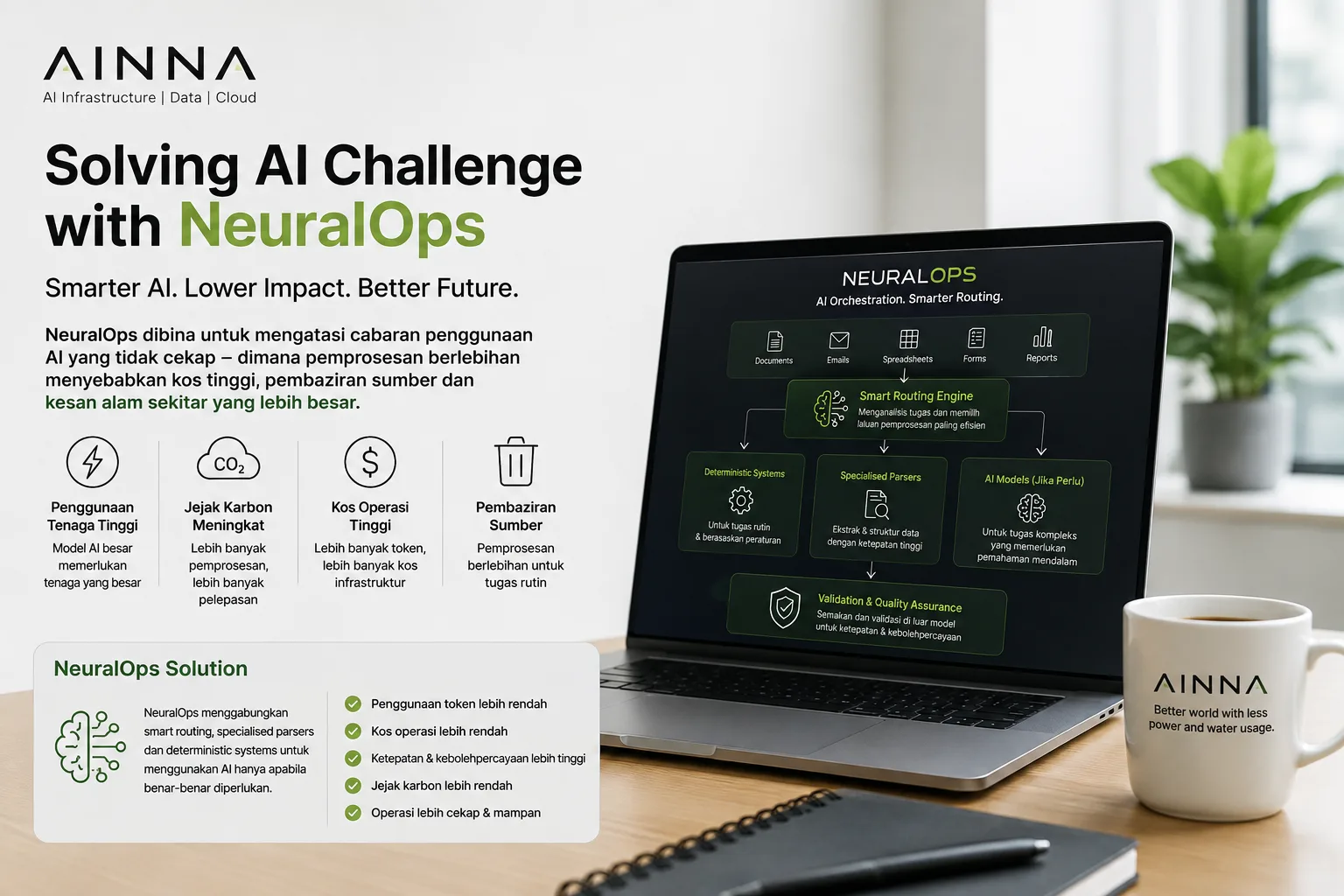
Most PKS I work with are investing in AI to improve productivity and tighten operasi.
But from a finance and accounting standpoint, there is a cost issue we rarely quantify early enough:
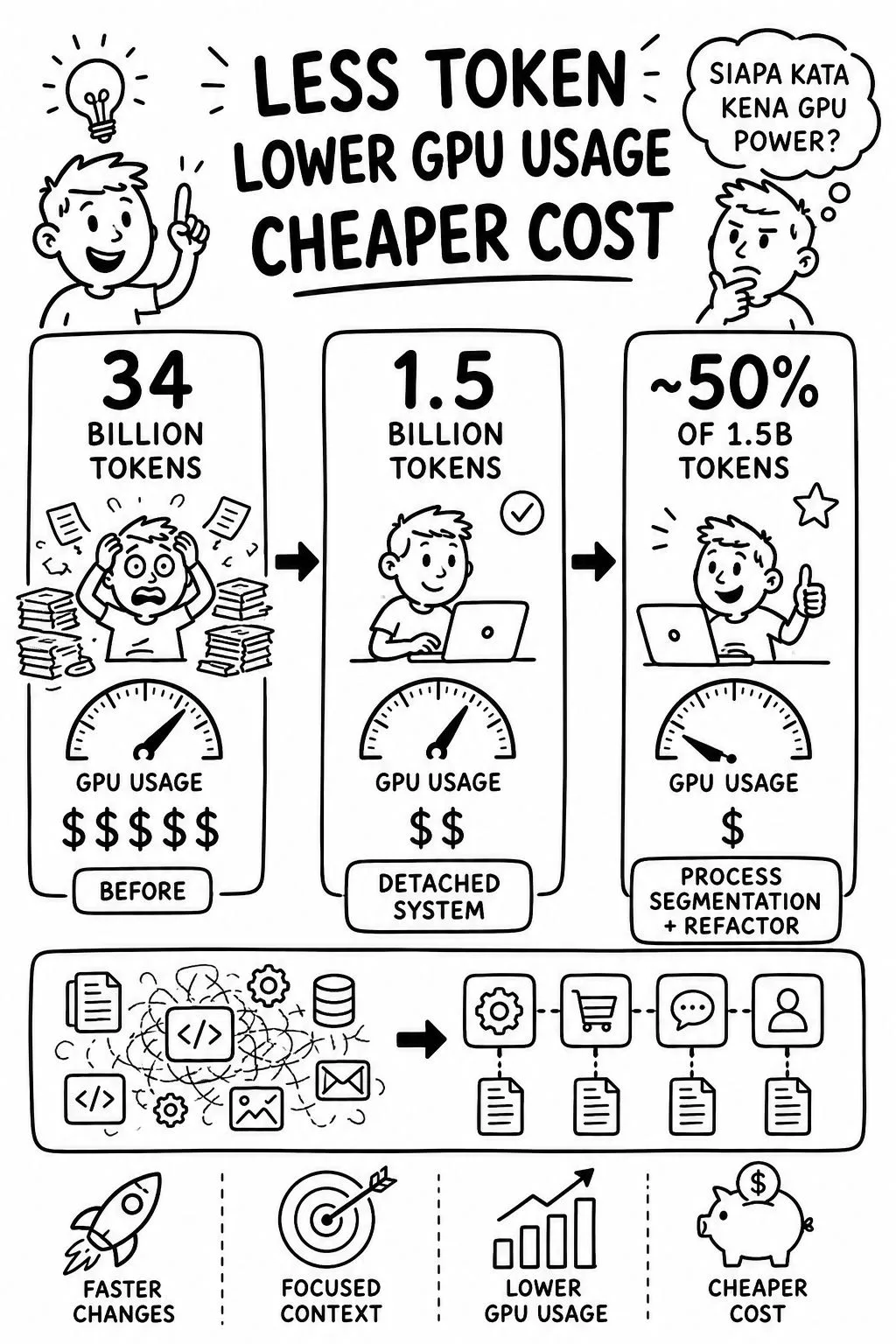
Every AI request burns tokens, compute cycles, infrastructure capacity, and operating budget. The more tasks we route to large models by default, the lebih pantas these costs compound.
At AINNA, we reviewed how many routine finance, accounting, and operations tasks were being passed to advanced AI models when they did not require advanced reasoning. Invoice parsing, validation, reconciliation, report formatting, and fixed-asset data updates were generating unnecessary token spend and compute load.
That inefficiency led us to build NeuralOps.
NeuralOps applies smart model routing, specialised parsers, workflow automation, and deterministic detached systems. It evaluates whether a task genuinely requires AI reasoning or whether deterministic software can complete it lebih pantas, lebih murah, and with a cleaner audit trail.
In finance and accounting operations, we apply NeuralOps to document extraction, financial data processing, validation, reconciliation, reporting, and business analysis.
The financial impact is measurable:
• Lower token consumption and reduced compute demand
• Lower operating costs per transaction
• Higher accuracy and stronger validation controls
• Lagi scalable AI adoption within constrained PKS budgets
• Lower environmental impact from reduced infrastructure load
Our operating principle is straightforward:
Deploy advanced AI only where advanced intelligence produces measurable value.
AI Mampan is not simply a question of model size.
It is a question of system design, cost discipline, and responsible asset management.
#NeuralOps #ArtificialIntelligence #MampanAI #GreenTeknologi #Automasi #DigitalTransformation #ESG #DataKedaulatan #AINNA















Ruang pembaca
Apa pendapat anda?
Komen disemak sebelum diterbitkan. Email diperlukan untuk moderasi dan tidak dipaparkan kepada pembaca.
इस हिस्से की व्याख्या सरल और समझने योग्य है।
इस लेख से सहमत हूँ और दिशा साफ़ है।
The figures on lebih murah make more sense than most posts.
Useful. We are handling every AI request burns tokens right now.
Bookmarked, mostly for fixed-asset.
The section on AI mampan is the strongest part for me.