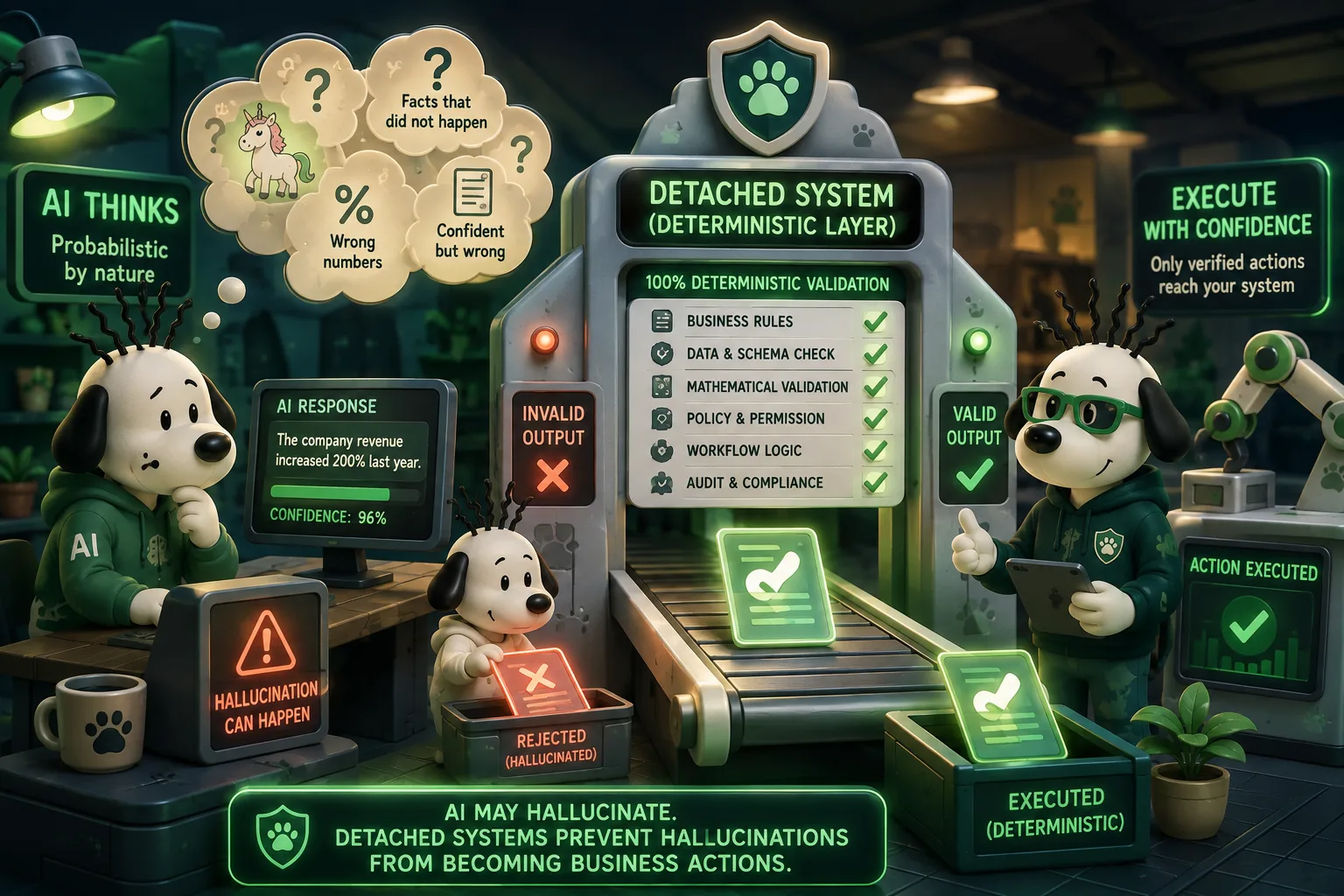
One of the biggest misconceptions in enterprise AI is the belief that hallucinations can eventually be eliminated by building larger and more powerful Large Bahasa Model. In reality, LLMs are probabilistic by design. Their outputs may become more accurate, but there will always be a non-zero possibility of error, inconsistency or unsupported information.
Instead of asking how to eliminate hallucinations completely, enterprises should ask a more practical question: why should critical business operations depend entirely on a probabilistic system? The problem is not only the model. It is the architecture that allows the model to analyse, decide, approve and execute without sufficient separation of control.
A stronger approach is to separate AI reasoning from operational execution through a 100% deterministic Sistem Berasingan. The AI can interpret data, identify patterns, generate recommendations and propose actions, but it does not directly control the final business process. Its output is treated as an input that must be independently verified.
Before any action is executed, the Sistem Berasingan checks deterministic business rules, schema integrity, mathematical consistency, user permissions, security policies, workflow conditions and audit requirements. If any condition fails, the system stops the process or escalates it for human review. The AI may still produce an imperfect answer, but that answer cannot automatically become an operational action.
The future of trustworthy enterprise AI will therefore not depend on hallucination-free models. It will depend on hallucination-safe architecture. By separating intelligence from execution, reasoning from validation and recommendation from control, enterprises can use the flexibility of AI denganout allowing probabilistic outputs to compromise critical systems.