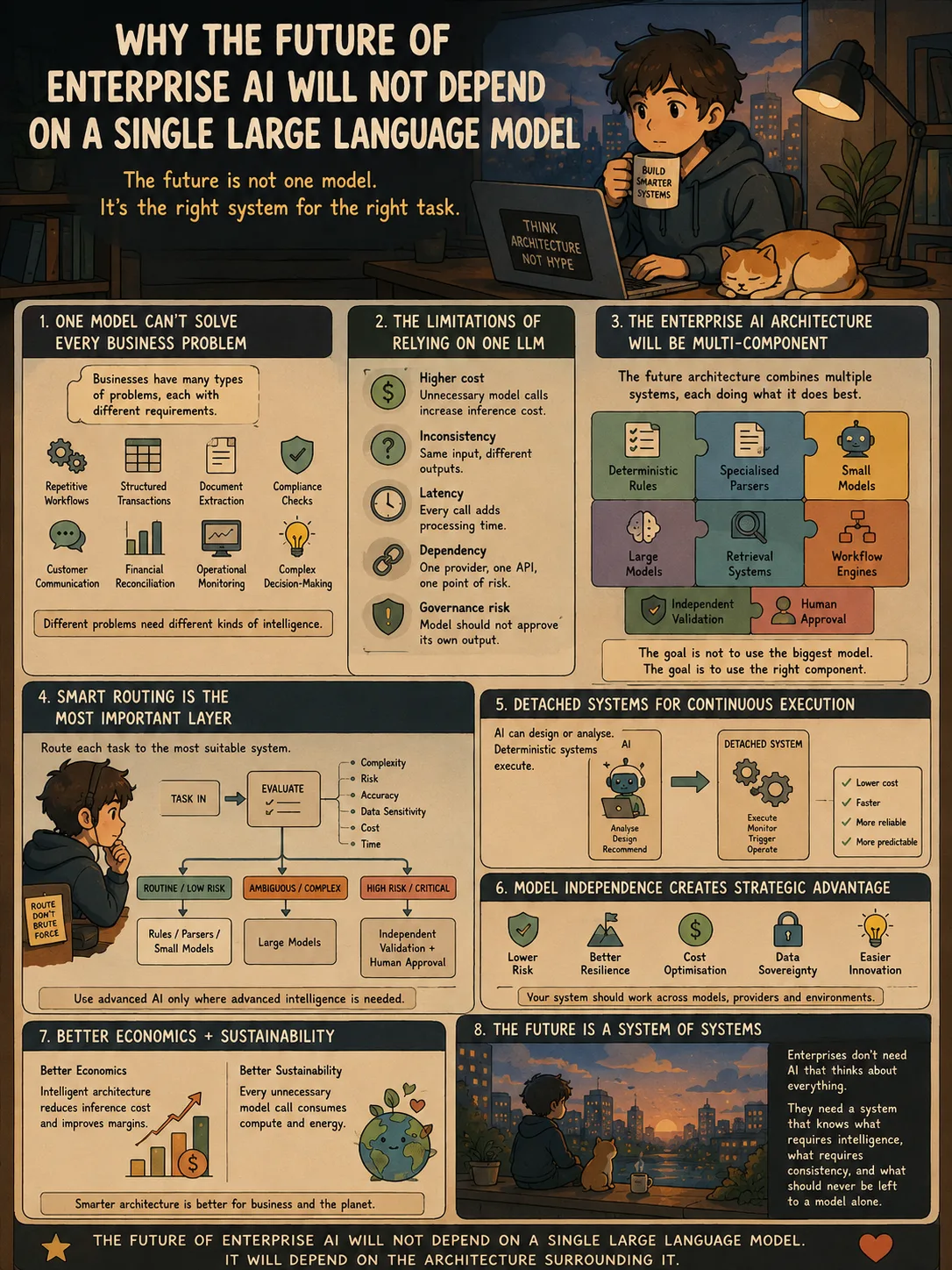
Many companies are currently building their AI strategy around one assumption:
Choose the most powerful Large Bahasa Model, connect it to company data, and use it for everything.
This may work for early experimentation.
It is unlikely to work efficiently at enterprise scale.
A business does not have only one type of problem.
It has:
repetitive workflows
structured transactions
document extraction
compliance checks
customer communication
financial reconciliation
operational monitoring
complex decision-making
Each task has different requirements.
Some require advanced reasoning.
Lain-lains require speed, consistency, privacy, deterministic accuracy or very low cost.
Many tasks do not require a Large Bahasa Model at all.
Using a large model to validate a date, check a balance or extract a known field is often unnecessary. It increases cost, latency and dependency without creating proportional value.
The stronger enterprise architecture will combine multiple components:
deterministic business rules
specialised parsers
Model Bahasa Kecil
Large Bahasa Model
retrieval systems
workflow engines
independent validation
human approval
The critical layer will be Smart Routing.
Before processing a task, the system should evaluate its complexity, risk, required accuracy, data sensitivity and cost.
Tugas rutin can be handled by lightweight systems.
Ambiguous or complex tasks can be escalated to more capable models.
High-risk outputs should be validated independently before execution.
This leads to another important principle:
AI governance must exist outside the model.
A model should not generate, validate and approve its own output without external controls.
Enterprise systems need schema checks, reconciliation, permissions, audit logs, transaction limits and escalation mechanisms.
There is also a growing role for Sistem Berasingan.
AI can design, analyse or modify a workflow, while deterministic software executes that workflow continuously without calling the model every time.
This can reduce inference cost, improve reliability and make automation more predictable.
The future of enterprise AI is therefore not one universal model controlling everything.
It is a coordinated system of systems.
Large models will remain important, but they will become one component inside a broader architecture of routing, validation, specialised processing and independent execution.
The long-term winners may not be the companies using the most AI.
They may be the companies that use advanced AI only where advanced intelligence is genuinely required.
#EnterpriseAI #AIInfrastruktur #ArtificialIntelligence #LLM #AIEjen #Automasi #DigitalTransformation #SovereignAI #SmartPenghalaan #TechStrategy