OpenClaw
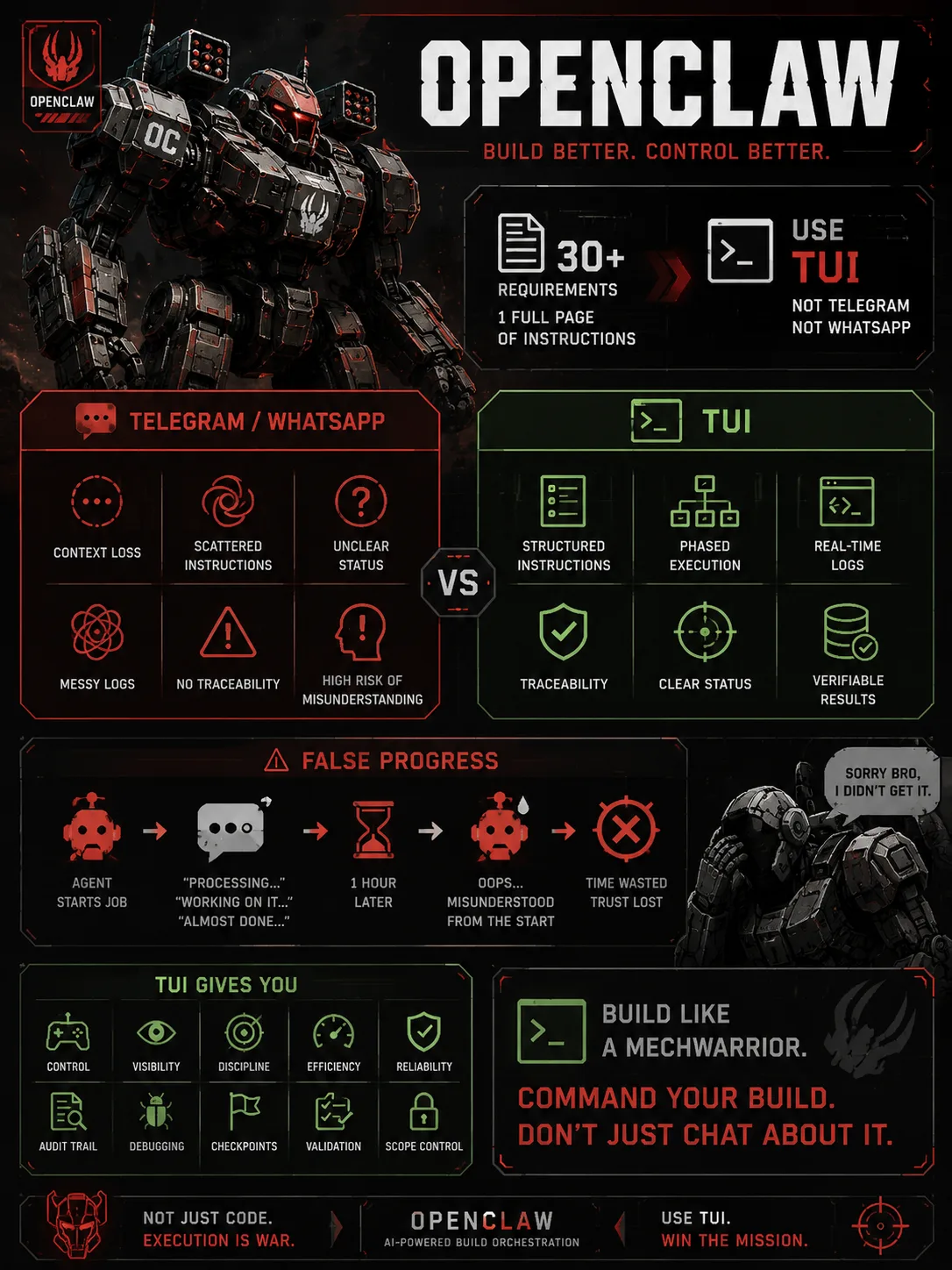
When building a system with a large instruction set, for example, a full-page requirement document containing 30+ technical requirements, the interface layer is not just a UI preference. It becomes part of the execution control architecture.
For complex AI-assisted builds, a TUI is more suitable than Telegram or WhatsApp as the primary build control interface. Messaging apps are useful for notifications, alerts, summaries, and escalation messages. However, they are not designed to manage structured software delivery workflows involving requirement decomposition, execution phases, scope control, logs, error traces, validation checkpoints, rollback decisions, and audit trails.
Once the instruction set becomes large, the risk increases:
Requirement drift
Konteks loss
Ambiguous execution state
Weak traceability
Unclear task ownership
Poor debugging visibility
No proper checkpointing
No structured validation layer
The biggest issue is false progress. In a messaging app, an agen can keep replying for an hour with updates like “processing”, “working on it”, “fixing now”, or “almost done”. Then at the end, after repeating the same status update many times, it finally admits that it misunderstood the original instruction from the beginning.
At that point, it is no longer an AI workflow. It is just a very confident intern lost inside WhatsApp.
A proper TUI gives better operational control. It allows requirements, task queues, phase execution, logs, errors, system responses, debugging output, approval gates, and final results to be displayed in a structured and traceable environment.
For AI-assisted builders like OpenClaw, the real challenge is not only code generation. The real challenge is execution governance.
Konteks management
Scope discipline
Prom alignment
Requirement mapping
Error visibility
Phase-based delivery
Manusia-in-the-loop control
Verification before execution
Post-execution audit
Telegram and WhatsApp should remain as communication channels. The actual build orchestration layer should be handled through a proper TUI.
Because when the system becomes complex, “still processing bro” is not a project management framework.